This article was first published on TurkishNYR.
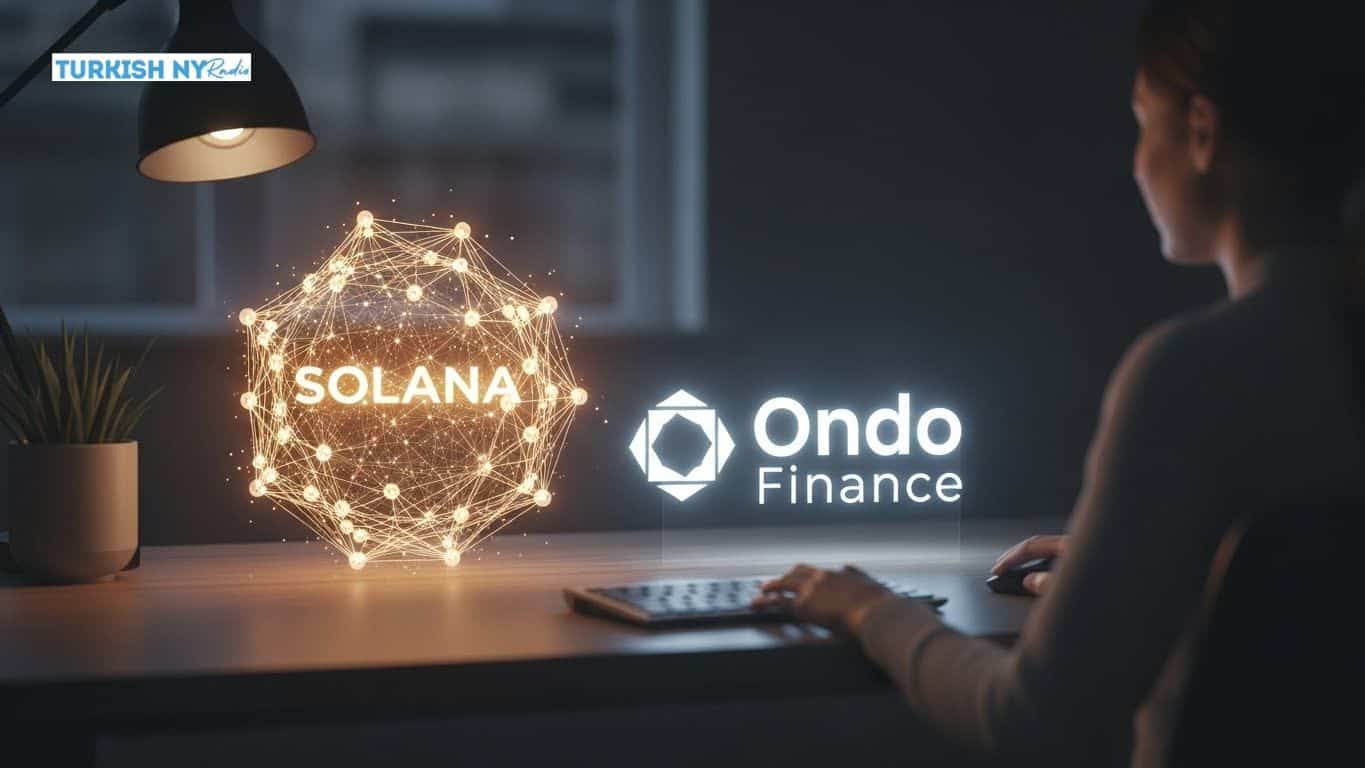
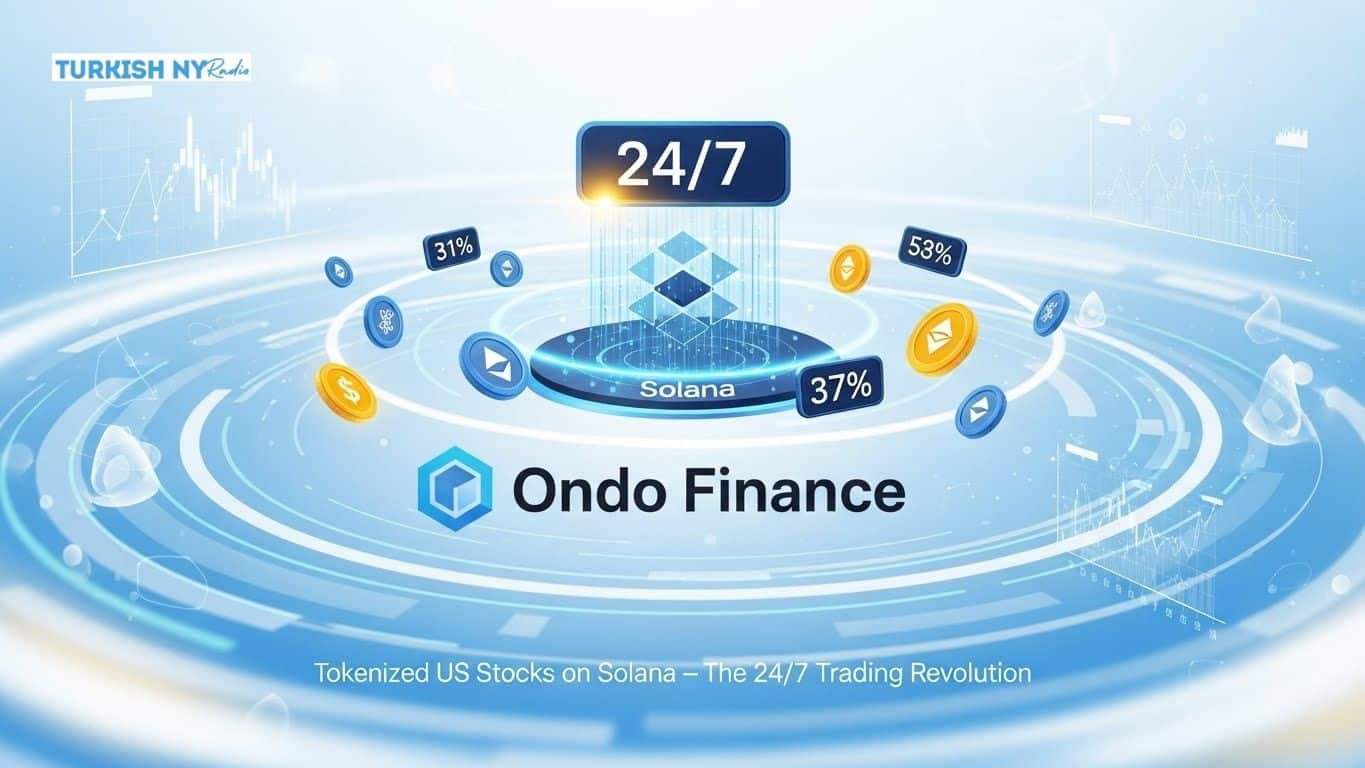
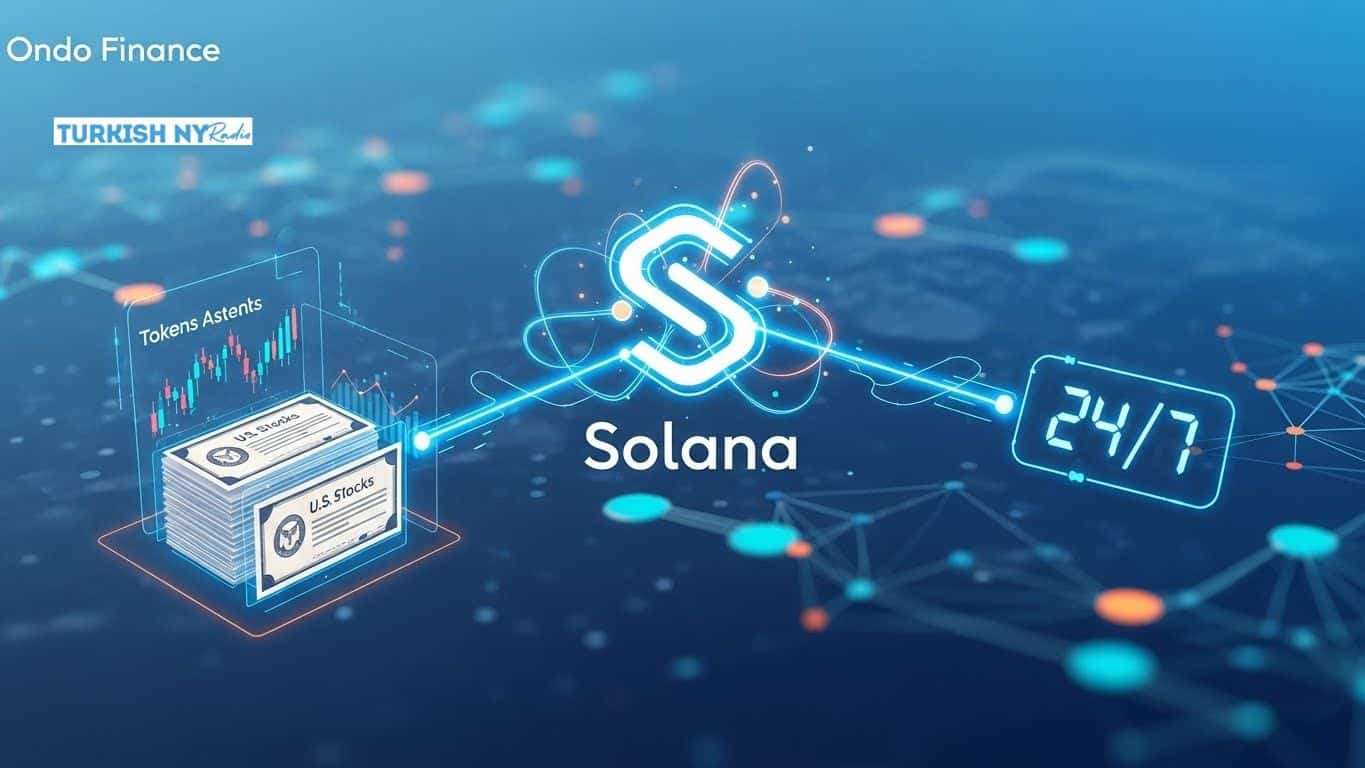
Ondo Finance, a top real-world asset (RWA) issuer, is set to open up tokenized U.S. stocks and ETFs on the Solana network in early 2026. This extends Ondo’s RWA platform (which previously only touched Treasuries and cash funds) into equities, offering investors the opportunity to transact U.S. stock exposure 24/7 via blockchain rails.


The announcement states that Ondo’s tokens will be custody-backed with the stocks held by U.S. broker-dealers, and structured such that on-chain holders only get economic interests. ie, dividend equivalents, and not the direct shareholder rights
By settling trades in seconds on Solana’s high-speed, low-cost network, Ondo’s platform is intended to provide a connection between traditional equity markets and DeFi, essentially allowing access to U.S. stocks even when Wall Street is closed.
Ondo Set to Launch Tokenized US Stocks on Solana
Already, Ondo Finance’s core offering, the Global Markets platform, offers on-chain exposure to more than 100 U.S. stocks and exchange-traded funds (ETFs) supported by networks including Ethereum.
The Solana expansion will migrate this catalog to a new blockchain, with an early 2026 launch. Ondo will create each stock or ETF as a new token on Solana. One could hold a token that represents economic exposure to Apple or an S&P 500 ETF, for example.
Those tokens will be supported by the real shares in the custody account. When users purchase a stock token, Ondo or an authorized partner mints a token against the newly purchased shares; when users redeem, the tokens are burned and shares are delivered (or cash equivalent) in return.
One major advantage is that trading is open around the clock. While U.S. stock exchanges have set hours, Ondo’s listing on the Solana platform means that users can trade these tokens any time of day or night.
Some of the features found on Ondo’s Solana stock platform are as follows;
24 Hours Trading: U.S. stock and ETF tokens trade any time day or night on Solana.
Custody-Backed Tokens: Each token is 1:1 backed by real shares held at regulated custodians, as such providing true asset coverage.
Near-instant Settlement: With Solana, trades settle in seconds which is much quicker than traditional stock clears.
Inbuilt Compliance: Tokens hold on-chain restrictions (using Solana token extensions) to enforce kyc, eligibility and transfer rules.
These components combine to represent the economics of stock ownership on-chain, all while benefitting from the efficiencies of blockchain.
Most importantly for investors, dividends and other returns are still credited to them, as the actual securities continue to be held in custody.
Custody and Compliance
Ondo uses a custody-backed token model. The U.S. stocks (or ETF units) are held off-chain by one or more U.S.-regulated broker-dealers or custodians. Ondo’s smart contracts on Solana then generate digital tokens that are a claim on those off-chain assets.
By holding the real shares in custody, Ondo doesn’t have to create a potentially risky synthetic or unbacked product. Instead, tokens only follow the physical pool one to one.
To balance the peg at 1:1, Ondo lets authorized agents (or users) mint and redeem tokens. Minting happens when new shares are deposited. Redemption, on the other hand, burns the tokens if a holder exchanges them for the asset (or cash equivalent).
Because token transfers on the blockchain can happen at any time, trades are effectively decoupled from settlement windows: one can buy or sell a stock token on Solana in the middle of the night if they want to, but creation/redemption operates during stock market hours for compliance.
Ondo particularly wants to utilize Chainlink oracles for live price feeds and pricing adjustments for dividends or splits.
For instance, if a stock price changes or a dividend is paid, the Chainlink feed updates the token value so that traders on-chain know what the most current total return should be. This ensures the token remains always “on price” with the real world stock.
Most importantly, compliance roams with every token. There must be transfer restrictions for every stock token, unlike a regular crypto token. Solana accomplishes this with Token Extensions like Transfer Hooks.
Ondo can code up any token such that when it is transferred, the hook verifies some conditions, such as the recipient’s jurisdiction, KYC status, or whether this token is allowed into specific DeFi contracts.
These regulations secure that only qualified investors hold the token
Factors that Buoyed Solana as a Choice
Solana was chosen deliberately. Its main advantage is speed and cheapness. Solana can handle thousands of transactions per second and with sub-second finality, and at essentially no cost.
This is useful in a high-frequency, 24/7 market as traders can do many trades without being paralyzed by high gas prices. Solana also has a much higher throughput, which allows for low-value swaps and rebalance trades to be settled economically.
Furthermore, Solana features a massive, vibrant retail user base. Millions of users hold and make transactions using the Solana wallet every day for trading and DeFi.
Ondo President Ian De Bode said going live on Solana
“opens access to millions of users who are already active on Solana but have not interacted much with tokenized traditional assets”
In other words, Ondo’s stock tokens will automatically be accessible to Solana’s current pool of traders and applications.
The following table compares Ethereum and Solana specifically for Ondo:
| Feature | Ethereum/BNB Chain | Solana |
| Transaction Speed | Slower (seconds-minutes) | Very fast (milliseconds) |
| Throughput (TPS) | 15-30 (Ethereum) | Thousands per second |
| Transaction Fee | Often tens of cents+ | Fractions of a cent |
| Congestion Risks | High (with many users) | Low, due to high capacity |
| Built-in Compliance Support | Limited token hooks | Rich extensions (Transfer Hooks) |
| User Base (Active Wallets) | Large (80M+ wallets) | Also large and growing |
| Ecosystem for DeFi Trading | Mature but costly | Fast-growing, trading-focused |
Powered by Solana, Ondo hopes to make trading tokenized stocks feel as easy and immediate as possible. No waiting in line for several minutes or expensive fee hurdle.
Regulatory and Market Context
Launching tokenized equities requires heavy compliance. Ondo’s timeline (2026)acknowledges this regulatory work.
Securities laws require careful structuring: Ondo must ensure registration or exemption by the SEC, employ transfer agents or the equivalent thereof, engage broker-dealers and diligently apply KYC/AML to investors.
Ondo can not just launch crypto token; it has to work within traditional finance compliance.
U.S. regulators have warned that products based on digital assets must not be deceptive. Holders of Ondo’s stock tokens, for example, will not receive the right to vote as shareholders. Ondo has to keep reinforcing that its tokens provide economic exposure exclusively, not full ownership rights.
All in all, the early 2026 timing allows Ondo the room to navigate these legal barriers.
Conclusion
Ondo’s tokenized stocks on Solana offer a new method for trading U.S. stocks. Using Solana’s speed and Ondo’s custody-backed setup could put tokenized stocks on par with the ease of swapping a stablecoin.
It would also give investors 24-hour access to stock markets, accompanied by instant settlement directly out of their crypto wallets. This bridge between conventional equities and decentralized finance is supported by clear regulation (Ondo’s tokens are backed by real assets and in compliance with the SEC) and major industry partnerships.
If regulators’ approval continues according to schedule, Ondo’s Solana launch in early 2026 could establish a new model for how the world trades and gains access to stocks.
Glossary
Tokenized Stock: A token on a blockchain representing ownership in a real-world stock. Each token represents an economic interest in returns (price moves, dividends) associated with the actual share and the share is held by a custodian.
Custody-Backed Token: A digital token on the blockchain that is collateralized by and redeemable for an off-chain asset held in custody.


Solana Blockchain: A fast and inexpensive blockchain engine, capable of processing 65,000 transactions per second without sacrificing decentralization.
Chainlink Oracle: A decentralized data source providing real-world information (such as stock prices or dividends) to a blockchain.
Real-World Asset (RWA): Traditional market’s financial instruments (stock, bond, real estate etc.) on blockchain.
Frequently Asked Questions About Ondo Finance Tokenized US Stocks
What are tokenized stocks?
Tokenized stocks are digital assets issued on a blockchain, that represent shares of actual companies. Every token is supported by a real (or part) share held in reserve.
How will Ondo’s tokenized stocks on Solana function?
Ondo’s platform uses tokens issued on Solana to mirror U.S. stock and ETF prices against the assets traded by users. The tokens are one-for-one backed by the actual securities, held by a custodian. Users can buy and sell these tokens 24/7 on Solana; in the background, Ondo mints or redeems tokens to show real buying or selling of the actual shares.
Why build on Solana and not Ethereum?
Solana boasts transaction speeds many times faster and fees far lower than Ethereum. Its fast pace enables high-volume trading to be done profitably. Solana also comes with advanced token features (such as transfer hooks) that allow Ondo to encode compliance rules directly into each
Will tokenized stocks settle instantly?
Yes. Unlike traditional stock trades (which settle over the course of days), Ondo’s Solana-based trades can settle in seconds on-chain. That near-instant settlement is one of the big promises of using blockchain rails for equities.