![Sun [New]](https://s2.coinmarketcap.com/static/img/coins/64x64/10529.png)



This article was first published on TurkishNY Radio.
Bitcoin ownership shifts in 2025 with institutions buying more and retail investors selling. New data indicates greater levels of supply being controlled by businesses, funds and governments. The shift signals a fundamental change in the shape of the crypto market.


Analysts are saying that this trend of Bitcoin ownership may impact liquidity, volatility and longer-term price dynamics. It marks an increasing institutional confidence in Bitcoin as a strategic asset.
Bitcoin Ownership Landscape Shifts Toward Institutions
Data shared by River indicates a clear rise in institutional holdings this year. At the same time, individual ownership has declined. The redistribution signals a move away from retail dominance.


Separate data from Arkham Intelligence highlights high concentration among major holders. Together, these developments point to an evolving BTC ownership landscape.
The 2025 transfer of Bitcoin ownership is about more than just who owns Bitcoins. It also demonstrates how Bitcoin is seeping into the world of traditional finance. Corporations and governments are increasingly holding Bitcoin as a reserve asset.
Retail investors appear to be accessing exposure through regulated products rather than direct custody. This approach changes how supply circulates in the market.
Institutional Accumulation Grows
Corporate treasuries and asset managers have increased allocations this year. Many firms now describe Bitcoin as a long-term portfolio diversifier. This strategy reduces short-term trading activity.
When large entities hold coins for extended periods, circulating supply tightens. That dynamic alters market structure.
Retail Share Declines
River’s data suggests individual investors now control a smaller percentage of total supply. Market volatility in previous cycles may have pushed out weaker hands.
Regulated financial products also offer indirect exposure. Investors can gain access without managing wallets. This reduces direct retail BTC ownership.
Government Participation Expands
Another component of the Bitcoin ownership shift involves sovereign actors. Some governments hold Bitcoin directly. Others gain exposure through investment vehicles.
This signals broader acceptance of digital assets. It also links Bitcoin more closely with traditional financial systems.
Concentration Among Major Holders
Arkham Intelligence data shows Bitcoin remains concentrated. Satoshi Nakamoto wallets hold roughly 1.096 million BTC, over 5% of supply.
Coinbase controls close to 1 million BTC. Binance holds more than 600,000 BTC. BlackRock’s spot ETF owns over 760,000 BTC. Strategy holds more than 400,000 BTC. The U.S. government reportedly controls more than 300,000 BTC.
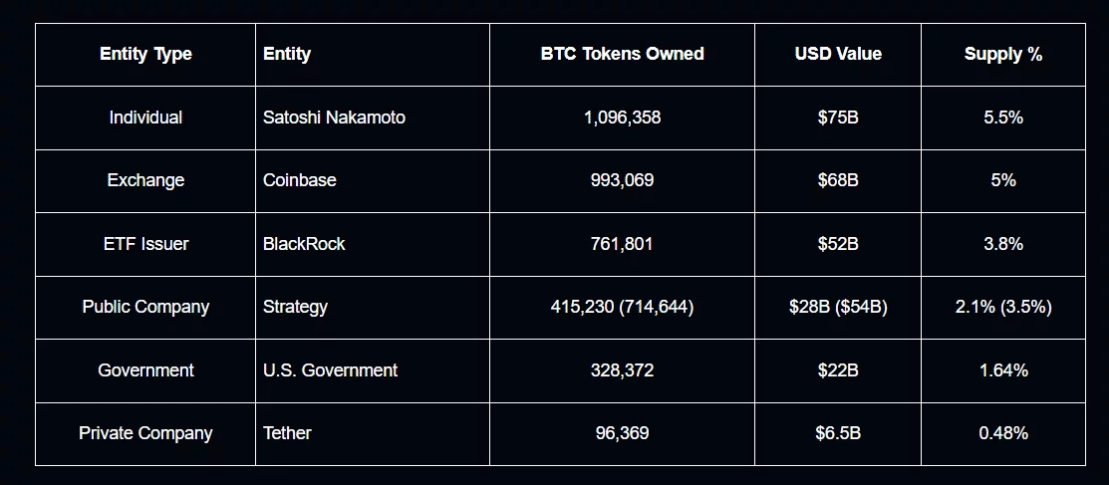
Dormant holdings reduce effective float. That influences price during strong demand periods.
Price Action and Technical Signals
Bitcoin recently fell from the mid-$90,000 range to near $60,000. It later rebounded and now consolidates around $68,000. The 50-day simple moving average near $83,000 acts as resistance.
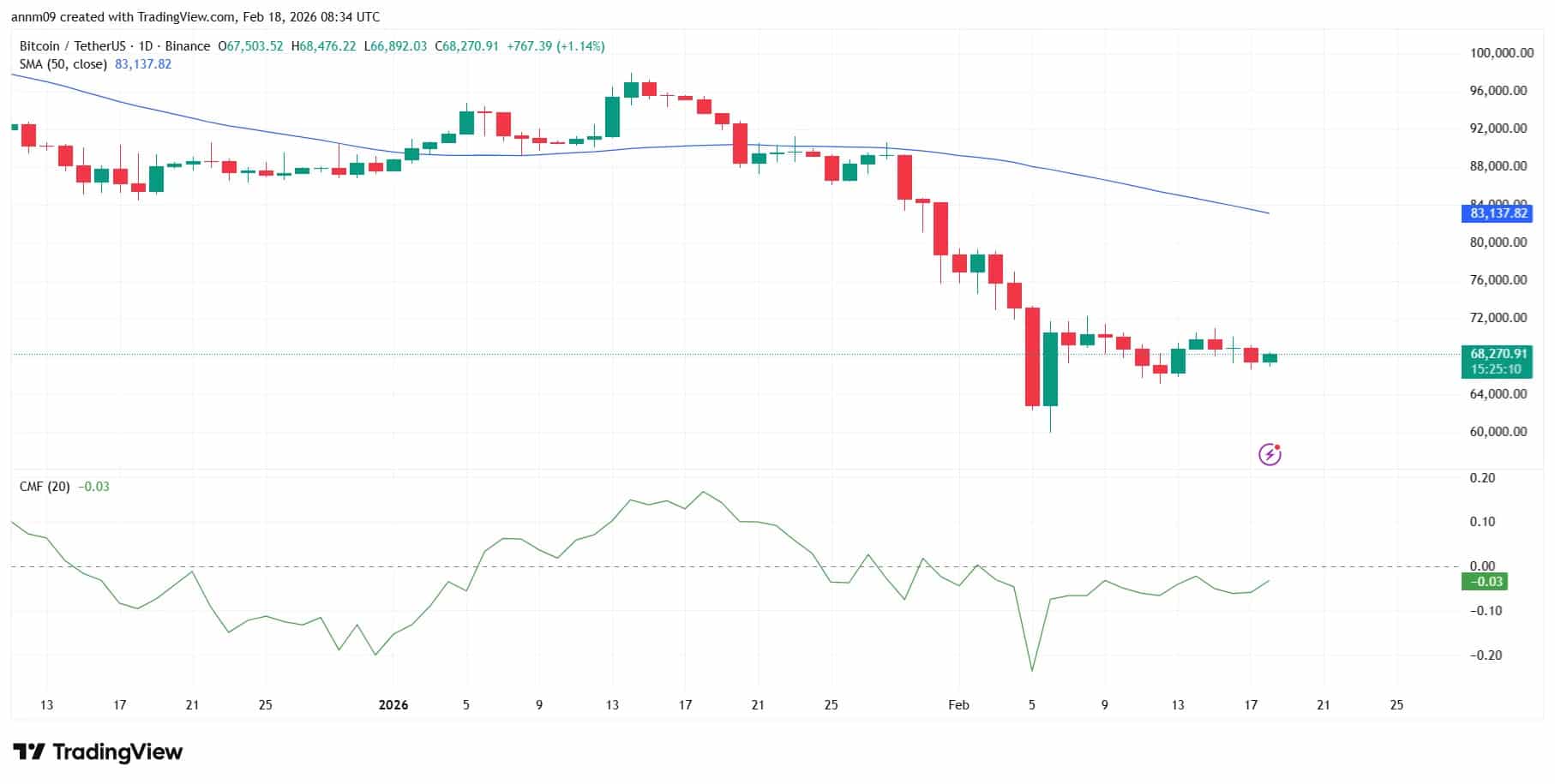
The Chaikin Money Flow indicator remains slightly negative. This suggests capital inflows are still limited. Short-term momentum remains fragile.
Exchange Balances and Liquidity
Exchange-held Bitcoin plays a different role. When exchanges hold large reserves, liquidity remains available for trading. If exchange balances decline while ETFs accumulate, supply may tighten quickly.
In that case, modest demand could trigger outsized moves. BTC ownership patterns therefore directly affect volatility.
Stability Versus Centralization
Institutional ownership may bring stability and credibility. Long-term allocations reduce panic selling. However, concentrated BTC ownership also raises concerns.
Large holders could shape liquidity conditions. Integration with traditional finance may increase sensitivity to macro events.
Conclusion
BTC ownership in 2025 reflects a clear shift toward institutions and governments. Retail participation has declined in relative terms. Concentration among large holders remains significant.
This redistribution may tighten supply during demand surges. At the same time, it introduces new structural risks. The evolution of Bitcoin ownership will likely shape the next phase of the market cycle.
Appendix: Glossary of Key Terms
Institutional: Bitcoin holding against corps, funds, asset managers or financials.
Retail Investors: Individuals who are purchasing and holding Bitcoin directly.
Circulating Supply: The quantity of Bitcoin that can be traded in the market.
Trading: Bitcoin held on exchanges for liquidity and trading.
Spot ETF: A fund that directly owns Bitcoin and follows its price in the market.
Diversification Tool: An investment that lowers risk exposure by spreading between investments.
Liquidity: How easy it is to buy and sell Bitcoin without causing significant effect on price.
Frequently Asked Questions: Bitcoin Ownership
1- What is the BTC ownership shift 2025?
It refers to growing institutional and government holdings while retail ownership declines.
2- Why are institutions increasing exposure?
Many firms now treat Bitcoin as a strategic reserve or portfolio diversifier.
3- Does ownership concentration affect price?
Yes. Dormant large holdings reduce circulating supply and can amplify price swings.
4- Are governments holding Bitcoin?
Some governments hold Bitcoin directly, while others gain exposure through regulated products.
References