
This Article Was First Published on TurkishNY Radio.
The Gig Economy in the United States has moved from the margins to the mainstream. It no longer describes only ride-hailing drivers and food couriers. It now includes coders, designers, online teachers, digital creators, and consultants who build income through short contracts instead of one lifelong job.




Within a decade, the Gig Economy has shifted from a backup plan to a core part of the labor market. Surveys show that more than one-third of the U.S. workforce identifies as independent workers at least part of the year, which translates to tens of millions of Americans who earn income through gigs or freelance work. Many households now rely on this income to close real gaps in rent, healthcare, and daily expenses.
Why Americans Are Turning To On-Demand Work
For many families, the Gig Economy starts as a simple survival decision. Extra money from delivery apps, freelance design jobs, online tutoring, or weekend driving helps pay down credit card balances and student loans, or covers a sudden medical bill. A common pattern is clear. One person keeps a traditional job for health insurance and retirement benefits, then stacks flexible gigs on top when inflation squeezes the budget.
Flexibility carries just as much weight as income. Research from monetary authorities shows that younger adults are far more likely to take on gig work than older age groups.
Roughly a quarter of Americans in their late teens and twenties report doing some kind of gig in a year, compared with a much lower share among people near retirement age. For many young workers, control over schedule, location, and project type often matters as much as the hourly rate.
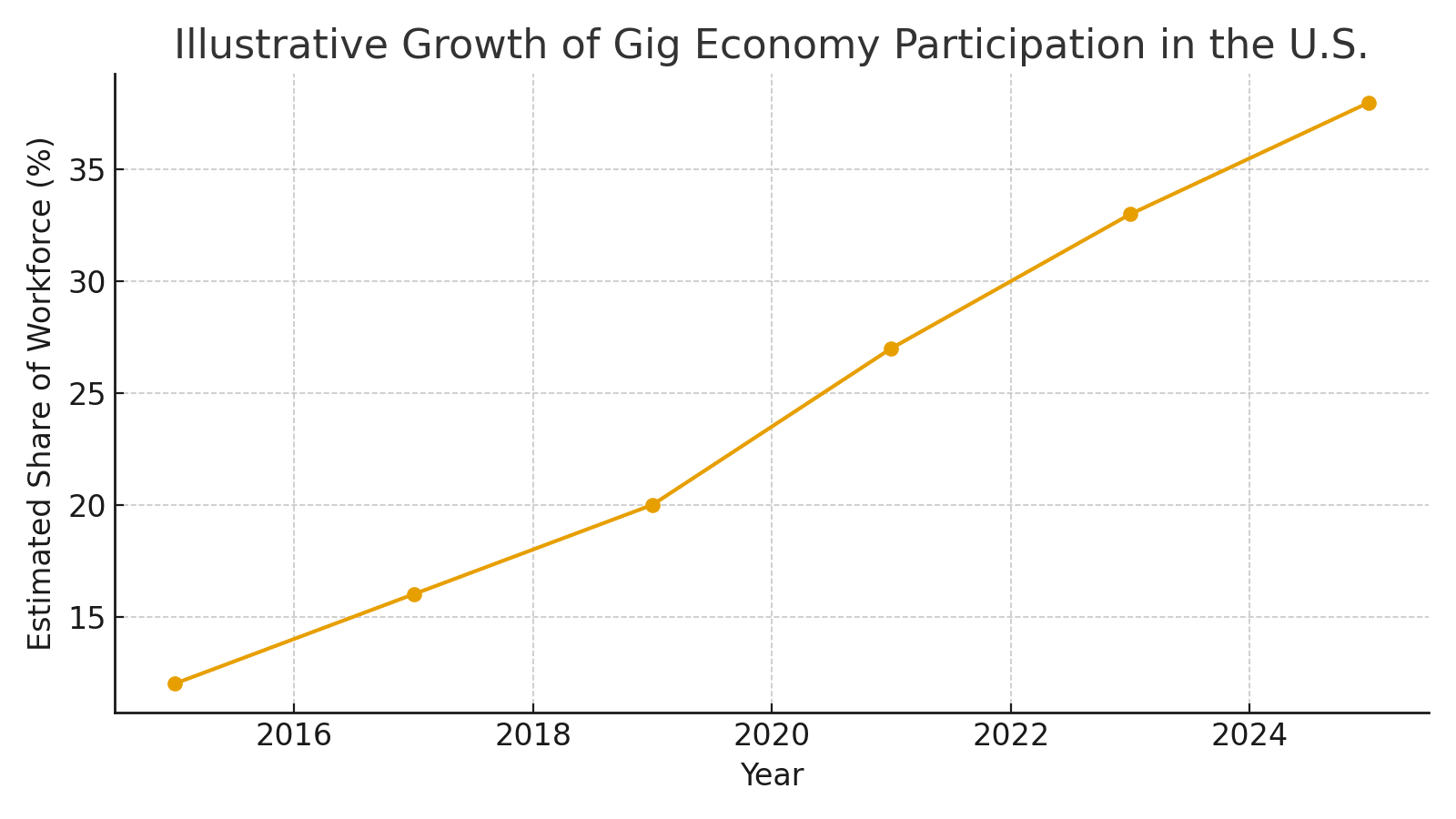
Key Indicators Of A Structural Shift In The Gig Economy
Several signals show that the Gig Economy is not a passing trend but a structural shift.
One key indicator is scale. Millions of nonemployer businesses and sole proprietors operate across the country, and a growing share of them depend on digital platforms as the main source of clients. Analysts estimate that freelancers and gig workers now contribute well over a trillion dollars to U.S. economic output every year. That means gig activity now sits alongside some of the largest traditional industries.
Another indicator is the way companies build teams. Instead of hiring every skill in house, many firms now keep a lean core staff and pull in specialists only when needed. Designers, editors, software engineers, customer support agents, and content creators rotate through projects as independent contractors. As companies lean on the Gig Economy for marketing, tech, and operations support, they quietly shift fixed labor costs into flexible ones.
Technology, Digital Money, And Faster Payouts
The Gig Economy runs on code, data, and smartphones. A driver, editor, or translator can open an app and see new tasks in real time. Collaboration tools make it easy to share files, review drafts, or jump into video calls with clients in other states or even other continents. Work becomes less about a fixed office and more about a steady stream of notifications.
Payments are changing just as quickly. Studies of global freelance platforms show that a majority of active freelancers now hold some form of digital currency, and more than half have already accepted at least one payment in crypto. For American gig workers who serve overseas clients, crypto and stablecoins can cut international fees and reduce the long delays that often come with bank wires.
Large payment networks are paying attention. Visa, for example, is piloting systems that send dollar-backed stablecoins directly into supported wallets for creators and gig workers, using stablecoin rails to speed up access to funds. This link between crypto payouts and the Gig Economy is still young, but it points toward a future where flexible work is paired with near instant, borderless money.

Risks, Inequality, And Policy Tensions
The story is not only positive. The Gig Economy also brings sharp trade offs.
Many gig workers lack employer sponsored health insurance, paid leave, or predictable schedules. Research on independent workers shows that a significant share struggle to cover emergency expenses and sometimes delay medical care because of cost. Income can swing heavily from week to week, which makes planning and saving much harder than in a steady salaried role.
Legal questions create more tension. Regulators and courts still argue over when a platform worker should count as an employee and when that worker should remain an independent contractor. The answer matters for minimum wage rules, overtime, tax reporting, and access to benefits. Policy makers are trying to update labor law for a system that grew faster than the rulebook, and the Gig Economy sits in the center of that debate.
Who Is Driving Adoption Of The Gig Economy
In city centers, the Gig Economy appears in the constant flow of drivers, shoppers, couriers, and task helpers that move through traffic every day. But the pattern runs deeper.
Younger adults, immigrants, and parents who need flexible childcare schedules show up in high numbers on many platforms. They use short jobs to fit income around school runs, language classes, or caregiving duties.
At the same time, a very different group is also leaning into the Gig Economy. Highly skilled professionals in software, cybersecurity, marketing, and finance are building independent practices that serve clients in multiple time zones. For them, the draw is less about survival and more about autonomy, rate control, and project choice.
Signals For Investors And The Broader Gig Economy
For investors, the Gig Economy is both a warning and an opportunity. Demand is rising for tools that make life easier for independent earners. Instant payout services, automated tax dashboards, income smoothing products, and portable retirement accounts are all gaining attention. Financial services now need to follow the individual worker instead of sitting inside a single company payroll system.
At the macro level, this shift can make the economy more flexible because households have more ways to earn when one income source fails. It can also increase stress, because many gig workers take the full hit when demand drops. The health of the Gig Economy will depend on whether new forms of portable benefits and social insurance can grow fast enough to support millions of flexible workers.
Conclusion: The Next Phase Of Work In America
The United States is moving through a quiet rewrite of its social contract around work. The Gig Economy is now woven into the way people use phones, the way firms manage costs, and the way digital money moves across borders. It has widened the path for creative careers, remote collaboration, and global hiring, while also exposing many workers to unstable income and thin safety nets.
The real test now is simple but difficult. Platforms, regulators, and financial institutions must find a balance between flexibility and basic security. If that balance appears, Americans can keep the best parts of the Gig Economy without living in constant fear of the next slow week. If it does not, the country may be left with a workforce that looks agile on paper but feels permanently exhausted in practice.
Frequently Asked Questions
Why are so many Americans turning to independent work in the Gig Economy?
Many people use short term projects to supplement wages, pay down debt, or replace jobs that provide low security and weak wage growth.
Is the Gig Economy only about low skill service jobs?
No. Many highly skilled professionals in software, marketing, design, and finance now build full careers through independent contracts and consulting work.
How does crypto influence online work and freelancing?
Crypto assets and stablecoins can reduce fees and delays for cross border payments, and they give global clients more options for paying remote workers.
Does flexible work replace traditional full time roles?
Often it does not replace them, it layers on top. Many people keep a regular job for benefits and stability, then add side gigs for extra income and flexibility.
Glossary Of Key Terms
Gig worker
A person who earns income from short term, task based, or on demand jobs instead of a single long term position.
Digital platform
An app or online service that connects customers with independent workers, manages tasks, and processes payments and reviews.
Stablecoin
A digital asset that aims to keep a stable value by linking its price to a reserve, such as the U.S. dollar or short term government bonds.
Freelancer
An independent professional who offers services to clients on a project by project basis, often working inside the broader Gig Economy.