


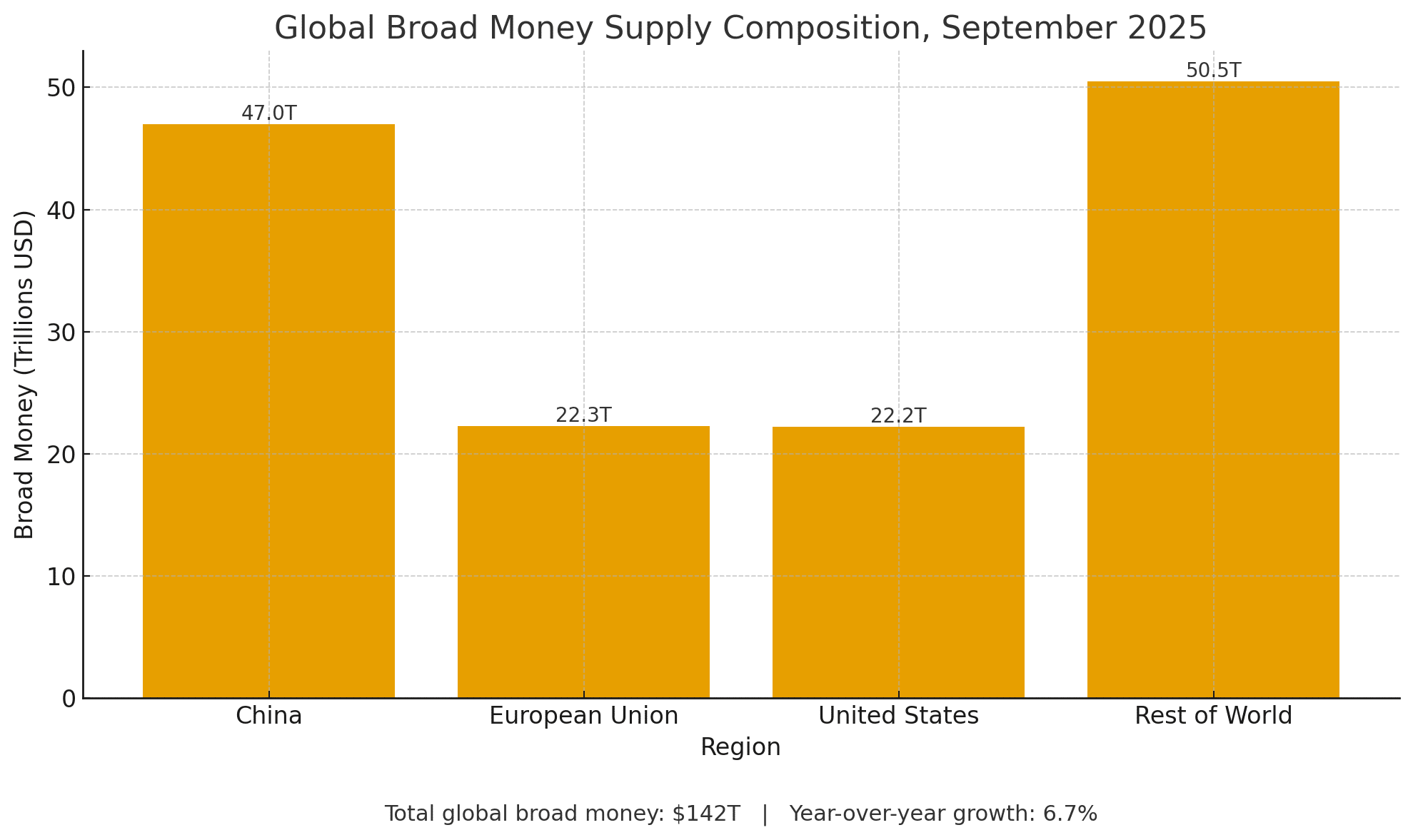
Global broad money rose to an all-time high of about $142 trillion in September. Growth accelerated year over year, with China, the European Union, and the United States accounting for the largest shares. The pace and scale of this expansion point to a world where liquidity is abundant again, even as inflation runs cooler than in the peak post-pandemic period.
Table of Contents
ToggleThe regional picture behind the headline
China’s financial system now hosts the largest broad money stock, followed by the EU and the U.S. This split reflects structural differences.


China’s banking-led model tends to create larger deposit bases, the euro area’s bank intermediation remains dominant for credit creation, and the U.S. blend of banks and capital markets channels liquidity differently. These blocks together explain most of the recent climb, which has continued through the third quarter.
The policy turn that markets are watching
Monetary policy signals are shifting. Senior Federal Reserve officials have indicated that bank reserves are approaching the “ample” zone. That stance implies the end of balance-sheet runoff and the possibility of gradual asset purchases to maintain stable reserves.
Officials have stressed that such buying would serve plumbing needs rather than macro stimulus, but markets rarely split hairs when liquidity grows. Timing chatter centers on a window that could open after balance-sheet reduction stops, with some analysts eyeing early 2026 for net additions.
Why crypto cares about broad money
Crypto tends to respond to changes in global liquidity, not in a straight line, but with visible beta over cycles. When broad money grows and policy shifts toward reserve maintenance, yields often drift lower on the margin, risk budgets widen, and investor appetite for nontraditional assets improves.
Bitcoin historically has tracked the direction of global liquidity over multi-quarter horizons. For major smart-contract platforms, a friendlier funding backdrop can lower discount rates used in cash-flow or network-usage models, which benefits longer-duration assets.
Reading the indicators that matter
The level and growth rate of global broad money speak to the size of the liquidity tide. U.S. and euro area reserve balances hint at how close the system is to the “ample” threshold. Repo spreads flag stress or relief in short-term funding. When those metrics lean easier, liquidity often migrates toward higher-volatility assets, including crypto. Momentum does not erase risk, but it changes the asymmetry.
The next leg depends on follow-through. If balance-sheet runoff truly ends and the reserve backdrop steadies, dips in crypto may meet stronger sponsorship. If inflation or growth shocks force a policy rethink, the bid can fade quickly. The tape will track funding markets first, then risk assets. For now, the record level of broad money and a softer policy tone form a constructive mix, even if price action remains choppy.
Conclusion
Liquidity is not a silver bullet, but it sets the stage. A $142 trillion global money pool, paired with signals that the Fed is nearing “ample” reserves, tilts the medium-term backdrop toward risk. Crypto thrives when cash is plentiful and policy uncertainty narrows. The world is not there yet, but it is closer than it was a few months ago.
Frequently Asked Questions
Q: What is broad money and why is it rising?
A: Broad money includes cash, checking and savings deposits, and other liquid instruments. It rises when banks extend credit and when central bank conditions support reserve growth.
Q: Does an end to balance-sheet runoff mean new stimulus?
A: Officials describe future purchases as technical, aimed at maintaining ample reserves. Markets still react because net asset buying usually eases financial conditions.
Q: How does this affect Bitcoin and major altcoins?
A: Easier liquidity often lifts risk appetite. Bitcoin tends to track global liquidity cycles, while altcoins react to both liquidity and network-specific growth.
Glossary of Key Terms
Broad Money: A wide measure of money that includes cash and easily spendable deposits, used to gauge overall liquidity.
Ample Reserves: A regime where bank reserves are high enough to keep short-term rates stable without day-to-day balance-sheet stress.
Quantitative Tightening (QT): Central bank policy that shrinks securities holdings, reducing reserves and liquidity.
Asset Purchases: Buying government or agency securities to add reserves. In this context, framed as technical operations to maintain ample reserves.
Repo Market: Short-term lending market where securities are sold and repurchased; a key barometer of dollar funding conditions.
Liquidity: The ease with which cash flows through the financial system. Higher liquidity often supports risk assets, including crypto.