A reversal with real consequences
The FTX Recovery Trust has withdrawn its motion that sought special “restricted jurisdiction” procedures for claimants in dozens of countries, including China, Russia, and Ukraine. Court dockets reflect a formal notice of withdrawal, ending a proposal that could have delayed or even forfeited distributions where local rules were deemed too complex to navigate.


The filing marks a meaningful shift in a long and bruising bankruptcy, and it removes a key source of uncertainty for thousands of customers abroad.
How the withdrawal unfolded
Throughout October, the court pressed the estate on why an extra layer of restrictions was needed before standard distributions could proceed. At a late October hearing, a judge signaled that the framework was premature, and legal reporters noted the trust had “moved too early” on jurisdiction rules.
That scrutiny collided with a wave of objections from affected creditors, most visibly a cohort of Chinese claimants, and momentum for the motion faded. By November 3, the trust filed its withdrawal.
What it change for creditors
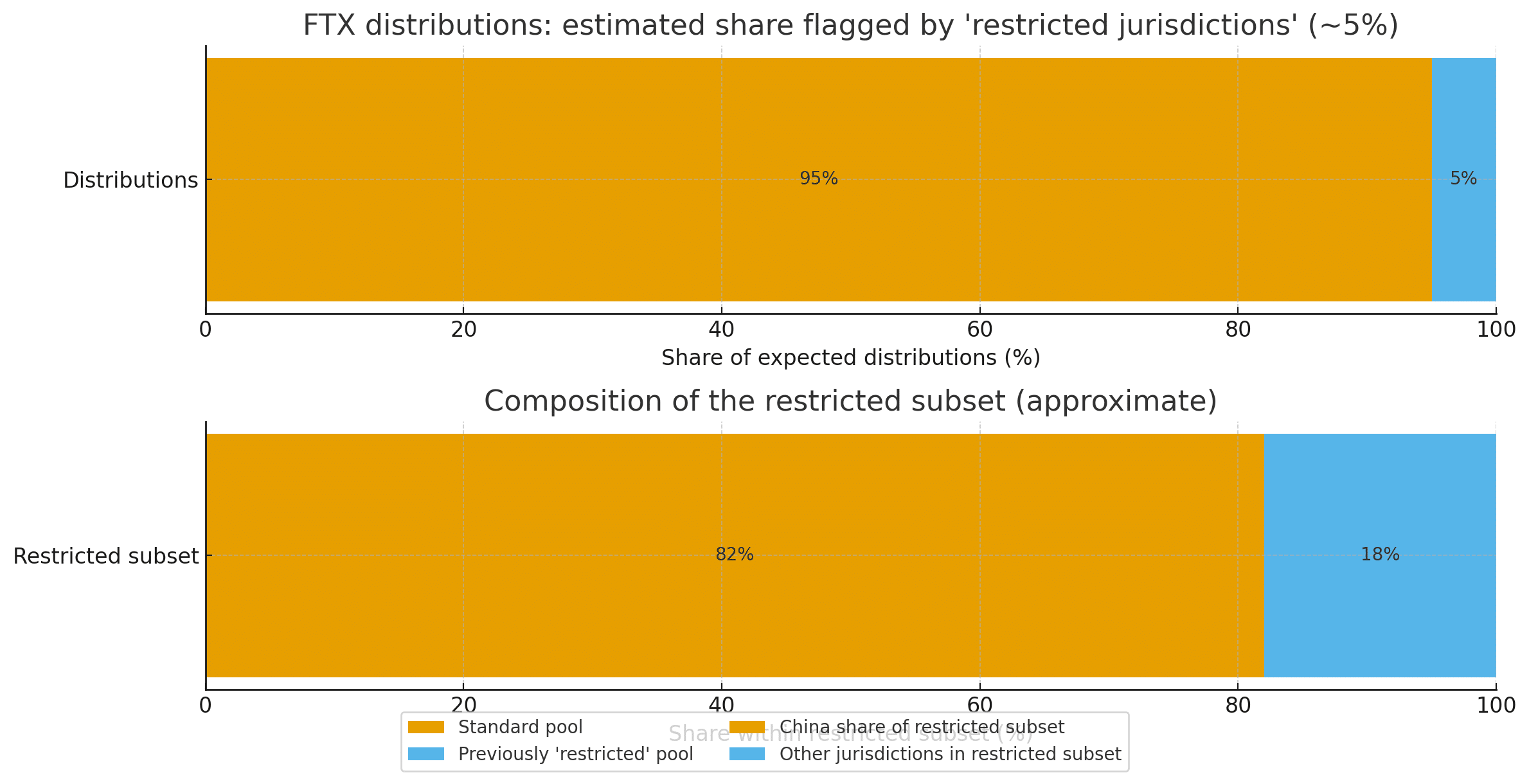
Coverage indicates that roughly 49 jurisdictions sat on the proposed list, representing hundreds of millions of dollars in claims. Some reports placed the pool near the half-billion range, while others cited about 5 percent of total FTX distributions, with China comprising more than four-fifths of the disputed amount.
The estate had argued it needed a bespoke process to ensure local compliance. With the motion gone, those claims rejoin the standard plan mechanics, subject to ordinary pre-distribution checks rather than a separate forfeiture track.
Signals from the people closest to the fight
Public commentary from creditor advocates framed the outcome as a rights win. One organizer posted, “This is a victory for all potentially affected creditors,” while urging claimants to keep working through the claims portal until payouts arrive. That message captures the mood on the ground. The policy battle is over, but the paperwork remains.
Why this matters to markets
Bankruptcy overhangs weigh on liquidity and sentiment. Removing a broad country-level restriction reduces tail risk in several ways. It lowers the odds of fragmented repayment paths, improves visibility on timelines, and trims litigation uncertainty that can freeze capital.
For traders who track legal catalysts, the withdrawal tightens the distribution range around expected recoveries and frees attention for price drivers like dollar liquidity, stablecoin flows, and funding rates. Put simply, clarity encourages participation.
This reversal does not erase every hurdle. The plan still governs cash on hand, reserves, and subsequent distribution dates, and individual claims must satisfy the usual eligibility checks. But eliminating an extra procedural barrier should speed processing at the margin.


Markets will watch for updated notices from the estate, any refined guidance for high-risk regions, and the cadence of subsequent distributions under the confirmed plan. For now, a complex problem has just become simpler.
Conclusion
The withdrawal of the “restricted jurisdiction” motion is more than a headline. It is a practical step that folds sidelined claims back into the mainstream process and reduces uncertainty for a large block of customers.
After months of friction and a pointed courtroom dialogue, the case has one less bottleneck. Creditors gain a cleaner path, and crypto markets shed a small but stubborn risk factor.
Frequently Asked Questions
Is the withdrawal final?
Yes. The trust filed a formal notice of withdrawal in the Delaware case, which removes the motion from consideration and returns affected claims to the plan’s normal track.
How much money is impacted?
Reports vary from roughly 500 million dollars to about 5 percent of expected distributions, with China accounting for the majority of those claims.
What should traders watch now?
Watch for distribution updates, litigation noise that could affect reserves, and market indicators such as stablecoin issuance, funding rates, and spot liquidity.
Glossary of Key Terms
Restricted jurisdiction procedures
A proposed framework that would have imposed extra steps or forfeiture risks for creditors in certain countries. It is now withdrawn.
Distribution date
A scheduled date when the estate pays allowed claims, subject to cash availability and plan requirements.
Pre-distribution requirements
KYC and documentation steps creditors must complete before receiving payments under the plan.
Plan administrator
The party that administers distributions and reserves under the confirmed Chapter 11 plan.
Creditor objection
A formal filing that challenges a motion or treatment of claims. In this matter, objections from Chinese and other creditors were pivotal.