
Updated on 30th October, 2025
The Federal Reserve reduced rates by 25 basis points and emphasized flexibility around balance sheet runoff. The rate move was expected. The liquidity signal was the story.


Chair Jerome Powell said policy is sufficiently restrictive and indicated the Committee is ready to adjust quantitative tightening to keep reserves ample. That guidance tends to move risk assets more than the headline cut because it feeds directly into real yields, the dollar, and ultimately ETF demand.


Why plumbing matters more than the policy rate
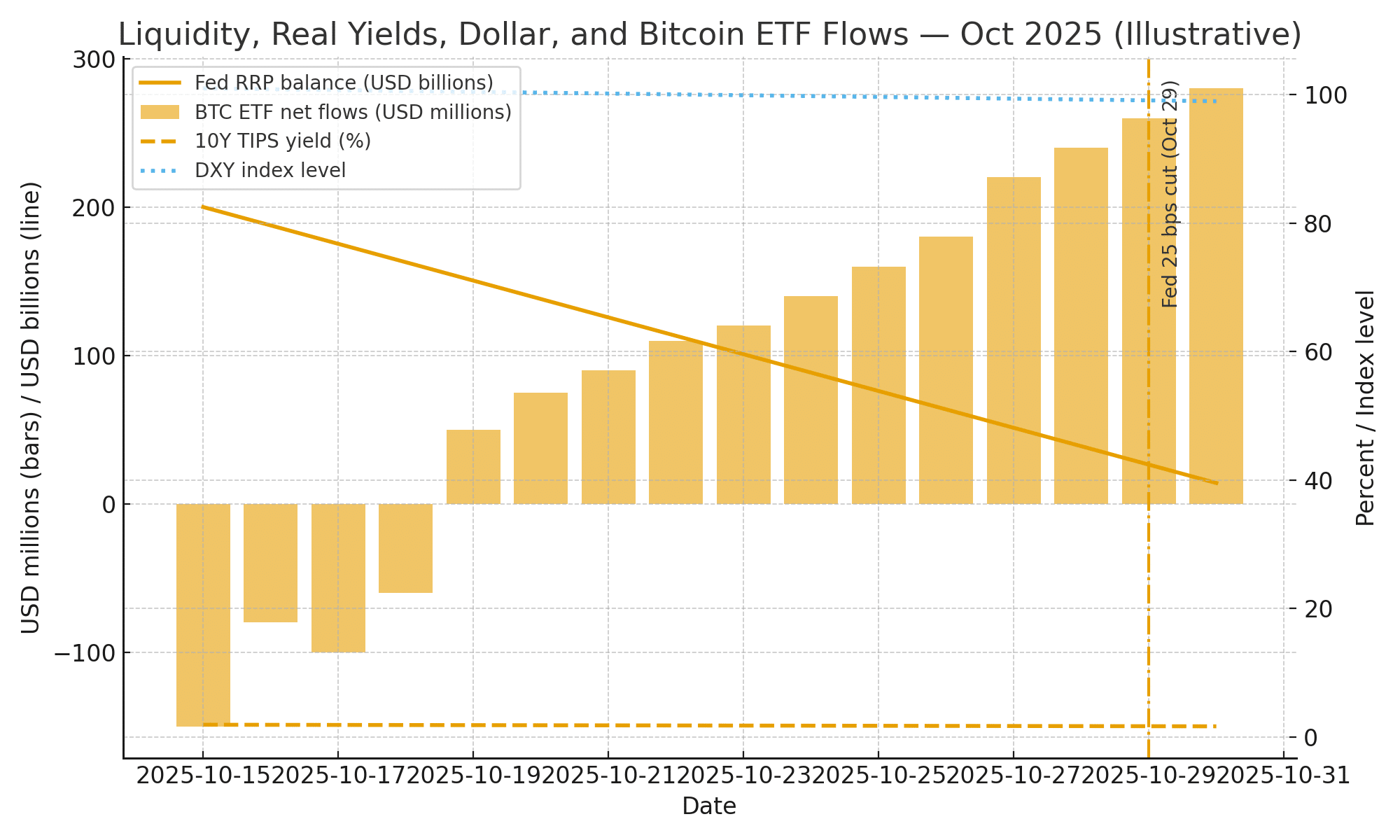
The overnight reverse repo facility sits near empty, a sign that excess cash buffers in the system have been drawn down. With the RRP largely drained, any further balance sheet runoff now pulls on bank reserves instead of idle pockets of liquidity. When reserves fall, real yields firm up and the dollar stabilizes.
When reserves rise, the opposite often happens. That is the channel Bitcoin responds to, not the funds rate in isolation. Recent New York Fed and FRED prints show RRP usage hovering in the teens of billions, a dramatic comedown from prior peaks.
Real yields, the dollar, and the ETF link
Heading into the decision, the 10-year TIPS yield sat near 1.7 percent, while the dollar index hovered around the high-90s. Softer real yields reduce the opportunity cost of holding non-yielding assets and typically nudge the dollar lower, which historically coincides with better risk appetite in digital assets.
If Powell’s “ample reserves” message carries through, real yields can ease further and the dollar can drift, setting a friendlier backdrop for spot Bitcoin ETF creations.
ETF flow pulse is already stabilizing
Spot Bitcoin ETFs showed signs of renewed interest in the days before the meeting, with roughly four hundred to five hundred million dollars of net inflows during the week of Oct. 20 to 27, according to multiple trackers.
That followed a choppy mid-month stretch and suggested investors were positioning for easier policy and steadier liquidity. The question now is whether day-two and day-three prints confirm the trend as funding markets digest the Fed’s guidance.
The near-term setup
The Fed cut rates and stressed balance sheet flexibility. The RRP is nearly tapped, so changes in QT now hit reserves directly. Real yields are off their summer highs and the dollar is softer than in early October. This cocktail tends to support ETF creations, particularly when macro volatility is not flaring elsewhere.
If the Committee follows through with a slower runoff, reserves can stabilize and liquidity can trickle back into markets, a constructive near-term setup for Bitcoin exposure via regulated funds. If inflation chatter returns to center stage and the Fed hardens its tone, real yields may firm and flows could cool. The tape will take its cue from the next few sessions of money-market data, yield moves, and ETF prints.
Bottom line
A 25 bps cut is not the catalyst by itself. The balance sheet is. With the RRP nearly drained and QT nearing an endgame, the guidance around reserves is likely to steer real yields, the dollar, and spot Bitcoin ETF demand over the next several days.
For allocators, watching real yields and the dollar can be as useful as tracking price. For traders, the tell will be whether creations accelerate into week-end settlements.
Frequently Asked Questions
What is the direct link between Fed policy and Bitcoin ETFs?
Balance sheet guidance influences bank reserves, which affect real yields and the dollar. Softer real yields and a weaker dollar often support ETF inflows.
Why does the overnight reverse repo facility matter now?
With RRP usage near zero, further QT would reduce reserves rather than drain idle cash, making liquidity more sensitive to policy tweaks.
Are flows already improving?
Yes. Multiple trackers reported hundreds of millions in net inflows during Oct. 20–27, suggesting interest is returning into a friendlier macro tone.
Which indicators should investors watch next?
Watch 10-year TIPS, the dollar index, and daily ETF creations. These mirror liquidity conditions that tend to drive near-term crypto risk.
Glossary of key terms
Quantitative tightening (QT): The Fed’s process of shrinking its balance sheet by allowing securities to mature without reinvestment, which can reduce bank reserves and tighten liquidity.
Overnight Reverse Repurchase Agreement facility (RRP): A tool that lets money-market funds and others park cash overnight with the Fed in exchange for Treasuries, influencing short-term rates and system liquidity.
Real yields (TIPS yields): Yields on Treasury Inflation-Protected Securities that reflect inflation-adjusted borrowing costs and are a key driver of risk appetite across assets.
Dollar Index (DXY): A measure of the dollar’s value versus a basket of major currencies, often inversely correlated with risk assets when liquidity improves.
ETF creations: The process by which authorized participants deliver cash or assets to an ETF sponsor to create new shares, a useful gauge of investor demand in regulated vehicles.