This Article Was First Posted on TurkishNY Radio.
The European Union has taken a decisive step with the Markets in Crypto Assets Regulation, widely known as MiCA. For the first time, a major economic bloc has a single, horizontal framework for most crypto assets and the firms that handle them. That move is already influencing how exchanges, stablecoin issuers, and institutional investors think about risk, compliance, and where to deploy capital.


MiCA aims to pull crypto out of the grey zone and into a clearer regulatory perimeter. Instead of relying on scattered national rules, the European Union wants predictable standards for token issuance, reserve management and investor protection.
The result is a regime that many market participants see as demanding but workable, and that other regulators quietly treat as a reference point for their own playbooks.
MiCA at a glance
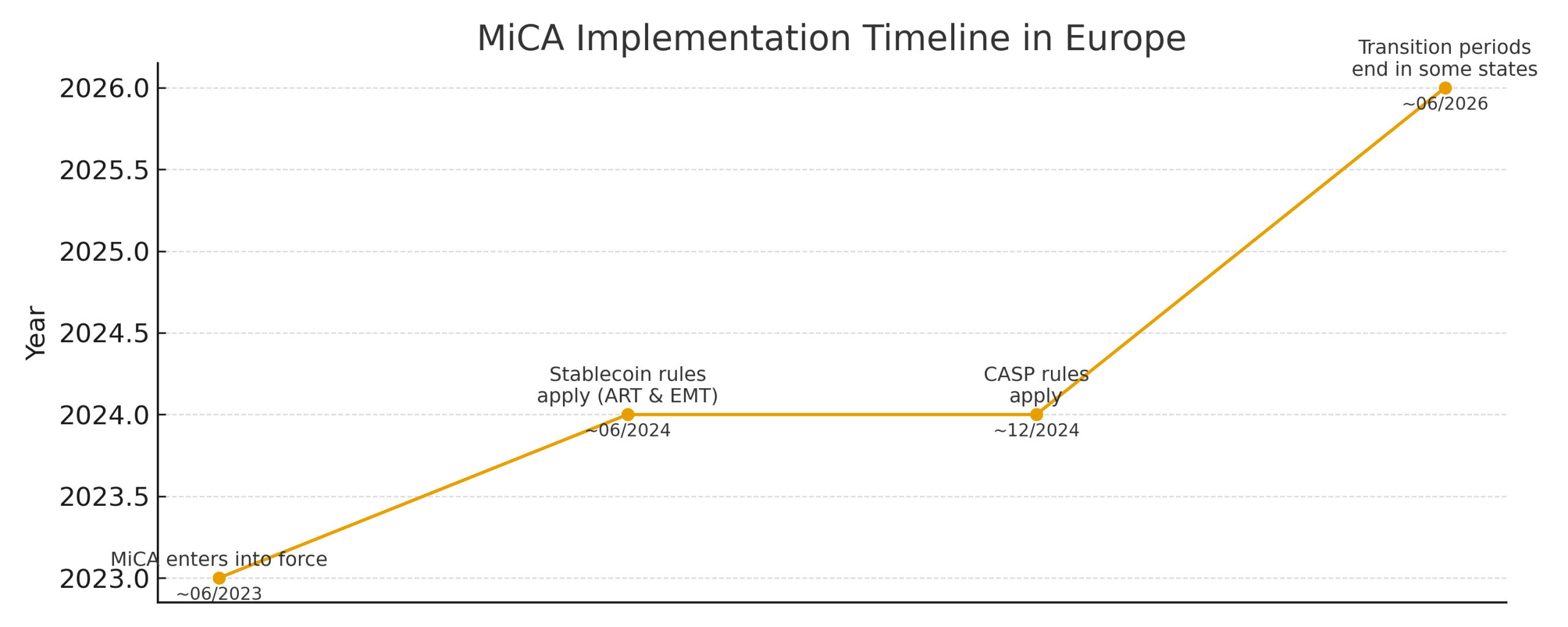
MiCA formally entered into force in 2023, but its rules arrive in stages. The provisions for stablecoins, described in the law as asset-referenced tokens and e-money tokens, became applicable on June 30, 2024.
The core requirements for crypto asset service providers, including trading platforms, custodians and brokers, apply from December 30, 2024. Existing firms can benefit from a limited transition period that, in some member states, runs into mid 2026.
From that point, a firm that wants to serve clients across the bloc will need MiCA authorization from a national authority. Once granted, that license can be “passported” throughout the European Union, a concept borrowed from banking and securities law. The goal is to cut through regulatory fragmentation, give serious firms a real scale advantage and reduce the appeal of shopping for the easiest national regime.
For investors, the promise is simple. A token offered in one member state should meet broadly similar standards in another. White papers, governance information and risk disclosures should follow a common template, whether an investor logs into a platform in Madrid or Helsinki. In theory, that reduces the information gaps that once allowed glossy marketing to mask weak controls or questionable business models.
Stablecoins in the spotlight
Stablecoins sit at the center of both crypto markets and regulatory concern. Global reviews show that stablecoin transfer volumes reached the tens of trillions of dollars in 2024 and that these tokens represent a very large share of centralized exchange activity. They function as the main transactional “cash leg” for trading, collateral and settlement.
MiCA regulation places strict conditions on issuers of asset-referenced tokens and e-money tokens. They must hold high quality, liquid reserves, maintain minimum own funds and prepare detailed redemption and recovery plans.
The objective is to lower the risk of a classic run on a major token, which could trigger fire sales of short-term government debt or bank deposits if reserves are liquidated in a hurry. Recent communications from European authorities stress that large stablecoin portfolios invested in short-dated securities can become a channel of contagion back into the traditional system.
MiCA also tackles the cross-border dimension. Policymakers have warned that foreign stablecoins used widely in the euro area should face safeguards comparable to those applied to domestic issuers.
Without that, offshore dollar linked tokens could undermine monetary policy and financial stability, especially in stress scenarios. This concern has sharpened the debate over foreign stablecoins and strengthened arguments for a possible digital euro as a sovereign alternative.
A higher bar for crypto businesses
For exchanges, brokers, custodians and portfolio managers, MiCA sets a much higher entry bar than the largely unregulated environment of previous years.
To obtain authorization as a crypto asset service provider, a firm must demonstrate strong governance, risk management, capital and investor protection arrangements. Supervisory bodies have already issued consultation papers and technical standards on authorization files, market abuse controls and operational resilience, which flesh out the day to day impact of the law.

The prize for passing this test is access to a large, unified market. A single license can support businesses across all member states, as long as the firm respects the common rulebook. Over time, a MiCA license is likely to act as a quality signal, similar in spirit to a banking or investment firm license in a respected jurisdiction.
Investors, counterparties and even institutional gatekeepers may begin to ask whether a platform or product operates inside that perimeter.
However, the adjustment is significant. Compliance programs will affect token listing processes, treasury management, operational outsourcing, marketing, and onboarding flows.
Firms that move early can help shape supervisory expectations around grey areas such as staking, yield products or the interface with tokenized securities. Late movers may discover that the standard has already settled around practices that favor early adopters with mature risk and compliance teams.
Global ripple effect of MiCA
Although MiCA is a regional law, its influence stretches far beyond the European Union. Comparative analyses of stablecoin regimes and digital asset frameworks now routinely place MiCA alongside new proposals in North America, the United Kingdom and major Asian financial centers.
Some jurisdictions are leaning into a “second mover” strategy. They watch how MiCA plays out in practice, how quickly licenses are granted, where enforcement pressure lands and how liquidity responds.
They can then adopt elements that seem to work, such as tight reserve rules for systemic stablecoins, while tailoring other areas, for example by offering sandboxes for tokenization or lighter regimes for small scale innovation. Industry voices in key hubs have described this as a way to benefit from European experience while avoiding some early design errors.
For global crypto businesses, MiCA is already a reference standard. A project that can meet MiCA level expectations for disclosure, governance and reserve management is better positioned to comply with similar rules elsewhere. Conversely, firms that depend on opacity or minimal oversight may find their options narrowing as more regulators converge on core principles such as clear licensing, traceable reserves and enforceable consumer protections.
Gaps, risks and the next chapter
MiCA is wide, but it is not complete. The text explicitly excludes fully decentralised finance from its central provisions, which leaves protocol-driven activity in a grey area for now. There are also open questions at the boundary with banking, securities, and anti-money laundering rules, where complex groups can run trading, lending, custody, and issuance under one umbrella.
Recent work by European and national bodies has highlighted systemic risk from large, multi-jurisdiction stablecoin schemes and from multi-function crypto groups. These bodies have called for strong enforcement of MiCA and close coordination between supervisors, so that weaknesses at the edge of the regime do not become channels for contagion.
How that coordination evolves will determine whether MiCA delivers lasting stability benefits or leaves important vulnerabilities untouched.
Conclusion
MiCA marks a turning point for digital assets in Europe. It tries to protect investors and financial stability with clear rules on reserves, licensing and disclosures, while offering serious firms a predictable route to scale across a large single market. At the same time, it acknowledges that further work is needed on decentralized finance, cross-regime issues, and global coordination.
Worldwide, the regulation already acts as a benchmark. Regulators, industry groups and institutional investors increasingly talk in terms of “MiCA like” standards when they discuss stablecoins, custody models or token offering rules. The framework will not create a single global law for crypto, but it narrows the distance between leading jurisdictions and makes pure regulatory arbitrage a harder strategy to sustain.
For the crypto sector, MiCA looks less like a ceiling and more like a new floor. Projects and platforms that can live with higher transparency and stronger governance may gain deeper and more stable pools of capital. Those that cannot may find that both regulators and markets have less patience than in the previous cycle.
Frequently Asked Questions about MiCA Regulation
What is MiCA?
MiCA is the Markets in Crypto Assets Regulation of the European Union. It sets common rules for most crypto assets that are not already treated as traditional securities and for the firms that provide services around them.
When did MiCA begin to apply?
MiCA entered into force in 2023. The rules for stablecoins began to apply on June 30, 2024. The main requirements for crypto asset service providers apply from December 30, 2024, with a limited transition period for existing firms in some member states. Cyfrin+1
Does MiCA cover decentralised finance and non fungible tokens?
MiCA focuses on centralised issuers and intermediaries. Fully decentralised protocols and many non fungible tokens remain outside its direct scope for now, although separate policy work on those areas is already underway. World Economic Forum


How does MiCA affect global crypto markets?
Because Europe is a major financial centre, MiCA acts as a template. Projects that meet its standards are better placed to adapt to similar laws elsewhere. Foreign firms that want to serve European clients at scale will need to align with the framework or partner with entities that do.
Glossary of key terms
Asset referenced token
A category of stablecoin under MiCA that aims to maintain value by referencing a basket of currencies, commodities or other assets instead of a single currency.
Crypto asset service provider
A regulated business under MiCA that offers services such as trading, custody, portfolio management or operation of a trading platform for crypto assets.
E money token
A type of stablecoin under MiCA that maintains a stable value by being fully backed by a single official currency, similar in concept to regulated e money.
Passporting
A mechanism in European financial law that allows a firm authorized in one member state to provide services across the entire European Union, subject to a common rulebook.
Stablecoin
A digital token that aims to keep a stable value, often by being backed with reserves of fiat currency or short term securities, and widely used as transactional cash in crypto markets.