
A New Treasury Battle Emerges
The conversation around Ether vs Bitcoin Treasuries has evolved beyond the usual “which is better” argument. In 2025, it has become a matter of treasury philosophy, a divergence in how institutions define safety, yield, and strategic exposure to digital assets.


On one side stands Bitcoin, the original hedge, a digital reserve asset held by companies and sovereign funds alike. On the other is Ethereum, which has quietly positioned itself as the income-generating engine of the decentralized economy.
Institutional portfolios, once heavily skewed toward Bitcoin, are now split. The numbers tell part of the story: while corporate treasuries collectively hold over 848,000 BTC, Ethereum’s treasury and ETF-held supply have crossed 12.5 million ETH, nearly 10 percent of its circulating supply.
What began as a diversification experiment is now an open contest for dominance.
Bitcoin Treasuries: The Digital Gold Standard
When Michael Saylor declared Bitcoin the “best treasury reserve asset” years ago, the statement echoed across boardrooms. His reasoning was simple: scarcity. Bitcoin’s fixed supply of 21 million coins created a measurable floor for long-term value preservation.
Bitcoin treasuries embody that philosophy, a fortress against inflation and currency debasement. They are built for simplicity: no yield, no smart contracts, no protocol risks. Just pure exposure to scarcity.
According to public filings and blockchain data aggregators, firms and ETFs collectively control nearly 4 percent of Bitcoin’s total supply. These holdings act as long-term reserves rather than liquid assets. Many corporations, from electric vehicle makers to fund management firms, view Bitcoin as a strategic insurance policy, similar to holding gold during a volatile macro cycle.
As one portfolio manager recently posted on X, “Bitcoin is no longer a speculative asset. It is collateral, the cleanest, most liquid form of digital collateral we have ever had.”
That belief has kept Bitcoin at the heart of treasury strategies, even as newer opportunities have surfaced elsewhere.
Ethereum’s Rise: From Utility to Yield Engine
Ethereum’s appeal lies in its utility and its evolving monetary structure. After its 2022 merge and 2023 Shanghai upgrade, staking turned Ethereum into a yield-bearing asset.
Treasury managers could now hold ETH and simultaneously earn a native return, typically between 3 to 5 percent annually, by staking or using institutional-grade validators.
In contrast to Bitcoin’s static nature, Ethereum offers functionality. It powers decentralized finance, NFTs, stablecoin issuance, and tokenized real-world assets. Treasuries holding ETH can interact directly with this ecosystem, unlocking liquidity or hedging positions without needing intermediaries.
In the Ether vs Bitcoin Treasuries debate, this utility-versus-purity contrast has become central. Ethereum offers yield and optionality, while Bitcoin delivers simplicity and predictability.
Citigroup analysts recently raised their year-end price target for ETH to $4,500, citing “institutional reallocation from static BTC positions into yield-generating ETH exposure.” The note also mentioned that Ethereum’s staking structure offers “a measurable carry advantage for treasuries seeking blended return profiles.”
For long-term allocators, this is more than just an interest rate, it is an architectural shift in how digital treasuries function.
Institutional Rotation: Signs of a Structural Shift
Throughout 2025, inflows into Ether-based ETFs and treasuries began to outpace Bitcoin’s. Fund flow trackers show that Ethereum-linked products captured roughly 54 percent of all new institutional inflows in Q3.
Some analysts believe this signals a quiet rebalancing, not necessarily a rejection of Bitcoin, but a shift toward yield optimization.
A senior strategist at a European digital asset fund explained it this way: “Bitcoin is the vault. Ethereum is the engine. Smart treasuries are learning to hold both.”
The term “smart treasuries” itself has become a trend in 2025. These entities, typically DAOs, fintech firms, and forward-looking corporates, manage digital reserves dynamically, adjusting between BTC, ETH, and tokenized treasuries based on yield curves and liquidity needs.
In this new model, Ether vs Bitcoin Treasuries is not an either-or decision. It is a ratio that reflects risk appetite, capital objectives, and operational flexibility.
The Yield Effect: Why Ethereum Changes the Equation
The addition of staking yield transforms Ethereum into a quasi-income asset, giving it qualities of both equity and debt. This is especially relevant for treasuries that manage opportunity cost.
In traditional finance, idle cash in corporate accounts loses value to inflation. Bitcoin resolves that by holding purchasing power. Ethereum goes one step further, it earns.
Institutional staking providers have enabled non-custodial or regulated staking services, making it easier for corporations to participate without compromising compliance. Many firms report that integrating ETH staking into treasury management adds 30 to 50 basis points to annual return on reserve capital.
That incremental yield compounds meaningfully over multi-year cycles.
However, this comes with complexity. Ethereum’s validator economics, protocol upgrades, and potential slashing risks introduce variables that Bitcoin treasuries never face. It is not just a financial decision; it is also a governance one.
As one analyst from a major bank commented in a recent research note, “Ethereum’s yield is attractive, but the operational stack behind it is not trivial. Treasurers need crypto-native infrastructure to manage it responsibly.”
Corporate Examples and Market Trends
The shift can be seen in how companies are positioning their digital reserves.
Some mid-sized public firms have quietly expanded their ETH exposure while keeping BTC as the anchor. A few firms in Asia have even pivoted entirely to Ethereum, citing faster liquidity access and higher on-chain engagement.
One of the most talked-about cases this year involved a small crypto-mining company that saw its stock surge over 3,000 percent in a week after announcing plans to hold Ethereum instead of mined Bitcoin as its primary treasury asset. This was not a speculative bet, it was a strategic repositioning toward a yield-based treasury model.
Meanwhile, large asset managers are experimenting with hybrid treasury portfolios, combining Bitcoin for security and Ethereum for yield. The blended approach mirrors modern portfolio theory: balance growth and stability.
The conversation surrounding Ether vs Bitcoin Treasuries has therefore evolved into something more nuanced; it is no longer about dominance, but diversification.
The Numbers Behind the Debate
Recent data illustrate the gap and the convergence.
-
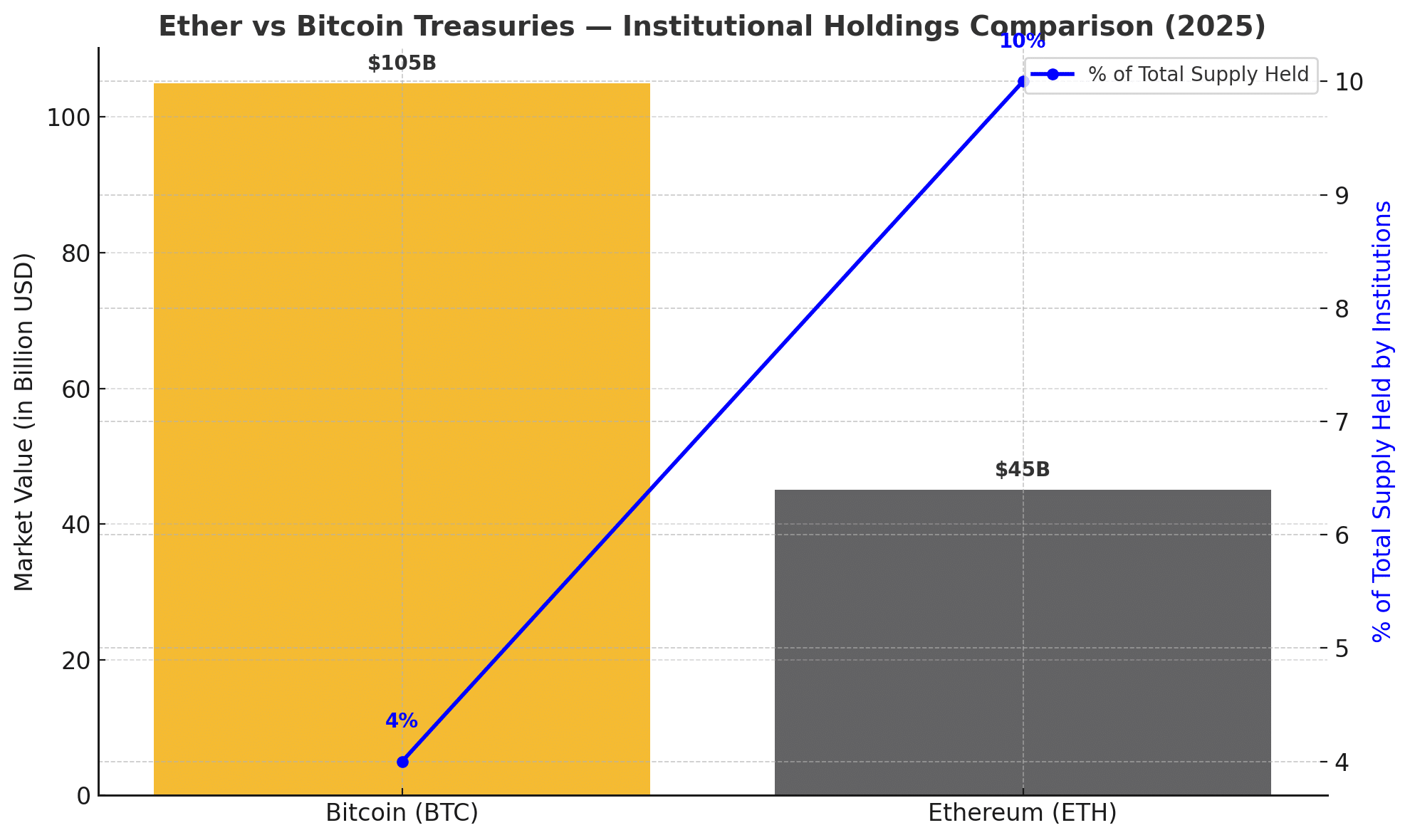
Bitcoin treasuries: approximately 848,000 BTC held by institutions and ETFs, worth over $105 billion at recent prices.
-
Ethereum treasuries and ETF holdings: around 12.5 million ETH, equating to about $45 billion.
While Bitcoin still leads in dollar terms, Ethereum’s share of circulating supply held by institutions (around 10 percent) exceeds Bitcoin’s by a wide margin.
That figure matters more than nominal totals. It signals commitment and long-term conviction. In terms of relative supply lockup, Ethereum has become the more institutionally concentrated network.
The Convergence of Strategies
Looking forward, analysts expect a more integrated treasury model where both assets coexist.
Bitcoin will likely retain its role as a macro hedge and liquidity reserve, favored by firms that prioritize stability and regulation-friendly exposure. Ethereum will continue attracting tech-aligned corporations, DeFi operators, and institutions seeking programmable yield.
As tokenization of real-world assets expands, Ethereum’s infrastructure advantage could push its treasury relevance further. On the other hand, Bitcoin’s growing use as collateral in ETF and derivatives markets strengthens its case as a financial primitive.
Both paths lead to institutional legitimacy, but via different roads.
As a senior crypto economist summarized in a recent panel, “Ethereum is building a digital economy. Bitcoin is anchoring a digital monetary system. Treasuries must decide which one fits their DNA.”


Conclusion: Not a Competition, but a Calibration
In 2025, the Ether vs Bitcoin Treasuries question is less about competition and more about calibration.
Bitcoin represents preservation, Ethereum represents participation. The former defends against currency decay; the latter enables economic engagement within the crypto-native world.
Smart treasuries will likely continue to hold both, adjusting weightings as market cycles shift. The balance between scarcity and yield, between vault and engine, will define the next phase of corporate crypto strategy.
Ultimately, it is not about which asset wins. It is about how intelligently they are used together.
Frequently Asked Questions
1. What does “Ether vs Bitcoin Treasuries” mean?
It refers to the growing trend of companies and institutions choosing between holding Bitcoin or Ethereum in their balance sheets as reserve or yield assets.
2. Why are more treasuries adding Ethereum in 2025?
Ethereum offers yield through staking, tokenization benefits, and utility across DeFi, giving it additional layers of return and flexibility compared to Bitcoin.
3. Are Bitcoin treasuries still relevant?
Yes. Bitcoin remains the dominant store of value and the simplest reserve asset for long-term holding, especially for conservative corporate portfolios.
4. Could Ethereum surpass Bitcoin in treasury dominance?
While it leads in share of supply held by institutions, surpassing Bitcoin in total value may depend on ETH price appreciation and continued institutional adoption.
Glossary of Key Terms
Treasury Assets:
Digital or fiat assets held by corporations to preserve value, manage risk, or earn yield.
Staking:
Locking Ethereum to secure the network and earn rewards.
ETFs (Exchange-Traded Funds):
Investment funds that hold assets like BTC or ETH and trade on traditional stock exchanges.
Institutional Flows:
Capital movement from professional investors and funds into specific digital assets.
DeFi (Decentralized Finance):
Financial applications built on blockchain networks like Ethereum that enable lending, borrowing, and trading without intermediaries.