![Sun [New]](https://s2.coinmarketcap.com/static/img/coins/64x64/10529.png)


This article was first published on TurkishNY Radio.
The El Salvador Bitcoin policy is the country’s contribution to the world stage, but it is not what keeps President Nayib Bukele popular at home. Voters tell opinion survey researchers that they back his government largely because they believe the streets are safer.


Polls show that reduced crime and stronger action against gangs are far more important to most citizens than cryptocurrency law. The El Salvador Bitcoin policy has been the subject of much conversation outside of the country, but not so much inside it.
According to recent survey data, only a few segments of respondents identify Bitcoin as Bukele’s most significant failure. When people are asked to speak about his record in office, many do not bring up at all the cryptocurrency.
El Salvador Bitcoin policy and Public Opinion
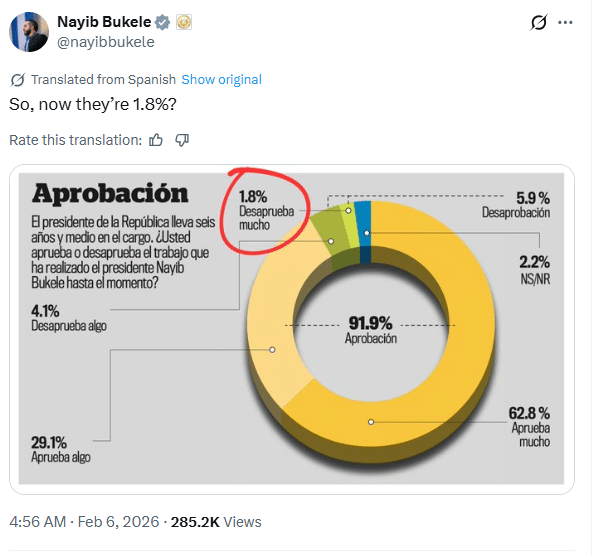
In the survey of 1,200 respondents, nearly two-thirds voiced strong approval of the president’s performance, while fewer than 2% reported strong dissatisfaction. Bukele later responded to the results on X with a sarcastic remark, questioning the size of the disapproving group.
The El Salvador Bitcoin policy was launched in 2021 after the country’s legislative body adopted a law that made Bitcoin legal tender, alongside the U.S. dollar. The enabling law mandates that businesses accept Bitcoin where they can, at least when technology supports it.


With the move, El Salvador became the first country in the world to use Bitcoin as its currency. The move won praise from some advocates of cryptocurrency and sharp criticism from traditional financial institutions.
Security Crackdown and Public Support
Bukele was sworn in as president in June 2019 and quickly initiated an aggressive campaign against gangs that had held vast swaths of neighborhoods for years. His government also inaugurated CECOT.
Official data suggest a marked decline in homicide rates compared to previous years. For many people, this disruption to everyday life is more important than their reservations or hopes about El Salvador Bitcoin policy.
Limited Daily Use of Bitcoin
Despite its legal-tender status, Bitcoin is still used only in a narrow slice of everyday transactions. Most people continue to pay in U.S. dollars for food, transport and services.
Small businesses often report that customers rarely request to pay in Bitcoin, even when digital wallets are available. Bukele admitted in a 2024 interview that adoption has fallen short of early expectations, a gap that now defines much of the El Salvador Bitcoin policy in practice.
IMF Pressure and Financial Risks
The International Monetary Fund has repeatedly warned that exposure in size to Bitcoin could pose fiscal and financial stability risks. It’s prompted concerns around price volatility, balance sheet shocks and the consequences for public debt.
Nevertheless, despite these tensions, El Salvador was able to obtain a $1.4 billion loan from the IMF in 2024. The deal added adjustments in some crypto-related projects and greater commitments on transparency, risk control and supervision.
Bitcoin Accumulation Strategy
Even under outside pressure, the government has not abandoned its accumulation plan linked to the El Salvador Bitcoin policy. Officials say the state has been buying one Bitcoin per day since 2022.
Public dashboards connected to the government’s Bitcoin office suggest that national reserves continue to grow. Supporters see this as a long-term strategic bet on digital scarcity. Critics argue that it exposes taxpayers to sharp price swings and potential future losses.
Future of the Chivo Wallet
The state-run Chivo wallet was launched as the main digital gateway to Bitcoin for citizens. It offered sign-up bonuses and zero-fee transactions at the start. Over time, however, users reported problems such as fraud, identity theft and technical outages.
As part of talks with the IMF, authorities are considering selling or shutting down Chivo, while allowing private wallets to serve the market. That shift would move retail use of Bitcoin away from direct state control and toward private providers.
Economic Outlook Beyond Bitcoin
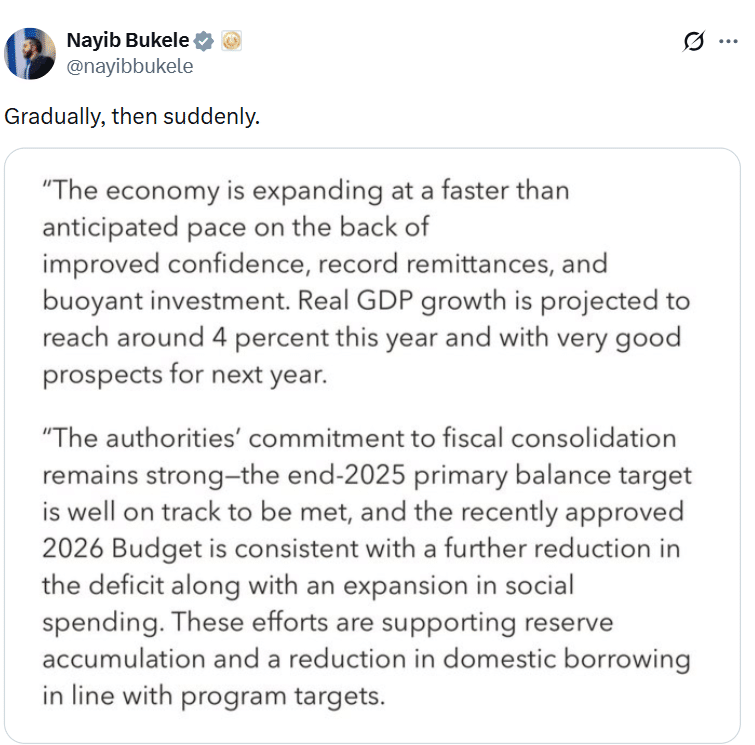
Despite the early shock around the Bitcoin law, recent assessments point to stronger-than-expected macroeconomic performance. The IMF now projects real GDP growth of around 4% this year.
Improved security, rising tourism, and increased investment all support this outlook. For many analysts, these forces now matter more than the El Salvador Bitcoin policy itself when judging the country’s medium-term prospects.
Conclusion
El Salvador’s experience shows that a bold crypto law does not automatically reshape everyday life. Bukele’s political strength rests mainly on security gains and a sense of order in once-violent communities.
The El Salvador Bitcoin policy remains historic and controversial. But for many citizens, it is only one part of a wider economic and social transformation.
Appendix: Glossary of Terms
Bitcoin Legal Tender: The legal ability to use Bitcoin for transactions in conjunction with the official currency of a country.
CECOT: A high-security prison center in El Salvador that was constructed to hold suspected gang members.
Chivo Wallet: The country’s government-sponsored digital wallet designed to support Bitcoin transactions in El Salvador.
IMF Lending Program: Financial resources that are made available by the International Monetary Fund contingent on policies that meet specific criteria of the IMF.
Homicide Rate: A crime statistic that reflects the number of murders per 100,000 inhabitants.
Crypto Volatility: Sudden and severe price fluctuations ,which are occurrences often experienced in crypto markets.
Fiscal Risk: The risk to public finances resulting from volatile assets or policy choices.
Digital asset reserves: It’s the holdings of cryptocurrency that a government would have as part of its national reserves.
FAQs El Salvador Bitcoin policy
1: What is the El Salvador Bitcoin policy?
It is the 2021 law that made Bitcoin legal tender alongside the U.S. dollar, required businesses to accept it where possible and allowed the state to use Bitcoin as part of its financial strategy.
2: Do most Salvadorans use Bitcoin in daily life?
No. Residents continue to rely on the U.S. dollar for everyday expenses, and BTC transactions are few and far between, especially outside of tourist spots or from major merchants.
3: How has the IMF reacted to the policy?
The IMF has cautioned about financial and fiscal risks from Bitcoin’s price volatility. It later signed off on a big loan while pushing the government for greater transparency and lower risk.
4: Is El Salvador still buying Bitcoin for its reserves?
Yes. Officials say the country continues to purchase one Bitcoin per day as part of a long-term accumulation plan connected to the broader national crypto strategy.
Reference