The European Central Bank (ECB) met in Florence and kept interest rates unchanged for a third straight meeting. The decision was widely expected. Price growth is near target and the economy is holding together better than many feared. The message was simple. Policy stays steady until the data say otherwise.
President Christine Lagarde signaled continuity. She has described policy as being in a “good place,” and officials have indicated they can live with small deviations around the target while they test whether inflation is fully tamed. The setting, away from Frankfurt, underscored that this was not a meeting for fireworks. It was about showing patience.


Recent growth numbers helped the Governing Council sit tight. Eurozone output rose 0.2% in the third quarter, beating expectations. Spain and France carried much of the load, while Germany and Italy remained soft. The upside surprise eased pressure to cut again quickly and gave the Bank more time to gauge the pass-through of earlier moves.
Markets had already priced in a long plateau. Some desks still whisper about one more trim in 2026 if inflation undershoots. Many economists prefer a long pause through new year forecasts and into mid-2026. Either way, the near-term path is flat. The message matters as much as the level. A predictable ECB lowers volatility across funding markets and leaves risk assets to trade the macro drift.
The backdrop is not spotless. Exports to the United States have cooled after tariff shifts. Europe also faces a flood of diverted Chinese goods that weigh on local industry. The euro has been firm on the crosses at times, which helps damp inflation but bites into external demand. The Bank knows these crosswinds. That is why officials stress the meeting-by-meeting approach and the need to avoid “overengineering” policy for minor bumps.
France’s data offered a bright spot. Output rose 0.5% in the quarter, beating forecasts despite political noise. The improvement, if it sticks, gives the euro area a sturdier core alongside Spain’s resilience. It also buys the ECB time to watch labor markets and wages without rushing to cut.
What The Hold Means For The Euro And Bonds
A steady ECB often supports the euro through reduced policy uncertainty. If growth continues to surprise on the upside in France and Spain, the currency can find a floor, especially against peers where easing cycles are more advanced. That said, the currency path still hinges on external demand and terms of trade. If Chinese diversion keeps pressuring European manufacturers, the euro can soften again as growth expectations cool.
Sovereign curves should remain anchored. The front end reflects a long plateau and the back end tracks global term premia. Germany’s fiscal stance and investment plans add nuance, but the bigger swing factor will be global risk sentiment and U.S. yields. A quiet ECB reduces local shocks, which bond desks welcome after a choppy two years.
Credit markets usually like this setup. Flat policy rates, modest disinflation, and no looming recession call reduce default anxiety. If earnings guidance stabilizes into year-end, spreads can grind tighter. The one caveat is trade. Fresh tariff headlines or a sharp drop in export orders can widen spreads quickly, especially for industrials.
The Crypto Lens: Why ECB Steadiness Matters Beyond Frankfurt
Crypto trades liquidity and confidence as much as narrative. A patient’s ECB improves both. With policy rates on hold and inflation near target, European real incomes stabilize. That supports steady retail flows into risk assets, including digital assets. On the institutional side, a predictable rate path encourages more measured allocation discussions, from corporate treasuries to asset managers running multi-asset sleeves.
EUR-denominated stablecoin activity could benefit as payment firms and market makers plan around a less jumpy funding curve. For exchanges that clear significant euro pairs, stable overnight rates reduce the friction cost of keeping balances in fiat rails. The result is cleaner pricing, narrower spreads, and potentially deeper books in BTC-EUR and ETH-EUR pairs. That improves market quality, which in turn attracts more flow.
There is also the macro beta. When Europe is not a source of policy surprises, global risk can focus on growth and earnings rather than headline shocks. In that environment, digital assets tend to trade with tech and high beta equities. If the euro holds range and global dollar liquidity remains stable, crypto volatility can compress before the next catalyst.
Correlation is not destiny. But flows care about direction. A steady ECB plus a data-dependent Fed creates a corridor where risk assets oscillate on fundamentals rather than fear. That corridor is often when builders ship, exchanges refine products, and institutions pilot new vehicles. Crypto adoption grows quietly in these windows.
Key Indicators Crypto Desks Should Watch
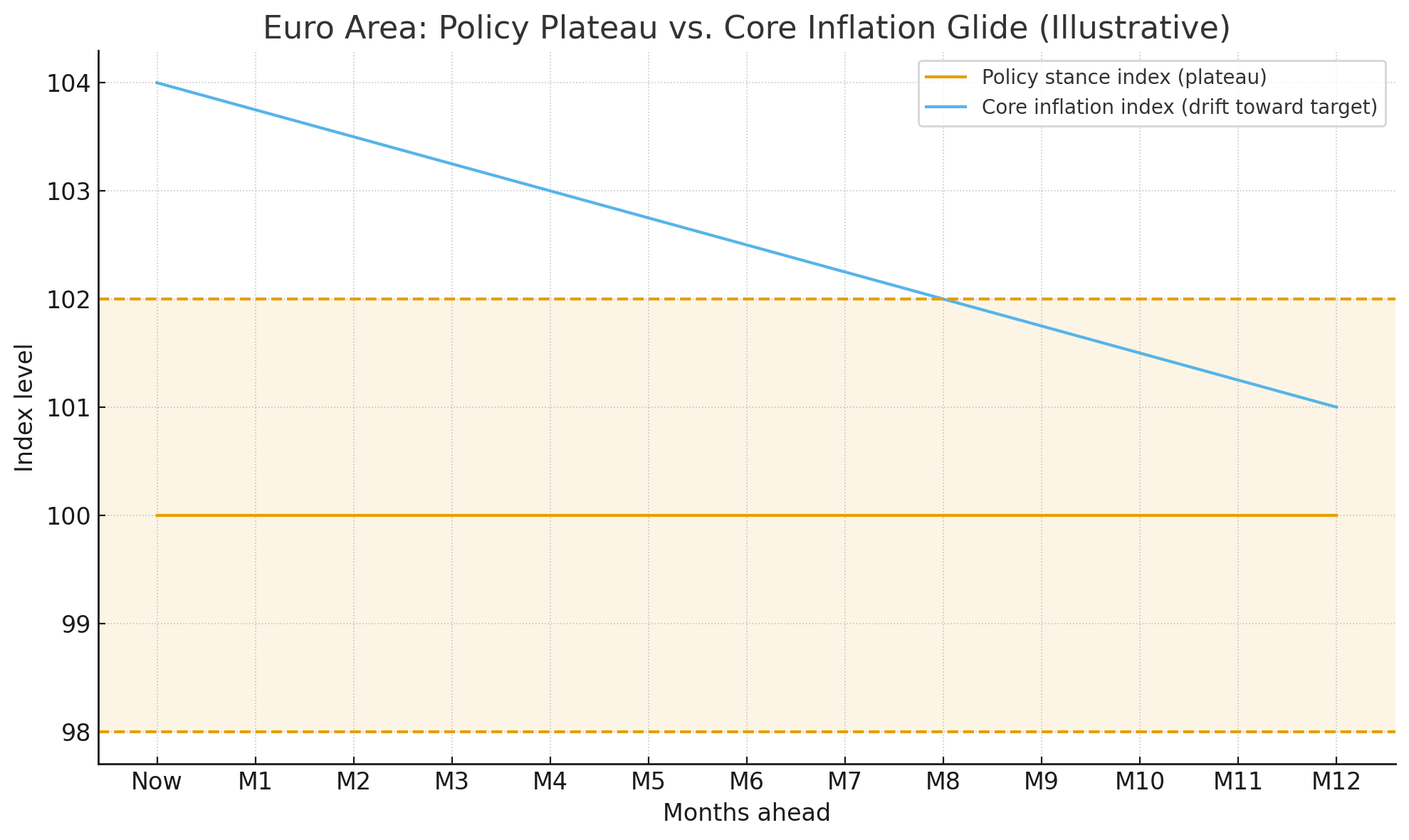
First, watch euro area inflation prints. If core keeps tracking comfortably toward the target, the plateau lasts. That supports range-bound funding and calmer volatility. Second, track PMI new export orders. Weakness here has been the pressure point for Europe.
Further slippage would hint at slower growth and might tug the euro lower, which can alter crypto correlations. Third, monitor cross-border flows into European equity funds. Rising flows imply an improving risk appetite that can spill into digital assets.
Finally, keep an eye on EUR-based stablecoin volumes and BTC-EUR spot depth. Healthier depth and tighter spreads are the tell that market quality is improving on European rails. Those microstructure signals often lead price action when macro headlines are quiet.
What Policymakers Said
Lagarde has been clear that decisions are data driven. She has used the phrase “good place” to describe the stance and has warned against trying to micromanage small deviations around target. That language returned around this meeting, reinforcing the idea of intentional patience.


Chief Economist Philip R. Lane has stressed the medium-term focus. He has reminded markets that the mandate is two percent inflation over time, not month by month. That anchors the communication strategy and reduces the incentive to react to every print.
During the press briefing cadence, officials reiterated the sequence for decisions and statements in Florence, which helped frame expectations and kept attention on the numbers.
Long-Term Impact: Three Paths And The Crypto Read-Through
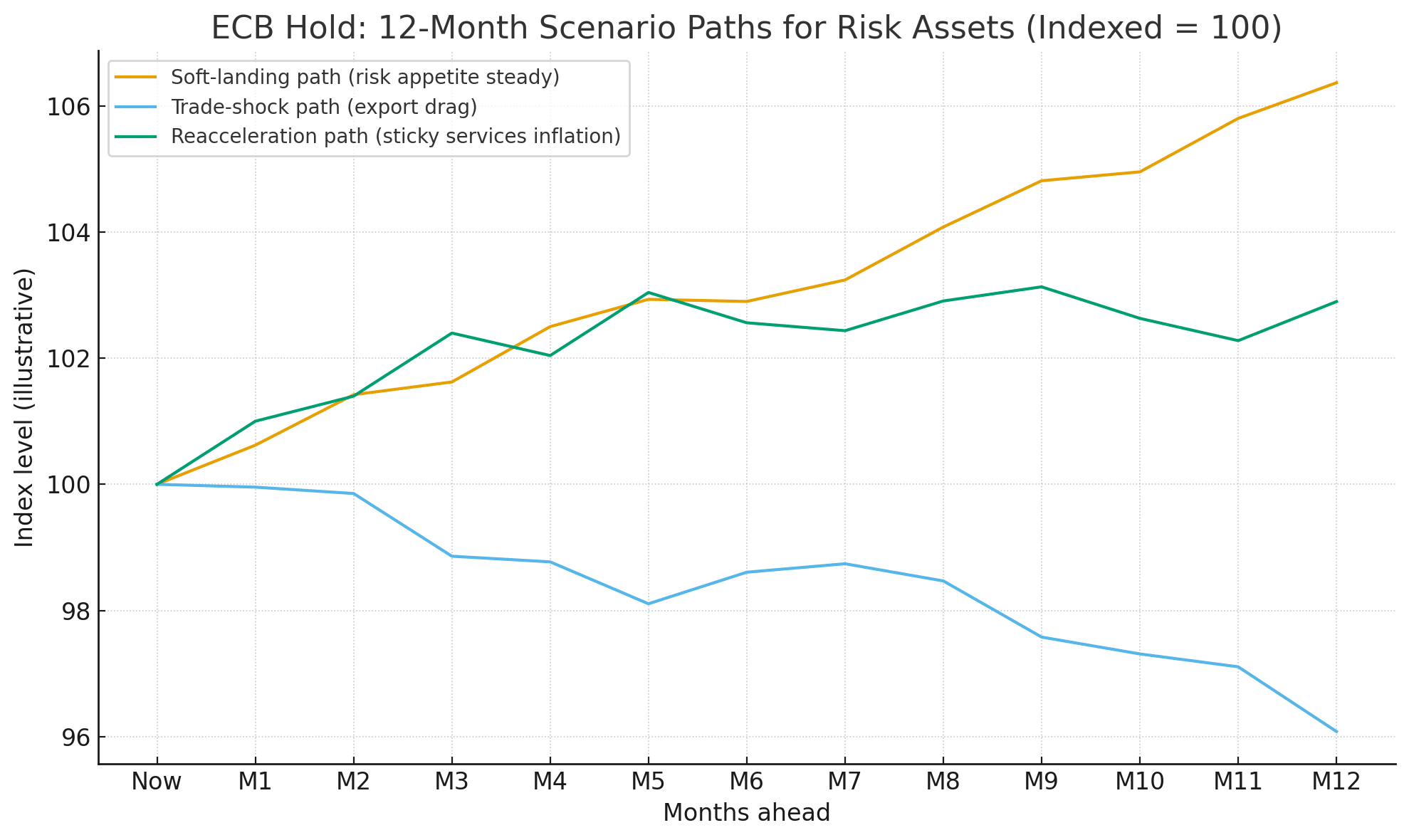
Soft-landing path. Growth holds near trend while inflation stays close to target. The ECB maintains a plateau, then trims modestly in late 2026 to align with neutral estimates. In this path, the euro trades range, European equities grind higher, and crypto benefits from steady risk appetite. The likely result is incremental adoption and institutional pilots moving into production.
Trade-shock path. U.S. tariff policy stays tight and Chinese diversion accelerates. European export orders soften further and capex plans pull back. The ECB tolerates slower growth until labor markets crack, then signals a cut sequence. The euro weakens. In crypto, EUR-denominated flows become choppier and volatility rises as macro beta turns more negative.
Reacceleration path. Fiscal spending in core economies like Germany gains traction. Infrastructure and defense outlays tighten labor markets again. If wages reheat and services inflation stalls, the ECB keeps the plateau longer and warns about persistence risks. That would keep real rates firm and dampen the most speculative corners of the market until productivity improved.
Practical Takeaways For Crypto Teams
Exchanges and market makers should prepare for a quieter EUR funding curve and focus on market quality. Tighter spreads and deeper books in EUR pairs help attract professional flow. Asset managers should revisit risk buckets for digital assets within multi-asset sleeves. A calm macro window is when new mandates pass compliance review.
Treasury teams at crypto-native firms should review interest income strategies on fiat balances. With a rate plateau, the forward curve is stable enough to evaluate laddered instruments and low-risk cash equivalents. Legal and compliance teams should map policy dates. The ECB’s December projections will be the next major waypoint, and that is when forward guidance language could shift.
Christine Lagarde said policymakers are “in a good place,” adding that decisions will be “data-dependent” and that the Bank will not try to “overengineer” policy in response to minor deviations from target. The phrasing set the tone for this meeting and the ones ahead.
Philip R. Lane reaffirmed the focus on stabilizing inflation at two percent over the medium term, and a meeting-by-meeting approach. That guidance continues to anchor expectations as the ECB navigates a complicated external backdrop.
The Bottom Line
The ECB chose patience in Florence. A modest growth beat, cooler inflation, and known trade risks argue for a steady hand. That steadiness bleeds into markets. For crypto, it means calmer funding, better market quality in euro pairs, and a cleaner backdrop for adoption work. The next big test arrives with the December projections. For now, Europe has earned a breather.
Frequently Asked Questions
Why does an ECB hold matter for crypto?
Crypto trades liquidity and confidence. A predictable rate path lowers uncertainty in funding markets, which improves market quality and supports measured risk taking. That can lift participation in BTC-EUR and ETH-EUR markets and make pricing cleaner.
Will a stronger euro hurt or help digital assets?
It depends on the driver. A stronger euro from healthier European growth can support risk appetite and flows into crypto. A stronger euro from external shocks that compress trade can weigh on risk assets.
Could the ECB cut again soon?
Most economists expect a long pause, with any cuts pushed into 2026 unless inflation undershoots or labor markets weaken meaningfully. December projections will refine that view.
What indicators should crypto desks track after this meeting?
Focus on core inflation, PMI new export orders, EUR-based stablecoin volumes, and BTC-EUR order book depth. These signals reveal whether the rate plateau is feeding into market liquidity.
Glossary
Governing Council
The main decision-making body of the ECB that sets interest rates and policy tools.
Plateau
A period when the central bank holds rates steady to assess how past moves affect the economy.
Overengineering
Policymaker shorthand for trying to fine-tune policy in response to very small data deviations, often discouraged by central banks.
Medium-term target
The ECB’s aim to keep inflation at two percent over time, not month by month.
Term premia
The extra return investors demand for holding longer-dated bonds rather than rolling over short-term debt.
Market microstructure
The plumbing of trading, including order book depth, spreads, and execution quality.
EUR-denominated stablecoin
A token that seeks to maintain a one-to-one value with the euro, used for trading and payments on crypto rails.
PMI
Purchasing Managers’ Index, a survey-based gauge of activity. New export orders are a key subindex for trade momentum.