
Dogecoin has been walking a tightrope for weeks, and the rope finally snapped. The world’s most recognizable memecoin broke below the critical $0.08 support level, sliding to a three-week low of $0.079 and sending shockwaves through the derivatives market. For traders who had been watching that price floor like a hawk, the breach confirmed what many feared but few wanted to say out loud.
What Triggered the Dogecoin Price Drop?
The DOGE price decline did not happen in isolation. A combination of deteriorating market sentiment, weakening broader altcoin momentum, and leveraged trader positioning created the perfect conditions for a sharp selloff. Once $0.08 gave way, the cascade effect took over almost immediately, as it tends to do in crypto markets when a widely-watched level breaks down.


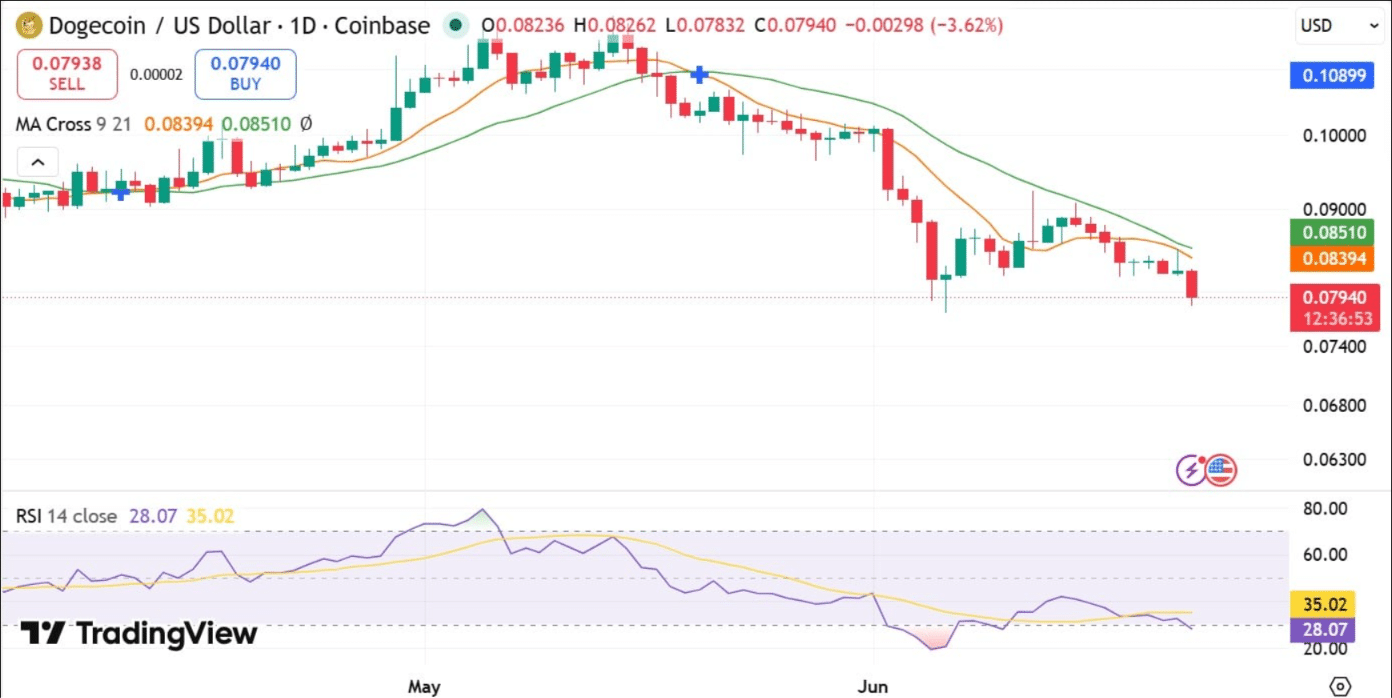
At the time of writing, Dogecoin traded at $0.07907, down 5.54% on the daily chart. More importantly, the coin slipped below both the 9-day and 21-day moving averages, technical indicators that traders routinely use to gauge short-term momentum and directional bias. When price closes beneath both of those levels simultaneously, it validates bearish structure and signals that sellers are in control of the narrative.
Liquidations Reached $7.68 Million as Leveraged Longs Got Crushed
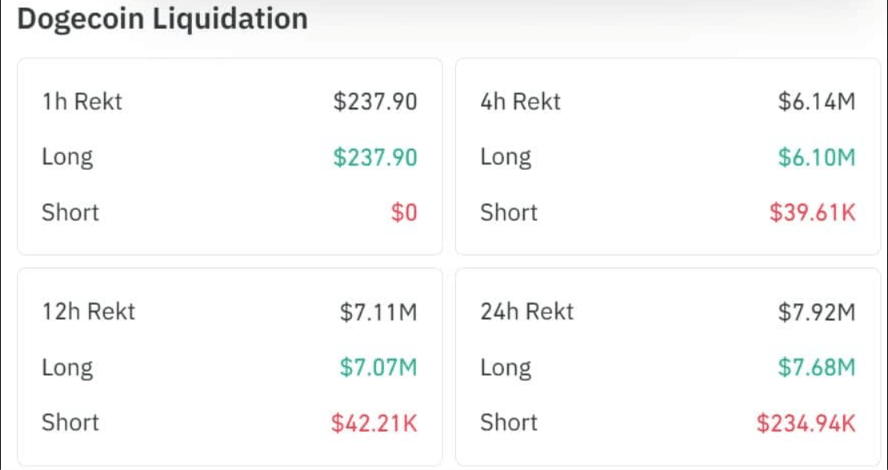
The breach of $0.08 did not just rattle spot holders. It triggered a wave of forced liquidations in the derivatives market that amplified the selling pressure significantly. According to CoinGlass data, $7.68 million worth of long positions were liquidated following the drop, a figure that reflects how heavily the market had been positioned on the bullish side of the trade.
Leveraged long liquidations of this magnitude are essentially forced selling. When a trader holds a leveraged long position and the price moves against them beyond a certain threshold, the exchange automatically closes the position to prevent further losses. That forced exit adds sell pressure on top of existing sell pressure, creating a feedback loop that can accelerate price declines well beyond what the initial move would suggest.
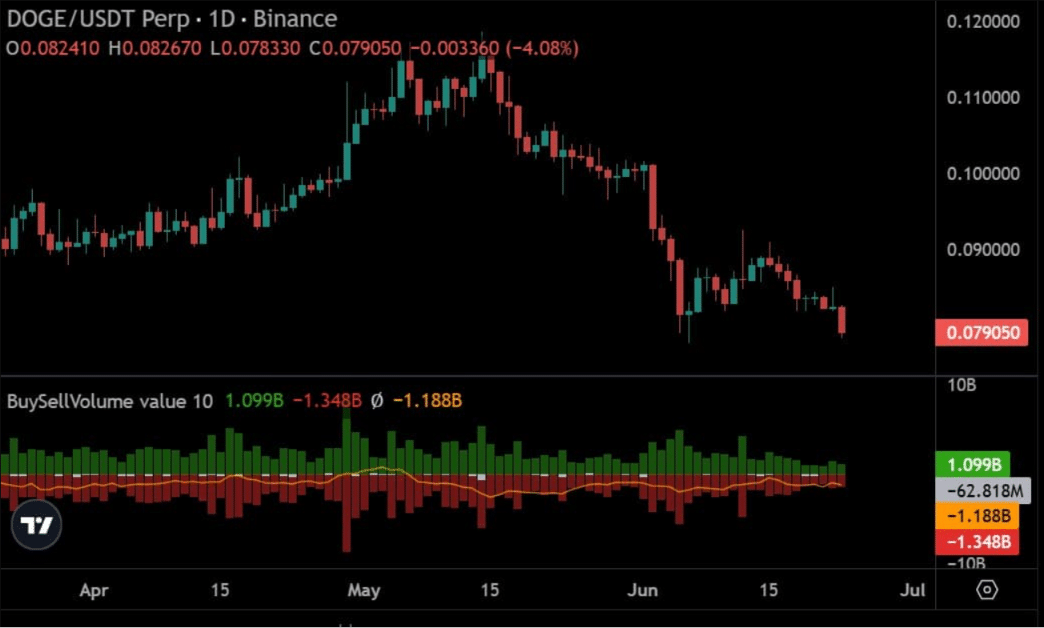
The perpetuals market told a similarly grim tale. Sell volume surged to 1.3 billion while buy volume dropped to 1.1 billion, and net buying turned deeply negative at -1.1 billion. That imbalance between buying and selling activity in perpetual futures suggests aggressive position unwinding rather than normal market rotation.
Dogecoin Futures Netflow Collapsed 459% as Sellers Dominated
Beyond the perpetuals, the futures market showed clear signs of capital flight. Over a 24-hour window, $460 million flowed out of futures contracts against $413 million in inflows, resulting in a futures netflow that collapsed 459% to -$46 million. When futures netflow turns deeply negative at this scale, it reflects institutional and large-scale retail traders moving capital away from the asset, not simply hedging.
This kind of aggressive futures selling has historically preceded extended consolidation or further downside, particularly when it coincides with technical breakdown below key moving averages. Dogecoin currently satisfies both conditions.
RSI at 28 Signals Oversold Territory, But Bears Still Hold Control
The Relative Strength Index (RSI) is one of the most widely used momentum oscillators in technical analysis. It measures the speed and magnitude of recent price changes to determine whether an asset is overbought or oversold on a scale of 0 to 100. Readings below 30 indicate oversold conditions, meaning selling has been extreme relative to recent history.
Dogecoin RSI currently sits at 28, firmly in oversold territory. While oversold readings can sometimes precede short-term bounces, they are not automatic buy signals. In trending markets, RSI can remain oversold for extended periods. Given the broader context of derivatives-driven selling, the 28 reading suggests exhausted buyers rather than an imminent reversal.
Spot Market Activity Offers a Contrarian Signal Worth Watching
Not everything points in the same direction. Spot market behavior has diverged noticeably from derivatives, and that divergence is meaningful. Spot netflow dropped to -$7.7 million, which signals higher outflows from exchanges. In crypto market analysis, coins leaving exchanges generally indicate that holders are moving assets to self-custody rather than preparing to sell, a behavior pattern often associated with a long-term accumulation mindset.
This kind of spot-derivatives divergence is exactly the setup that preceded recoveries in previous Dogecoin cycles. When derivatives sellers exhaust themselves while spot holders refuse to dump, even modest renewed buying interest can spark a meaningful price reversal.
Key Levels Traders Are Watching Now
If bearish conditions in derivatives persist, the next meaningful support for Dogecoin sits around $0.075. That level has historical significance and could attract dip buyers if reached. On the upside, a recovery requires DOGE to first reclaim $0.08 and subsequently post a clean daily close above $0.085 to shift the short-term technical structure back toward neutral.
Conclusion
Dogecoin finds itself at a genuinely pivotal crossroads. The derivatives market is under heavy bearish pressure, liquidations have spooked leveraged traders, and the RSI confirms that selling has been aggressive.
Yet the spot market suggests long-term holders are not panicking, and that distinction matters more than many casual observers realize. Whether DOGE reclaims $0.08 or slides toward $0.075 will likely depend on how quickly derivatives sentiment stabilizes and whether spot buying picks up enough momentum to shift the balance of power.
FAQs
Why did Dogecoin drop below $0.08?
The drop resulted from a combination of broader market weakness, heavy leveraged long liquidations totaling $7.68 million, and aggressive selling in the futures and perpetuals markets.
What does an RSI of 28 mean for Dogecoin?
An RSI below 30 signals oversold conditions, meaning selling pressure has been unusually intense. However, it does not guarantee an immediate price recovery.
What is futures netflow in crypto?
Futures netflow measures the difference between capital flowing into and out of futures contracts. A deeply negative netflow, like the -$46 million seen here, signals that traders are exiting leveraged positions at scale.
What price levels should Dogecoin traders watch?
Key downside support sits at $0.075, while a recovery would require reclaiming $0.08 and closing above $0.085 on the daily chart.
Glossary of Key Terms
Liquidation: The forced closure of a leveraged trading position by an exchange when losses exceed the margin threshold, resulting in automatic selling.
RSI (Relative Strength Index): A momentum indicator ranging from 0 to 100 that identifies overbought conditions above 70 and oversold conditions below 30.
Moving Average (MA): A price average calculated over a specific number of days (such as 9-day or 21-day) used to smooth out price action and identify trend direction.
Perpetual Futures: Derivative contracts with no expiry date that allow traders to speculate on asset prices using leverage, commonly traded on crypto exchanges.
Futures Netflow: The net difference between money entering and leaving futures markets, used to gauge whether institutional and large traders are increasing or reducing exposure.
Spot Netflow: Measures the movement of actual crypto assets onto or off exchanges, used to infer whether holders intend to sell or hold long-term.
Support Level: A price point at which buying interest has historically been strong enough to halt or reverse a downward price move.
Sources