![Sun [New]](https://s2.coinmarketcap.com/static/img/coins/64x64/10529.png)



This article was first published on TurkishNY Radio.
The Delaware Stablecoin Bill has grown one of the most widely studied pieces of US technological asset laws to date, signifying a fundamental shift in how authorities intend to regulate those who issue stablecoins.


As Delaware wants to become a national hub for sustainable crypto technologies, the Delaware Stablecoin Bill proposes strict reserve limitations, license requirements, and user safeguards. Government officials, industry professionals, and digital asset businesses are all looking at this law as a potential blueprint for future cross-border rules.
A State Framework Built for Stability
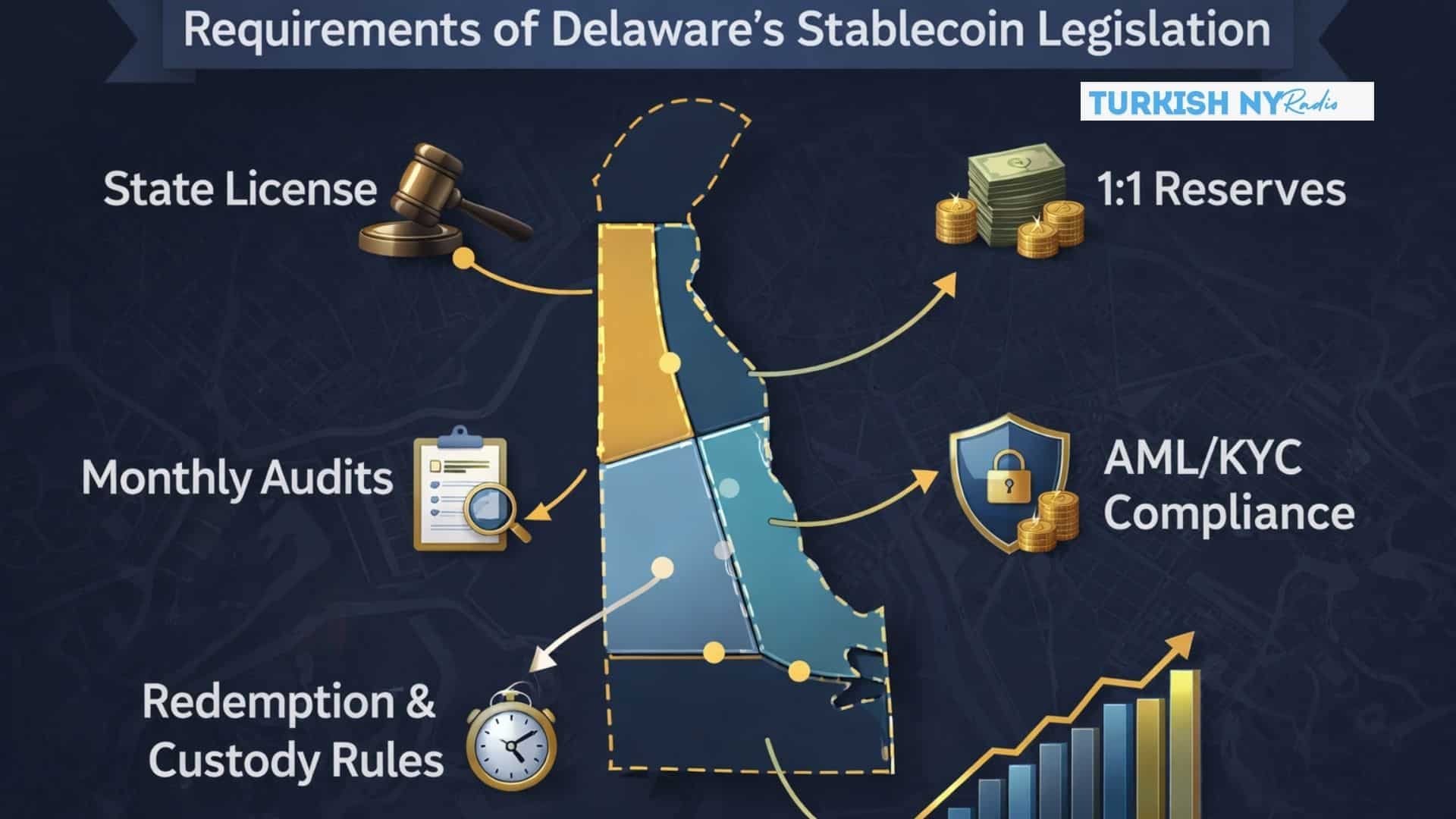
The Delaware Stablecoin Bill proposes a licensing structure under the Office of the State Bank Commissioner, requiring any stablecoin issuer operating in the state to hold a specialized license. This includes meeting rigorous standards for liquidity, transparency, and reserve management.
According to legislators, the bill sets “a clear pathway for responsible growth in digital finance,” emphasizing that companies must prove they can safely manage customer funds.
Under the rules, approved issuers must maintain a 1:1 reserve backing, meaning every token must be supported by an equivalent amount of cash or secure liquid assets. This measure intends to prevent collapses seen in previous years when unstable reserve portfolios triggered market-wide disruptions.

Transparency, Reporting, and Accountability
A major component of the Delaware Stablecoin Bill is the requirement for monthly reserve reporting, which obligates issuers to provide recurring proof of full backing. These reports will be subject to regulatory review, strengthening oversight and giving consumers more confidence in stablecoin systems.
One financial analyst commented,
“This level of mandated transparency could set a national standard. If a state like Delaware implements it successfully, others may follow.”
The introduction of these uniform reporting obligations is widely seen as an attempt to build trust in stablecoins at a time when regulatory scrutiny is at an all-time high.
Protecting Consumers Through Stronger Compliance
The Delaware Stablecoin Bill does not stop at reserves and reporting. It also mandates strict AML and KYC compliance, standards long applied to banks and financial service providers.
By requiring stablecoin issuers to deploy customer verification tools, Delaware aims to reduce exposure to money laundering and fraud.
Legal experts suggest that the Delaware Stablecoin Bill could serve as a “middle ground” between innovation and enforcement, creating an environment where firms can experiment while still remaining accountable.
Industry Reactions and National Implications
Crypto sector leaders have voiced moderate optimism. Some organizations see the Delaware Stablecoin Bill as a chance to develop confidence with authorities and customers, but others worry that the regulatory cost may stymie smaller ventures.
A leading blockchain researcher noted,


“If Delaware’s model gains acceptance, it could influence federal policymaking and reshape the stablecoin economy.”
Although the national framework still developing, states such as Delaware have pitched in to create the legislative framework.
Conclusion
The Delaware Stablecoin Bill is an important achievement toward integrating traditional financial regulation with the rapidly increasing world of digital assets. Delaware is distinguishing itself as a governmental pathfinder by putting customer protection, transparency, and responsible innovation first. Whether other states follow suit continues to be determined, but the Delaware Stablecoin Bill has definitely established a new standard for stablecoin administration in the United States.
Summary
The Delaware Stablecoin Bill establishes a complete the regulatory structure for stablecoin investors, including bringing state-level regulation to bear. It necessitates 1:1 reserve backing, regular financial reporting, strict AML/KYC procedures, and required license by the state financial commissioner. Supporters claim that the measure improves customer security and open communication, while others fear that its rigid requirements would impede innovation. As federal laws remain ambiguous, Delaware’s strategy might serve as a model for the US digital asset business.
Glossary of Key Terms
Stablecoin: A cryptocurrency linked to a stable reserve, such as US dollars or securities issued by the Treasury
1:1 Reserve Backing: Each of the tokens must be linked with a complementary physical resource.
AML (Anti-Money Laundering): Legislation that prohibit the use of money transfer systems for criminal purposes.
KYC (Know Your client): Authentication standards that require firms to validate client identities.
Issuer License: A legal authority for a corporation to issue stablecoins inside a certain territory.
FAQs for Delaware Stablecoin Bill
1. What, if any, is the Delaware Stablecoin Bill?
It is a state law that aims to supervise stablecoin issuers including authentication, reserve guidelines, and compliance criteria.
2. For what reason is the measure requiring 1:1 reserves?
In order to guarantee that each generated token is properly backed and redeemable for its corresponding value.
3.Who manages the license administration process?
Delaware’s Office of the Commonwealth’s Bank Superintendent.
4.Will the bill effect all bitcoin organizations?
No, it is which was mainly aimed for stablecoin issuers and firms that manage stablecoin deposits.
5.Does this law have the potential to impact government regulations?
Yes. Researchers believe Delaware’s model might influence future national laws on electronic property legislation.