The expansion of Decentralized Finance has literally turned the heads of not only crypto enthusiasts but also blockchain developers and financial analysts. The more the sector develops, the clearer the difference between opportunity and risk becomes.
On one hand, yield-earning, tokenized assets, and new credit markets promise fresh financial models. On the flip side, the shortcomings of smart contracts, governmental lack of clarity, and liquidity risk are amongst the points that serious caution must be applied to.


It points out the most important signs for 2025 and thus helps readers to comprehend the advantages and the DeFi risks.
Why Decentralized Finance Still Matters in 2025
Decentralized Finance, just like the financial market, continues to bring in money and new ideas regardless of the ups and downs in value. A new study forecasts that the worldwide DeFi sector will have a compound annual growth rate of 43% until 2029. Protocols are now integrating real-world assets, cross-chain mechanics, and modular features.
Analysts at StartUs Insights highlight a shift from speculative token models to utility- and revenue-based systems. Students, developers, and analysts are actually experiencing a shift in the story. Decentralized Finance (DeFi) is not solely a domain of high returns; it is more and more about robustness, creativity, and connection to the real world.
Where the Rewards Are and Why They Work
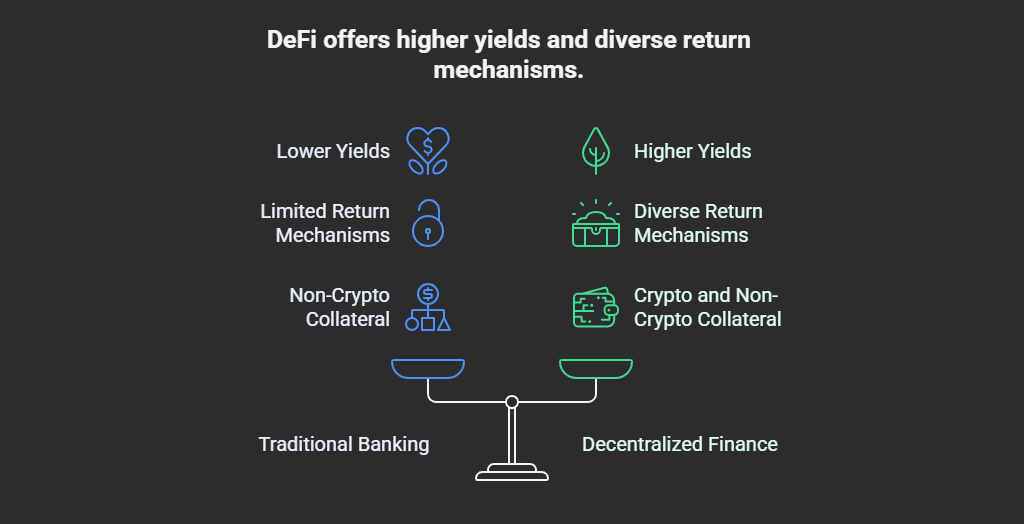
A significant attraction of Decentralized Finance is the opportunity to earn returns through mechanisms that traditional banking cannot match. Lending and staking protocols now offer yields often higher than conventional savings accounts. On-chain yield aggregator data shows hundreds of vaults operating across Ethereum, Base, Arbitrum, and Optimism.
The era of token-incentive-driven yields is also evolving into one of fee-based and revenue-based returns. Reports show that supply-side fees in DeFi surpassed token rewards in early 2025 ($13.99 billion vs. $13.53 billion), signaling the model’s maturity.
Tokenized real-world assets (RWAs) are further reshaping how yield is generated. Stablecoins, tokenized bonds, and treasury-backed assets are now part of DeFi strategies that allow exposure to both crypto and non-crypto collateral.
Stablecoin yield guides for 2025 indicate that strategies mixing stable assets with on-chain protocols offer more predictable, though still risky, outcomes.
For financial students and analysts, the key takeaway is this: the question is no longer “can you earn yield?” but “what kind of yield, from what source, and at what DeFi risks?”
Major Risk Factors and What to Watch Closely
The DeFi drawbacks are as significant as the rewards and therefore, the talk in 2025 is firmly centered on three main categories.
Smart Contract and Technical Vulnerabilities
At the heart of Decentralized Finance is code that runs without intermediaries. That code, however, can contain bugs, design flaws, and attack vectors. As one analysis warns, “Smart contract risk can lead to theft or loss of funds due to coding imperfections”.
In 2025, governance attacks, Blockchain Extractable Value (BEV) exploits, and oracle failures are among the most frequent technical DeFi risks. A recent study found BEV-related activities caused losses of roughly $540 million over 32 months through sandwich attacks and replay mechanisms.
Developers and analysts are now prioritizing audit quality, formal verification, oracle reliability, and governance systems. Confidence depends not only on yields but also on the strength of the underlying architecture.
Market and Liquidity Risk
Liquidity is still the blood that fuels Decentralized Finance and at the same time a possible danger to it. Many protocols rely on assumptions about collateral Value, user behavior, and market stability.
A sudden decline in collateral Value or rapid withdrawal of funds can trigger cascading liquidations. Several platforms saw Total Value Locked (TVL) declines in Q1 2025 amid macroeconomic uncertainty.
Yield opportunities that depend solely on token incentives can also collapse if the reward structure fails.
Regulatory and Governance Risk
Globally, regulation remains inconsistent. The Financial Stability Board (FSB) warned in October 2025 that “significant gaps” in crypto regulation could threaten financial stability.
Governance poses another critical challenge. Many protocols rely on token-holder voting systems that are vulnerable to low participation or manipulation. A thoroughly documented case caused a lending platform to suffer a loss of $17 million as a result of a malicious governance proposal.
Researchers and developers regard compliance, governance design, and legal clarity as equally important as code security. The absence of these factors can lead even the best-performing platforms to fall because of regulatory or governance failures.
Evaluating Key Indicators in DeFi
Serious analysts assess Decentralized Finance through measurable data rather than market hype. Several indicators matter most in 2025.
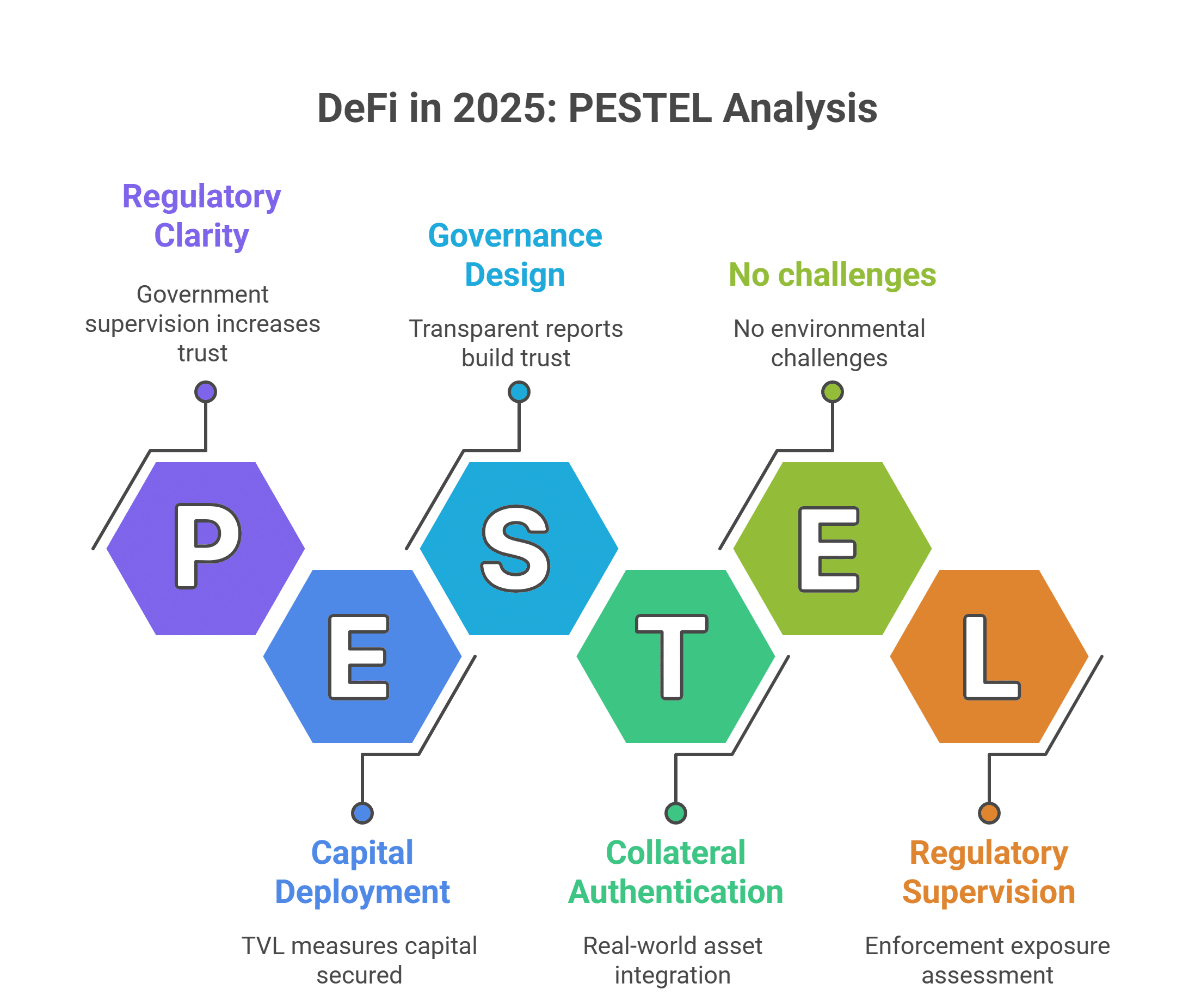
Total Value Locked (TVL) measures the amount of capital secured by a protocol. However, high TVL does not guarantee safety. Analysts recommend examining capital deployment, collateral quality, and the potential effects of leverage.
Yield Source Breakdown helps differentiate returns generated by protocol activity from those from token emissions. The move toward “real yield” has become a defining characteristic of sustainable DeFi models.
Security Audit and Governance Design are now standard evaluation factors. The maturity of an organization can be indicated by the use of continuous auditing, transparent reports, and resilient governance.
Authentication of Collateral and Asset Quality should be done too. The integration of real-world assets brings along custodial and legal DeFi risks, while the use of crypto collateral exposes the assets to volatility and liquidation risks.
The third factor is the Regulatory and Jurisdictional Clarity, which establishes the degree of the exposure of a protocol to the changing laws and enforcement. Robust regulatory supervision by governments has increased trust with the help of regulatory transparency as a significant sign.
Case Study: Yield Shift in 2025
At the start of 2025, the data indicated that the fee-related rewards were greater than the token emissions for the first time, thus marking the beginning of the trend towards sustainability in Decentralized Finance. Hefty users relying on token issuance are now being subjected to DeFi risks that have escalated if user growth slows down or if token prices drop.
On the other hand, protocols that generate their revenue from actual activities, for instance, trading fees, lending or staking, can withstand the adverse conditions better.
Stablecoin-based strategies, which were previously regarded as extremely safe, are now being questioned. In 2025, there were yields of up to 15% being offered on Ethereum and Optimism chains, among others, but still, there were risks coming from the protocol design and dependency on the issuers.
What This Means for Developers and Analysts
For both builders and analysts, the key to success in Decentralized Finance is to find a proper mix of innovation and safety. In this way, the developers will be needed to come up with trustworthy governance systems, dependable oracles, and upgrade paths that can be easily modified. Analysts and financial students should look beyond APYs and examine the structures that underpin them.
A DeFi app flashing an 80% APY while being entirely dependent on token emission is not as good, in terms of stability, as an app with its 10% yield coming from real activity and certified code. Sturdy expansion is a result of comprehending the risk-reward ratio and dealing with it very accurately.
A Balanced Perspective on DeFi in 2025
Think of DeFi as a dynamic engine rather than a guaranteed income stream. The opportunity is genuine but, at the same time, the risks are also very real. Responsible participation means spreading out investments, monitoring indicators, and being prepared for a change in either policy or market trends.


As we move toward 2025, the story is changing from “become rich overnight” to “earn through intelligence.” A long-lasting participation entails a thorough knowledge of the DeFi risks and the ways to counteract them.
Conclusion: Clear Eyes, Smart Strategy
Decentralized Finance offers meaningful opportunities for those who understand both its structure and its uncertainty. The investments, consisting of yield, innovation, and global accessibility, are pretty considerable. Nevertheless, the risks associated with DeFi are still around and they include technical vulnerabilities, liquidity crises as well as regulatory changes.
The most enlightened investors, analysts, and developers view DeFi as a developing ecosystem, not a sure way to profit. In the year 2025, the victory in DeFi will be less dependent on the excitement surrounding the field and more on characteristics such as resilience, transparency, and discipline.
The ones that put emphasis on sustainable design and risk consciousness are the most probable to determine the next chapter of DeFi.
Disclaimer: This article is for informational purposes only and does not constitute financial advice. Readers should conduct their own research before making any investment decisions.
About DeFi
Decentralized Finance, commonly referred to as DeFi, encompasses the area of cryptocurrencies that allows individuals to access financial services like lending, borrowing, and earning interest without the intervention of banks. In 2025, DeFi is going to be smarter and stable as it has already gone through a transition from hype-driven projects to systems of real value and utility. DeFi is the future of online finance as it empowers users with more control, transparency, and global access than ever before.
Glossary
- APY (Annual Percentage Yield): The real rate of return on an investment taking into account the effect of compounding interest.
- BEV (Blockchain Extractable Value): Revenues realized by miners or validators based on transaction manipulation (e.g., changing order, inserting or censoring).
- Composable: The characteristic of one DeFi protocol that allows it to connect without any problems with other protocols, thereby opening up the possibility for complex strategies to be implemented.
- Governance Token: A type of token that provides its holders with the power to vote or take part in the decision-making process related to the protocol.
- Liquid Staking Derivative (LSD): A digital currency that signifies the ownership of staking assets and can continue earning the rewards of staking while being used in another transaction.
- Oracle: A platform that supplies the smart contracts with outside data, one example would be price feeds.
- Real-World Asset (RWA): A non-crypto asset like bonds, real estate, or commodities, which is represented in a tokenized way.
- Token Incentive Model: A return model that rewards users with native tokens instead of the revenue-generated returns.
- Total Value Locked (TVL): The summed-up value of all assets in a DeFi protocol which is ‘locked’, and is a major indicator of liquidity and usage.
- Yield Farming: The strategy of shifting assets from one protocol to another in order to receive the highest possible interest.
FAQs About Decentralized Finance
Q1: Is DeFi still profitable in 2025?
Yes, but profitability depends on yield source, risk management, and protocol quality. Sustainable revenue-based models are increasingly preferred over pure token-issuance models.
Q2: What is the safest type of yield in DeFi?
There is no “safe” yield. To be on the safe side, yields supported by the received fees or interest on audited protocols with good governance still bear less risk than the high-APY token-emission model.
Q3: What impact do regulatory alterations have on DeFi?
Regulatory changes can affect user access, protocol compliance, token listings, and cross-border transactions. Protocols may face higher costs, stricter audits or loss of yield model flexibility.
Q4: What should developers focus on in 2025?
Security architecture (oracles, audits, governance), modular design for composability, and integration of real-world assets are key areas for building durable DeFi projects.