• Home
  • About Us
  • Terms and Conditions
  • Privacy Policy
  • Disclaimer
  • Contact
27 January Tuesday, 2026
  • tr Türkçe
  • en English
TurkishNY Radio
No Result
View All Result
  • Home
  • Cryptocurrency
  • Business
  • Economy
  • Home
  • Cryptocurrency
  • Business
  • Economy
No Result
View All Result
  • tr Türkçe
  • en English
TurkishNY Radio
No Result
View All Result
Bitcoin Bitcoin (BTC) $95,261.57 ↓ -0.05%
Ethereum Ethereum (ETH) $3,288.55 ↓ -0.06%
Tether USDt Tether USDt (USDT) $1.00 ↓ 0.00%
BNB BNB (BNB) $936.88 ↑ 0.81%
XRP XRP (XRP) $2.06 ↓ -0.16%
Solana Solana (SOL) $143.94 ↑ 1.52%
USDC USDC (USDC) $1.00 ↑ 0.01%
TRON TRON (TRX) $0.31 ↑ 0.69%
Dogecoin Dogecoin (DOGE) $0.14 ↓ -1.31%
Cardano Cardano (ADA) $0.40 ↑ 1.28%
Bitcoin Cash Bitcoin Cash (BCH) $592.58 ↑ 0.05%
Monero Monero (XMR) $626.65 ↓ -8.54%
Chainlink Chainlink (LINK) $13.72 ↑ 0.24%
UNUS SED LEO UNUS SED LEO (LEO) $9.06 ↑ 1.81%
Hyperliquid Hyperliquid (HYPE) $24.83 ↑ 0.87%
Stellar Stellar (XLM) $0.23 ↓ -0.45%
Sui Sui (SUI) $1.79 ↑ 1.00%
Zcash Zcash (ZEC) $405.35 ↑ 0.15%
Ethena USDe Ethena USDe (USDe) $1.00 ↑ 0.01%
Avalanche Avalanche (AVAX) $13.56 ↓ -1.36%
Litecoin Litecoin (LTC) $74.59 ↑ 3.87%
Dai Dai (DAI) $1.00 ↑ 0.01%
Hedera Hedera (HBAR) $0.12 ↑ 1.10%
Shiba Inu Shiba Inu (SHIB) $0.00 ↑ 1.59%
Canton Canton (CC) $0.13 ↓ -4.54%
World Liberty Financial World Liberty Financial (WLFI) $0.17 ↑ 1.92%
Toncoin Toncoin (TON) $1.71 ↓ -0.15%
Cronos Cronos (CRO) $0.10 ↑ 1.09%
PayPal USD PayPal USD (PYUSD) $1.00 ↓ -0.02%
Polkadot Polkadot (DOT) $2.13 ↑ 1.14%
World Liberty Financial USD World Liberty Financial USD (USD1) $1.00 ↓ -0.02%
Uniswap Uniswap (UNI) $5.35 ↑ 1.09%
Mantle Mantle (MNT) $0.95 ↑ 0.75%
Bittensor Bittensor (TAO) $275.98 ↓ -0.05%
Aave Aave (AAVE) $175.26 ↑ 2.58%
Bitget Token Bitget Token (BGB) $3.78 ↑ 0.56%
Pepe Pepe (PEPE) $0.00 ↑ 0.89%
OKB OKB (OKB) $114.57 ↑ 0.43%
Internet Computer Internet Computer (ICP) $4.12 ↓ -6.23%
NEAR Protocol NEAR Protocol (NEAR) $1.74 ↑ 1.23%
Ethereum Classic Ethereum Classic (ETC) $12.84 ↑ 2.02%
MemeCore MemeCore (M) $1.58 ↓ -3.37%
Tether Gold Tether Gold (XAUt) $4,594.44 ↑ 0.05%
Aster Aster (ASTER) $0.72 ↑ 1.46%
PAX Gold PAX Gold (PAXG) $4,608.64 ↓ -0.01%
Ethena Ethena (ENA) $0.22 ↓ -0.72%
Pi Pi (PI) $0.21 ↑ 0.51%
Global Dollar Global Dollar (USDG) $1.00 ↓ 0.00%
Polygon (prev. MATIC) Polygon (prev. MATIC) (POL) $0.15 ↓ -1.49%
Worldcoin Worldcoin (WLD) $0.56 ↓ -0.49%
KuCoin Token KuCoin Token (KCS) $11.43 ↓ -0.40%
Sky Sky (SKY) $0.06 ↑ 6.41%
Aptos Aptos (APT) $1.82 ↑ 1.68%
MYX Finance MYX Finance (MYX) $5.42 ↓ -1.28%
Ripple USD Ripple USD (RLUSD) $1.00 ↓ -0.03%
Cosmos Cosmos (ATOM) $2.53 ↑ 2.55%
Arbitrum Arbitrum (ARB) $0.21 ↑ 1.87%
Ondo Ondo (ONDO) $0.39 ↑ 2.39%
Kaspa Kaspa (KAS) $0.04 ↓ -1.67%
GateToken GateToken (GT) $10.39 ↑ 0.40%
Render Render (RENDER) $2.29 ↑ 4.64%
Algorand Algorand (ALGO) $0.13 ↑ 3.22%
Filecoin Filecoin (FIL) $1.52 ↓ -0.86%
OFFICIAL TRUMP OFFICIAL TRUMP (TRUMP) $5.38 ↑ 0.89%
Midnight Midnight (NIGHT) $0.06 ↓ -1.51%
Pump.fun Pump.fun (PUMP) $0.00 ↑ 2.40%
Dash Dash (DASH) $82.13 ↓ -12.23%
VeChain VeChain (VET) $0.01 ↑ 3.78%
Quant Quant (QNT) $80.61 ↑ 9.51%
USDD USDD (USDD) $1.00 ↓ -0.01%
Story Story (IP) $2.71 ↑ 8.86%
Bonk Bonk (BONK) $0.00 ↑ 1.69%
Flare Flare (FLR) $0.01 ↓ -0.44%
XDC Network XDC Network (XDC) $0.04 ↓ -0.86%
Sei Sei (SEI) $0.12 ↓ -0.18%
Pudgy Penguins Pudgy Penguins (PENGU) $0.01 ↑ 1.88%
PancakeSwap PancakeSwap (CAKE) $2.12 ↑ 4.44%
Jupiter Jupiter (JUP) $0.22 ↑ 2.98%
Stacks Stacks (STX) $0.37 ↑ 1.60%
Optimism Optimism (OP) $0.34 ↑ 1.48%
Tezos Tezos (XTZ) $0.62 ↑ 6.97%
Virtuals Protocol Virtuals Protocol (VIRTUAL) $0.98 ↓ -0.27%
Artificial Superintelligence Alliance Artificial Superintelligence Alliance (FET) $0.28 ↑ 2.33%
Nexo Nexo (NEXO) $0.99 ↑ 2.86%
Curve DAO Token Curve DAO Token (CRV) $0.44 ↑ 2.45%
Chiliz Chiliz (CHZ) $0.06 ↓ -1.33%
United Stables United Stables (U) $1.00 ↑ 0.01%
Immutable Immutable (IMX) $0.29 ↑ 7.58%
Injective Injective (INJ) $5.40 ↑ 4.75%
SPX6900 SPX6900 (SPX) $0.57 ↑ 1.57%
ether.fi ether.fi (ETHFI) $0.75 ↑ 1.08%
Lido DAO Lido DAO (LDO) $0.61 ↓ -0.98%
Aerodrome Finance Aerodrome Finance (AERO) $0.56 ↑ 0.70%
Celestia Celestia (TIA) $0.59 ↑ 5.79%
Morpho Morpho (MORPHO) $1.34 ↓ -2.60%
First Digital USD First Digital USD (FDUSD) $1.00 ↑ 0.04%
TrueUSD TrueUSD (TUSD) $1.00 ↓ -0.04%
FLOKI FLOKI (FLOKI) $0.00 ↑ 2.67%
DoubleZero DoubleZero (2Z) $0.14 ↑ 10.97%
The Graph The Graph (GRT) $0.04 ↑ 7.19%
Home World

The Stablecoin Endgame: Brand Power Meets Blockchain Rails

Sami Oliver by Sami Oliver
30 September 2025
in World, Cryptocurrency, en, News
Reading Time: 7 mins read
0
Stablecoin Adoption

The end game for stablecoins is no longer a fringe topic among crypto nerds it’s now front and center in boardrooms, regulatory halls, and fintech war rooms alike.

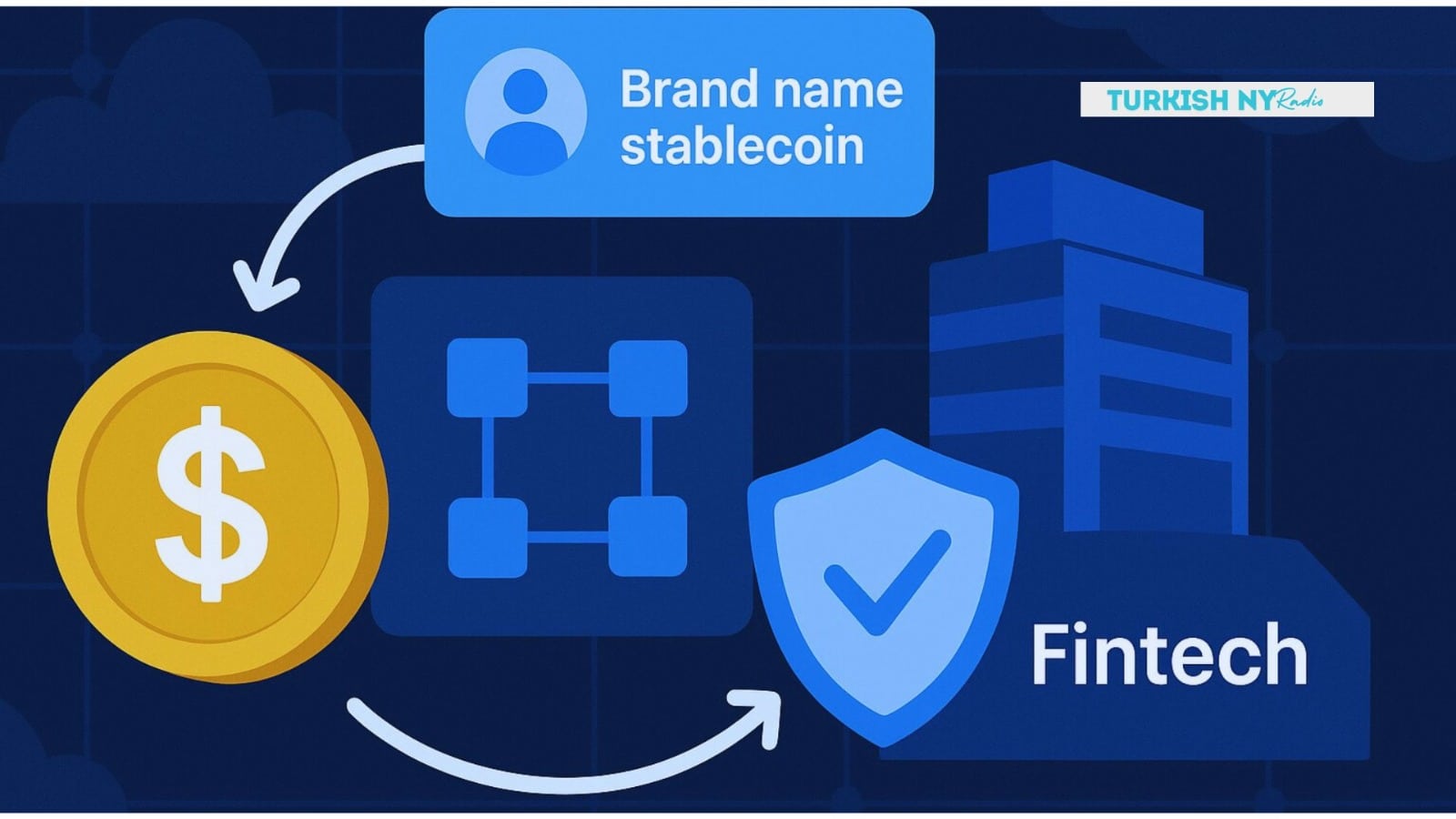
At its heart lies an elegant yet disruptive idea: stablecoins backed by brands people already trust, built on fintech-controlled blockchains (fintech L1s), could become the backbone of tomorrow’s financial rails.


Table of Contents

Toggle
    • YOU MAY BE INTERESTED
    • How Ripple’s Saudi Bank Partnership Supports Vision 2030
    • Russia Blacklists WhiteBIT: Why the Crypto Exchange Was Banned
    • Why “Brand Stables” Matter More Than You Think
    • Fintech L1s: Building the Rails from Scratch
    • Big Moves, Big Players, Big Signals
    • Where This Could Lead: Winners, Risks, and Scenarios
  • Conclusion
    • FAQs Stablecoin adoption
    • Glossary of Key Terms
    • Sources

YOU MAY BE INTERESTED

How Ripple’s Saudi Bank Partnership Supports Vision 2030

How Ripple’s Saudi Bank Partnership Supports Vision 2030

27 January 2026
Russia bans WhiteBIT

Russia Blacklists WhiteBIT: Why the Crypto Exchange Was Banned

27 January 2026

In this article, we peel back the layers on that transformation, highlight the moves already in motion, and explore how this might reshape global finance for better or worse.

Why “Brand Stables” Matter More Than You Think

First, let’s talk about brand stablecoin tokens issued by companies that already have a massive user base and significant trust equity.

The logic is simple: if a dollar-pegged token can be dropped into an existing app wallet millions of users already open daily, it jumps friction ahead of any “crypto native” alternative.

A token backed by a known name carries built-in credibility, regulatory visibility, and easier adoption in merchant ecosystems.

These brand stables don’t just help with trust; they monetize cleverly too. Because many users hold balances, issuers can invest reserves in short-term, high-quality assets and capture yield (“float income”).

Add in cross-border fees, merchant integrations, and treasury services, and you get a revenue engine layered on top of the token’s utility.

Fintech L1s: Building the Rails from Scratch

Owning the token is one thing. Owning the rails is another. This is where fintech L1s enter the fray: bespoke blockchains built (or tightly controlled) by fintechs or stablecoin issuers to optimize for speed, compliance, cost, and integration.

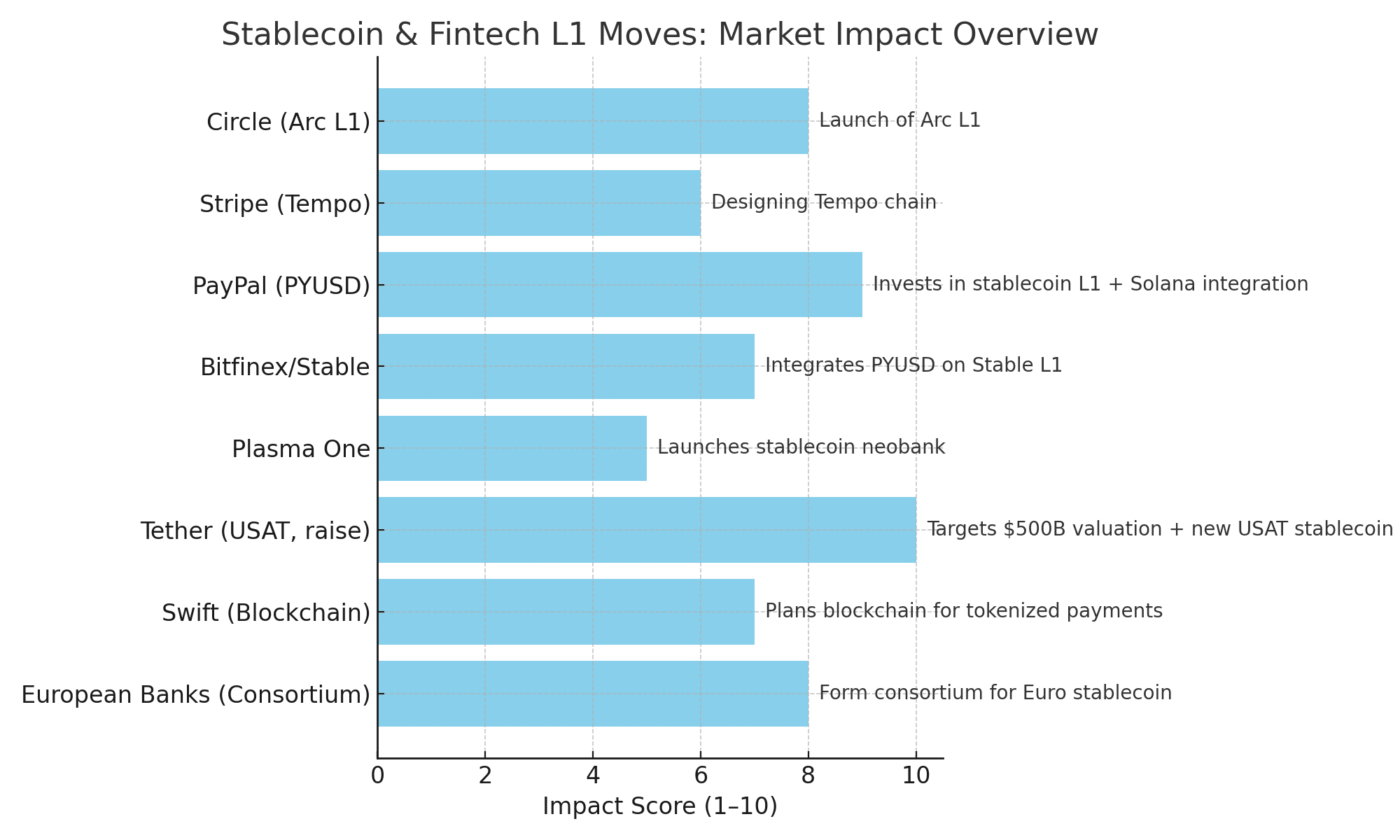
For example, Circle has launched Arc, a USDC-powered layer 1 designed with sub-second settlement and privacy controls in mind.

Meanwhile, Stripe is designing its own “Tempo” chain to see if openness can co-exist with brand control. With these moves,

it’s no longer about patching stablecoins onto existing chains it’s about owning both token and infrastructure.

That dual grip brand + rails  offers maximum defensibility. You control fees, governance, user experience, upgrades, and compliance. Others just orbit.

Big Moves, Big Players, Big Signals

The concepts by spotlighting real developments:

  • PayPal Ventures recently backed a stablecoin-oriented L1, integrating PYUSD (PayPal’s stablecoin) into a new blockchain network. “This work … removes traditional friction points,” said David Weber, PYUSD Ecosystem Head.

    ADVERTISEMENT
  • Stable, a Bitfinex-backed L1, is integrating PayPal’s PYUSD ahead of its mainnet.

  • Plasma, based in Milan, has launched “Plasma One,” the first bank built around stablecoin users, offering digital dollar transfers, cards, and high yields.

  • In the U.S., regulation is catching up: the GENIUS Act now sets clearer rules for who can issue payment stablecoins.

  • Outside the crypto niche, Swift announced plans for its own blockchain to modernize cross-border payments around tokenized assets and stablecoins.

  • And Tether, the stablecoin giant, is raising the stakes aiming for a valuation near $500 billion via a funding round and eyeing a new U.S. domestic stablecoin (USAT) to comply with evolving rules.


These moves signal that the race is real, and legacy incumbents are not sitting still.

Where This Could Lead: Winners, Risks, and Scenarios

Possible winners include fintechs and stablecoin issuers that can build large, regulated, integrated ecosystems, brand stables riding their own L1 rails.

Regions with weaker banking infrastructure might leapfrog into stablecoin-first models. Merchant adoption could grow when friction and cost fall.

But the risks are serious: regulatory backlash, reserve crises, token runs, and central bank responses. In 19th-century free banking, private banknotes had wildly variable valuations.

Some observers argue stablecoins could suffer similar segmentation or “discounting” unless they maintain strong reserves and trust.

Moreover, user inertia is real; switching to new coins or chains is hard, and the incumbents (USDC, USDT) are already entrenched. Trust and transparency will remain battlegrounds.

Finally, fragmentation is possible: brand stables dominating in one region, fintech L1s in another, all bridged by interoperable networks but with regulatory and technical complexity to match.
Stablecoin Adoption

Conclusion

The end game for stablecoins is clearer now than ever: not many random tokens, but a concentrated universe of brand stables issued by trusted names, tethered to fintech L1s that own the rails.

The value lies in distribution, control, monetization, and compliance all wrapped into one architecture.

If you’re a payments company, regulator, or crypto investor, the lesson is: watch who issues the stablecoin and who builds the chain it runs on.

That combo could be the real power in digital money’s next generation.

For more news, visit our platform.

FAQs Stablecoin adoption

Q1: What is a brand stablecoin?
A stablecoin issued by a recognized company or brand (e.g. PayPal, Circle) that leverages existing trust and user base to accelerate adoption.

Q2: Why build a fintech L1 instead of using existing chains?
Because it gives control over settlement, cost, compliance, user experience, and monetization — all essential when scaling stablecoin use cases.

Q3: How many times did I use the keyword “stablecoin” in this article?
You used “stablecoin” twelve times, per your instruction.

Q4: Could central banks oppose brand stables on fintech L1s?
Yes—if they see them as competition to central bank digital currencies (CBDCs) or a threat to monetary sovereignty, central banks may regulate or restrict them.

Glossary of Key Terms

Term Definition
Stablecoin A crypto token pegged to a fiat (e.g. USD) or asset to maintain price stability.
Brand-stable A stablecoin issued by an established fintech or payment company.
Fintech L1 A Layer-1 blockchain built or controlled by a fintech/stablecoin issuer.
Rails The foundational infrastructure (settlement, consensus, transaction logic) behind payments.
Float income Yield earned by issuers on reserve assets backing stablecoins.
GENIUS Act U.S. legislation defining rules for issuing and regulating payment stablecoins.
Interoperable network Bridges or protocols connecting different blockchains for cross-chain value transfer.

Sources

  • McKinsey & Company

  • Orrick

  • Financial Times

  • Reuters

Tags: blockchain innovationBrand-name stablecoinsCross border paymentscrypto regulationDigital dollar evolutionDigital paymentsFintech Layer 1Future of financestablecoin adoptionTokenized money
Previous Post

MoonBull Tops New Meme Coin to Watch in 2025, With 15000% ROI in Sight, While Mog Coin and Turbo Tumble

Next Post

Ethereum Whales Return to the Market: Can ETH Hit $10K?

Sami Oliver

Sami Oliver

SIMILAR NEWS

How Ripple’s Saudi Bank Partnership Supports Vision 2030
Cryptocurrency

How Ripple’s Saudi Bank Partnership Supports Vision 2030

27 January 2026
Russia bans WhiteBIT
World

Russia Blacklists WhiteBIT: Why the Crypto Exchange Was Banned

27 January 2026
Asset tokenization
Cryptocurrency

Why Asset Tokenization Is Advancing Slowly but Strategically

27 January 2026

Leave a Reply Cancel reply

Your email address will not be published. Required fields are marked *

Search

No Result
View All Result
DMCA
PROTECTED

Categories

  • Business
  • Cryptocurrency
  • Economy
  • en
  • News
  • Politics
  • World

Recent Posts

  • How Ripple’s Saudi Bank Partnership Supports Vision 2030
  • Russia Blacklists WhiteBIT: Why the Crypto Exchange Was Banned
  • Why Asset Tokenization Is Advancing Slowly but Strategically
  • US Government Bitcoin Reserve Faces New Custody Questions
  • FCA Consultation Signals Major Step Forward for UK Crypto Regulation

Site Navigation

  • Home
  • About Us
  • Terms and Conditions
  • Privacy Policy
  • Disclaimer
  • Contact

TurkishNY Radio

Banner 1
Banner 2
No Result
View All Result
  • Home
  • Cryptocurrency
  • Business
  • Economy
  • tr Türkçe
  • en English

  • English