![Sun [New]](https://s2.coinmarketcap.com/static/img/coins/64x64/10529.png)

![BitTorrent [New]](https://s2.coinmarketcap.com/static/img/coins/64x64/16086.png)

This article was first published on TurkishNY Radio.
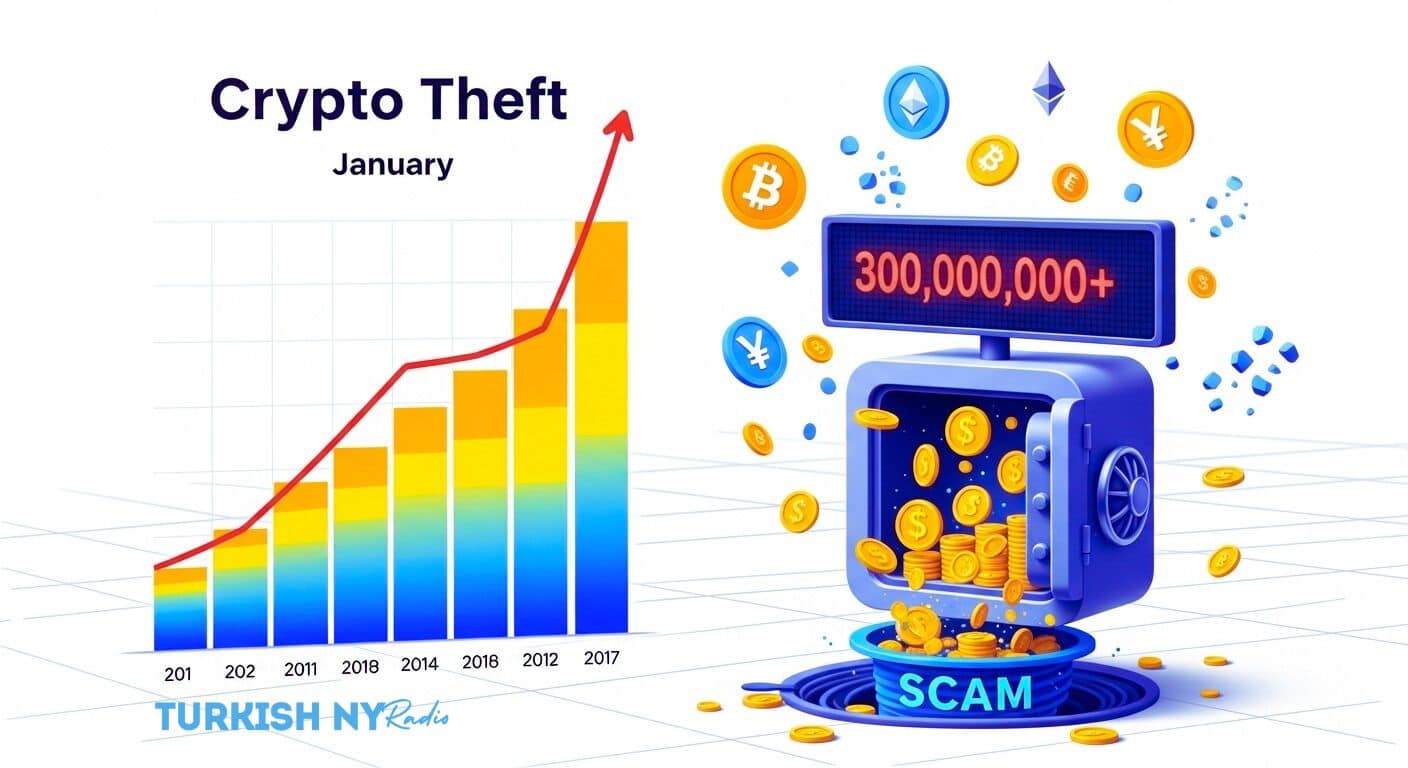
Cryptocurrency losses surged in January, with stolen digital assets totaling $370.3 million, marking one of the worst months for crypto-related crime in nearly a year.


The figures were published by CertiK, which tracks on-chain exploits, scams, and security incidents across major blockchain networks.
The January total represents a near fourfold increase compared with the same month last year, when losses stood at roughly $98 million.
It also reflects a 214% rise from December, during which attackers stole $117.8 million worth of crypto. CertiK recorded 40 separate incidents over the month, making January the costliest period since February 2025.
Crypto Theft January Driven by One Massive Phishing Attack
CertiK’s data shows that a single social engineering attack was responsible for the bulk of January’s losses.
One victim lost approximately $284 million after falling prey to a phishing scheme designed to manipulate wallet access rather than exploit a technical vulnerability.
The firm confirmed that phishing scams alone accounted for $311.3 million of the total funds stolen in January. This continues a growing pattern in which attackers increasingly focus on users instead of smart contracts.


CertiK stated that “phishing remained the dominant attack vector,” highlighting how criminals are shifting away from complex exploits toward tactics that rely on deception, impersonation, and fraudulent transaction approvals.
January Losses Stand Out Despite Earlier Mega Hacks
While January’s theft total is severe, it remains below the exceptional losses seen in February 2025, when attackers stole an estimated $1.5 billion in a single month.
CertiK attributed most of those losses to the $1.4 billion breach of Bybit, which remains one of the largest exchange hacks ever recorded.
Still, January’s data shows that large-scale losses persist even as exchanges and protocols expand security audits and monitoring tools.
DeFi Attacks Continue Despite Fewer Total Hacks
Additional blockchain security insights were provided by PeckShield, which tracked major decentralized finance incidents during January.
The largest protocol-related breach involved Step Finance, where attackers compromised treasury wallets and drained $28.9 million worth of assets. The incident resulted in the loss of more than 261,000 SOL tokens.
Another major exploit affected the Truebit on January 8. A smart contract flaw allowed an attacker to mint tokens at minimal cost, leading to $26.4 million in losses and a sharp drop in the TRU token’s market price.
PeckShield also reported attacks on SwapNet and the Saga, with combined losses exceeding $20 million.
Overall, PeckShield recorded 16 hacking incidents totaling $86.01 million. While this figure represents a slight decrease compared with the same period last year, it shows a clear increase from December.

Security Firms Warn That Users Remain the Weakest Link
January’s data highlights a broader shift in crypto crime. As smart contract security improves, attackers are increasingly targeting individuals rather than infrastructure. Wallet approvals, phishing links, and fake interfaces now pose greater risks than protocol flaws.
Security firms continue to stress that user education, transaction verification, and wallet security practices are essential to reducing losses. CertiK has repeatedly warned that human error remains the primary entry point for large-scale theft.
As crypto adoption grows globally, analysts expect phishing-related incidents to remain a major threat unless safeguards at the wallet and interface level improve.
Summary
Crypto losses jumped sharply in January, reaching about $370 million, with most of the damage coming from phishing and social engineering scams.
Security data shows that one major incident caused the bulk of the losses, underlining how vulnerable users remain.
While technical hacks were fewer, scams targeting individuals increased, showing that attackers are focusing more on deception than code as crypto use continues to grow.
Glossary of Key Terms
Blockchain Security
The systems and practices used to protect blockchain networks, wallets, and users from hacks, scams, and unauthorized access to digital assets.
Crypto Theft January
A phrase used to describe the sharp rise in cryptocurrency losses recorded in January, based on security data tracking hacks, scams, and phishing incidents.
Decentralized Finance (DeFi)
Financial services built on blockchains that operate without banks or intermediaries, allowing users to trade, lend, or manage assets directly through smart contracts.
On-Chain Data
Information recorded directly on a blockchain, such as transactions, wallet movements, and token transfers, which can be publicly verified and analyzed.
Phishing
A scam where attackers trick users into revealing wallet access or approving fake transactions, often through misleading links, emails, or copied websites.
Social Engineering
A method of attack that relies on manipulating people rather than technology, convincing users to take actions that give scammers access to their funds.
Smart Contract
Self-executing code on a blockchain that runs automatically when conditions are met. While generally secure, flaws can still be exploited if not properly audited.
Wallet Security
The steps users take to protect their crypto holdings, including using hardware wallets, checking transaction approvals, and avoiding suspicious links or messages.
FAQs About crypto theft January
Why did crypto theft January rise so much?
Losses jumped mainly because phishing scams targeted users instead of systems. One large incident caused most of the damage, pushing total losses close to $370 million.
Does this involve any fees or payment charges?
No. The figures reflect stolen funds, not service fees. Any recovery usually depends on exchanges, investigators, or blockchain security providers involved in the case.
What should crypto users learn from this?
The report shows how important basic wallet safety is. Checking links, approvals, and using secure storage can greatly reduce the risk of phishing-related losses.
What kind of support or updates are expected next?
Security firms will keep releasing alerts and reports. Users can follow these updates, learn from community discussions, and apply better security practices as threats evolve.