In this CoreWeave quarterly report, the AI-infrastructure provider generated eye-popping top-line growth while scaring investors with higher losses and rising operational costs. Revenue nearly tripled as the stock fell in after-hours trading, requiring the market to evaluate rapid growth against a delayed route to profitability.
Demand is red-hot but losses widen
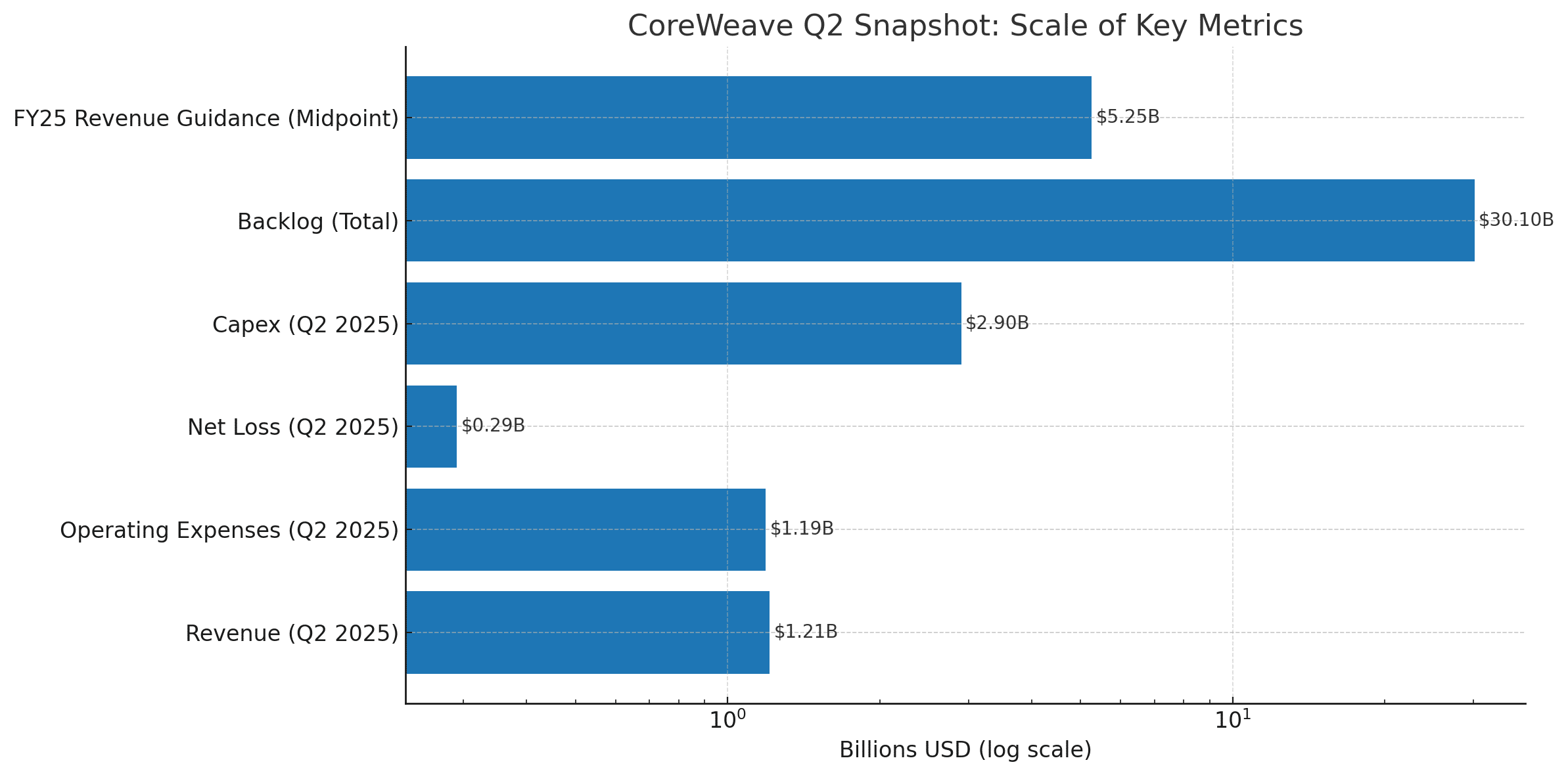
CoreWeave reported $1.21 billion in Q2 sales, above expectations, but incurred a net loss of ~$290.5 million due to increased operational expenditures from ~$318 million the previous year.


The business now maintains 33 AI data centers and is scaling around powerful GPU clusters. “Ultimately, the most significant challenge right now is accessing power shells that can deliver the scale of infrastructure that our clients require,” CEO Michael Intrator said, citing a supply-side barrier that comes with rapid expansion.
Raised Guidance, Record Capex, and a Towering Backlog
Management increased full-year revenue outlook to $5.15-$5.35 billion, indicating that demand for AI training and inference remained strong.
The sales backlog reached ~$30.1 billion, representing multi-year commitments. Capex touched a record around $2.9 billion as the business hurries to build capacity. CoreWeave earnings beat highlights both secular growth and the capital intensity of creating large-scale AI datacenters.
Why the Stock Fell
Despite the beat, shares fell 9-11% after hours as investors focused on the overall loss, increased operating expenses, and near-term dilution issues.
A lock-up expiry might increase volatility, and revenue concentration among mega-customers makes sentiment susceptible to news. For the time being, CoreWeave earnings reaction indicates that Wall Street needs a better view of margins as the build-out proceeds.
Deal Watch: The $9 Billion Core Scientific Acquisition
To secure electricity and reduce long-term operating costs, CoreWeave is pursuing a $9 billion all-stock acquisition of Core Scientific, which would contribute about 1.3 gigawatts of gross power.
A large Core Scientific shareholder has openly challenged the conditions, highlighting the fact that closure risks persist. The CoreWeave earnings backdrop emphasizes the deal’s strategic logic, power access and vertical integration.
Q2 Snapshot (Key Figures)
| Metric | Q2 2025 |
|---|---|
| Revenue | ~$1.21B |
| Net loss | ~$290.5M |
| Operating expenses | ~$1.19B |
| Backlog | ~$30.1B |
| FY25 revenue guide | $5.15–$5.35B |
| After-hours move | -9% to -11% |
Sources for figures: company release and major financial wires.
A Profitable Take for Investors and Traders
For medium-term investors, CoreWeave earnings tale is a high-beta gamble on AI infrastructure: a massive backlog, growing forecast, and a solid plan to secure electricity.
The risks—power limits, capex burn, client concentration- are not minor; therefore, position sizing and patience are critical. Short-term traders may continue to experience two-way volatility until margin growth becomes obvious.
Long-Term View
Margin recovery over the next 12-24 months is dependent on power procurement, implementation velocity, and a shift in service mix to higher-margin offerings.
If the Core Scientific purchase is completed and power ramps are implemented as planned, operating leverage may increase; otherwise, high spending may keep profitability under pressure even in the face of robust demand. This is the essence of the CoreWeave earnings argument.
Conclusion
This quarter’s CoreWeave profits demonstrate that AI compute demand is real, and persistent. However, the bill is high. The firm is expanding at dizzying pace, and investors want assurance that size will convert into consistently higher profitability.


For more news visit our platform.
FAQs
Why did the stock fall after a revenue beat?
Losses and operating costs widened, overshadowing the top-line strength.
What’s the significance of the backlog and guidance?
A ~$30.1B backlog and a higher FY guide imply multi-year demand visibility.
How does the Core Scientific deal fit?
It’s primarily about securing power capacity (≈1.3 GW) and improving long-term economics—though opposition adds closing risk.
Glossary
Backlog: Contracted future revenue not yet recognized.
Capex: Capital expenditures for long-lived assets like data centers and GPUs.
Lock-up: Period restricting insiders from selling shares after an IPO.
Operating leverage: Profit growth that outpaces revenue growth as scale improves.
Power shells: Data-center sites with utility capacity and physical plant ready for build-out.