
Coinbase has lost $300,000 due to an MEV bot exploit. The loss occurred after Coinbase mistakenly approved token transfers to the 0x Project’s swapper contract. This error allowed the automated MEV bot to exploit the corporate wallet.
Coinbase’s Chief Security Officer confirmed that customer funds were not impacted, but the incident raises significant concerns about smart contract misconfigurations in the crypto space.


MEV Bot Exploit Coinbase’s Token Approval Error
The breach took place when Coinbase’s wallet granted approval for token transfers to a swapper contract that was never intended for this purpose. Tokens such as ONDO, AMP, and SWELL were involved in the unauthorized transfer.
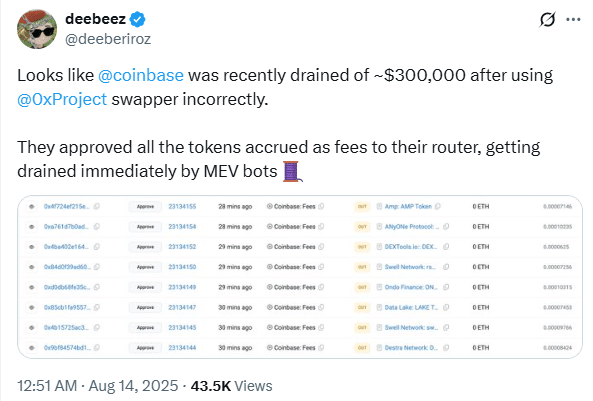
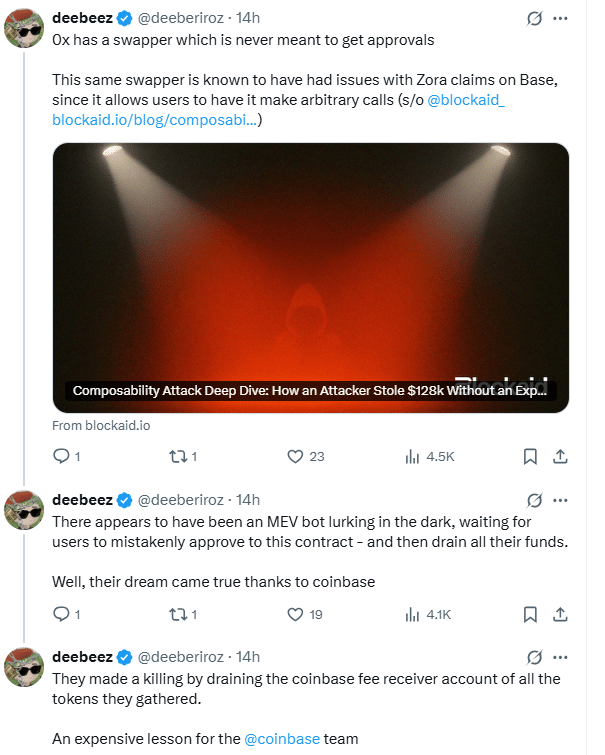
The contract was intended for trading, not storing token approvals. Unfortunately, this setup left the funds exposed, giving MEV bots the opportunity to exploit the flaw.
Maximal Extractable Value (MEV) bots are automated programs operating on blockchains. These bots are designed to take advantage of opportunities created by transaction reordering and price discrepancies.
In this case, the bots seized the moment to drain the funds from Coinbase’s fee receiver wallet before the company could revoke the token approvals.
What Went Wrong?
Coinbase’s security team, led by Philip Martin, confirmed that the incident stemmed from a recent change to one of its corporate DEX wallets. This modification inadvertently granted token approval to the wrong contract.
The approval allowed MEV bots to call the swapper contract and execute unauthorized transfers. The bots targeted Coinbase’s fee receiver wallet, quickly draining funds to their own addresses.
The vulnerability was spotted by a security researcher from Venn Network, deeberiroz. The researcher posted a screenshot of the token approvals, revealing the exposed assets. MEV bots, waiting for such an opportunity, swiftly executed the exploit.
While the loss of $300,000 is minimal for Coinbase, the incident underscores how even the largest exchanges can be vulnerable to sophisticated automated exploits.
MEV Bots in Action
MEV bots thrive in environments where they can reorder transactions to maximize profit. These bots rely on visibility into the mempool, a queue where unconfirmed transactions await validation.
By exploiting transaction reordering, MEV bots can profit from differences in prices before a transaction is finalized. In this incident, the MEV bots were able to invoke the swapper contract and execute transfers before Coinbase could stop them.
Coinbase’s Swift Response
Upon discovering the exploit, Coinbase acted quickly to shut down the token approvals. The company confirmed that no customer funds were affected by the incident. Coinbase moved swiftly to transfer the remaining assets into a new secure corporate wallet.
The breach highlighted the need for robust security measures when interacting with smart contracts. Coinbase’s swift action prevented the issue from escalating, but the incident serves as a cautionary tale for other exchanges in the crypto industry.
The Role of the 0x Protocol
The 0x Protocol, which underpins the swapper contract, is an Ethereum-based infrastructure for peer-to-peer digital asset trading. It is an open-source project that enables decentralized exchanges (DEX) to facilitate token swaps and liquidity pooling.
The 0x Protocol is used by various platforms to enable token swapping. Its flexibility makes it popular among decentralized applications, but it also comes with the risk of improper setups. In this case, Coinbase failed to properly manage the contract’s token approval, leaving its wallet vulnerable to exploitation.
MEV bot exploit and Blockchain Security
MEV bots have long been a part of the blockchain ecosystem, particularly in Ethereum. They capitalize on opportunities such as token launches, NFT mints, and liquidity events. While these bots can be useful in some contexts, they pose a significant threat when they exploit misconfigurations in contracts.
The Coinbase incident reveals how small mistakes can lead to large losses. MEV bots don’t need to be sophisticated—they simply wait for the right moment to strike. In this case, the bot’s strategy was to wait for Coinbase to approve the wrong contract, then execute the exploit before the company could react.
Conclusion
The MEV bot exploit at Coinbase highlights the risks of blockchain misconfigurations and the speed at which automated bots can act. While Coinbase quickly responded to the incident, the breach raises important questions about the security of smart contracts.
Despite the $300,000 loss, Coinbase’s swift action prevented further damage, demonstrating the importance of rapid response in the crypto world. The incident serves as a reminder that even the biggest players in the market are vulnerable to MEV bot exploits, making it essential to maintain constant vigilance.
Also read Coinbase Stock Drops 9% After Q2 Revenue Miss
Summary
Coinbase recently lost $300,000 due to an MEV bot exploit after mistakenly approving token transfers to a misconfigured swapper contract. The error exposed the funds, allowing MEV bots to exploit the vulnerability.
The incident involved tokens like ONDO, AMP, and SWELL. Coinbase quickly revoked the token approvals and moved assets to a secure wallet, assuring users that no customer funds were affected.
Frequently Asked Questions (FAQ)
1- What is an MEV bot?
An MEV bot is an automated program that exploits opportunities for profit in blockchain transactions, such as transaction reordering or identifying price differences.


2- How did the MEV bot exploit Coinbase?
The bots exploited a misconfiguration in Coinbase’s wallet that mistakenly approved token transfers to a swapper contract, allowing them to execute unauthorized transfers.
3- What is the 0x Protocol?
The 0x Protocol is an Ethereum-based infrastructure that facilitates peer-to-peer token trading through publicly audited smart contracts.
4- Were customer funds affected by the exploit?
No, Coinbase confirmed that the exploit was isolated to the corporate wallet, and customer funds were not impacted.
Appendix: Glossary of Key Terms
MEV (Maximal Extractable Value): A technique used by bots to extract profit from transaction ordering and price discrepancies within blockchain networks.
Coinbase: A leading cryptocurrency exchange platform where users can buy, sell, and store digital assets.
Swapper Contract: A smart contract designed for token swapping, not for storing token approvals.
DEX (Decentralized Exchange): A platform that allows peer-to-peer trading of cryptocurrencies without the need for a centralized authority.
0x Protocol: A decentralized open-source protocol used for exchanging ERC-20 tokens on the Ethereum blockchain.
Token Approval: A process in which a user allows a smart contract to access their tokens for specific actions.
References
CoinDesk – coindesk.com
The Block – theblock.co