![Sun [New]](https://s2.coinmarketcap.com/static/img/coins/64x64/10529.png)


![BitTorrent [New]](https://s2.coinmarketcap.com/static/img/coins/64x64/16086.png)


This article was first published on TurkishNY Radio.
Brazilian politicians are proposing new laws that would drastically limit the usage of some stablecoins. The new laws aim to prohibit stablecoins that have no backing by actual assets, representing a significant legislative change in Latin America’s largest economy.


The Brazilian stablecoin ban is presented as a consumer protection move aiming at limiting the dangers associated with unprotected online assets.
What the Proposed Law Says
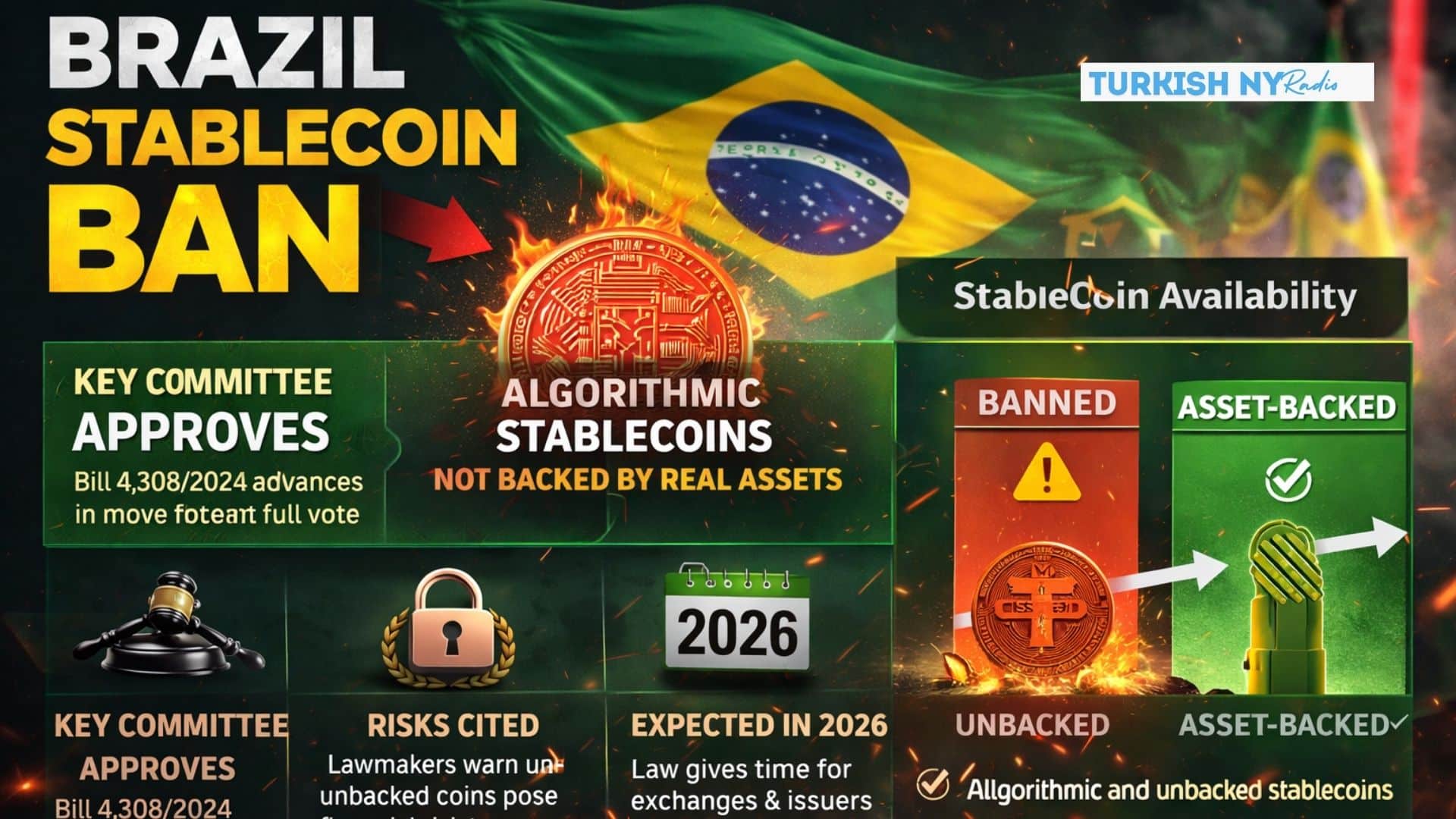
According to the report, the legislation, Bill 4,308/2024, was approved by a key committee in Brazil’s Chamber of Deputies. The measure would prohibit the creation and distribution of stablecoins that are not fully backed by assets like cash or securities issued by governments. This committee approval advances the measure through the process of legislating, but it still not make it policy.
The Brazil stablecoin ban is narrowly defined. It does not target all stablecoins, only those that rely on algorithms or other mechanisms instead of reserves. Lawmakers supporting the bill argue that these models expose users to sudden losses if market conditions deteriorate.
Algorithmic Stablecoins Risk Elimination
The Brazil stablecoin ban would have a direct impact on algorithmic stablecoins, which seek to preserve their peg by inducement instead of asset underpinning. According to CryptoTimes, lawmakers referenced past market failures to justify the restrictions, emphasizing that reserve-backed models are easier to supervise.
One lawmaker cited in the report said the proposal seeks to “prevent systemic shocks and protect retail investors,” highlighting concerns over transparency and risk management. The bill reportedly includes criminal penalties for issuing prohibited stablecoins, underscoring the seriousness of the Brazilian stablecoin ban.

What Happens to Existing Stablecoins
Importantly, the Brazil stablecoin ban does not automatically remove widely used, asset-backed stablecoins from the market. CryptoTimes notes that stablecoins with verified reserves could continue operating if issuers comply with authorization and disclosure requirements.
However, crypto exchanges would carry additional responsibility. Platforms listing stablecoins in Brazil would need to verify compliance or face potential penalties. This expands the reach of the Brazil stablecoin ban beyond issuers to intermediaries as well.
Why Brazil Is Taking This Step
Brazil is seeing an enormous rise in stablecoin utilization, notably for trade and international trade. On the basis of CryptoTimes, regulators are afraid that unbacked stablecoins would magnify financial turmoil and disguise capital movements.
The stablecoin prohibition in Brazil highlights a bigger regulatory goal: to integrate crypto operations into current financial surveillance as opposed to enabling rival systems to expand unregulated. Lawmakers have made it clear that the bill is favorable to regulation rather than against crypto.
Legislative Path and Timing
The Brazil stablecoin ban still requires approval from additional committees and a full vote in Congress. If passed and signed into law, implementation would not be immediate. In line with CryptoTimes, officials anticipate a transition phase during which enterprises will have the opportunity to either adapt or depart the industry.
While the law goes through the parliamentary process, its provisions are open to modification. Authorities have not yet released final implementation instructions.
Conclusion
According to CryptoTimes, Brazil is presenting itself as one of the harshest stablecoin authorities in key emerging economies. Brazil’s stablecoin ban demonstrates a strong predilection for asset-based digital assets and greater control. Either this method boosts market confidence or inhibits development will be determined by how the legislation is completed and implemented.
Summary
In accordance with CryptoTimes, Brazilian politicians have introduced legislation prohibiting stablecoins that are not backed by actual assets. The idea focuses on algorithmic models while enabling fully secured stablecoins to function under stringent circumstances. Supporters argue that the action safeguards shareholders and stability in the economy, while detractors worry about diminished flexibility. The measure is currently being reviewed and has currently become policy.
Glossary of Key Terms
Stablecoin: A digital asset with a fixed worth that is typically linked to a monetary unit.
Algorithmic Stablecoin: A stablecoin that employs algorithms as opposed to assets to maintain its fixed position.
Asset-backed: Funded by money bonds, or other physical assets.
Crypto Exchange: A marketplace for purchasing digital currencies.
Legislative Committee: An organization of legislators tasked with analyzing measures prior to a full vote.
FAQs for Brazil Stablecoin Ban
1. What is the Brazil stablecoin ban?
It is a proposed restriction on stablecoins that lack real-asset backing.
2. Is the law already in effect?
No. It has only passed a committee stage so far.
3. Are all stablecoins affected?
No. Asset-backed stablecoins may continue if they meet regulatory standards.


4. Who reported this development first?
The information comes from a Feb. 6 report by CryptoTimes.
5. Why are algorithmic stablecoins targeted?
Lawmakers cite higher risk and lack of transparent reserves.