Brazil’s Congress is about to put to the test a notion that was previously only discussed in crypto forums: a sovereign allocation to Bitcoin.
The Chamber of Deputies’ Economic Development Commission will hold its first public hearing on a plan to establish a Brazil Bitcoin reserve, with a maximum of 5% of foreign-exchange holdings, roughly $18-19 billion at current reserve levels.


The schedule, timing, and speakers have all been confirmed on the legislature’s website, making this the most definite step toward establishing a national digital asset buffer.
What does the bill truly propose?
Bill 4,501/2024 proposes creating a Sovereign Strategic Bitcoin Reserve (RESBit) under federal control. The text mentions diversification, protection against foreign exchange and geopolitical shocks, and potential support for the country’s digital-real (Drex) implementation.
Deputy Luiz Philippe de Orleans e Bragança requested a hearing and stated,
“We understand that it is essential to gather the monetary authority’s technical perspective on this bill with a view to improving the text.”
Confirmed panelists include Bitcoin industry strategy leaders and an ABCripto policy official, signaling a mix of market and public-policy perspectives.
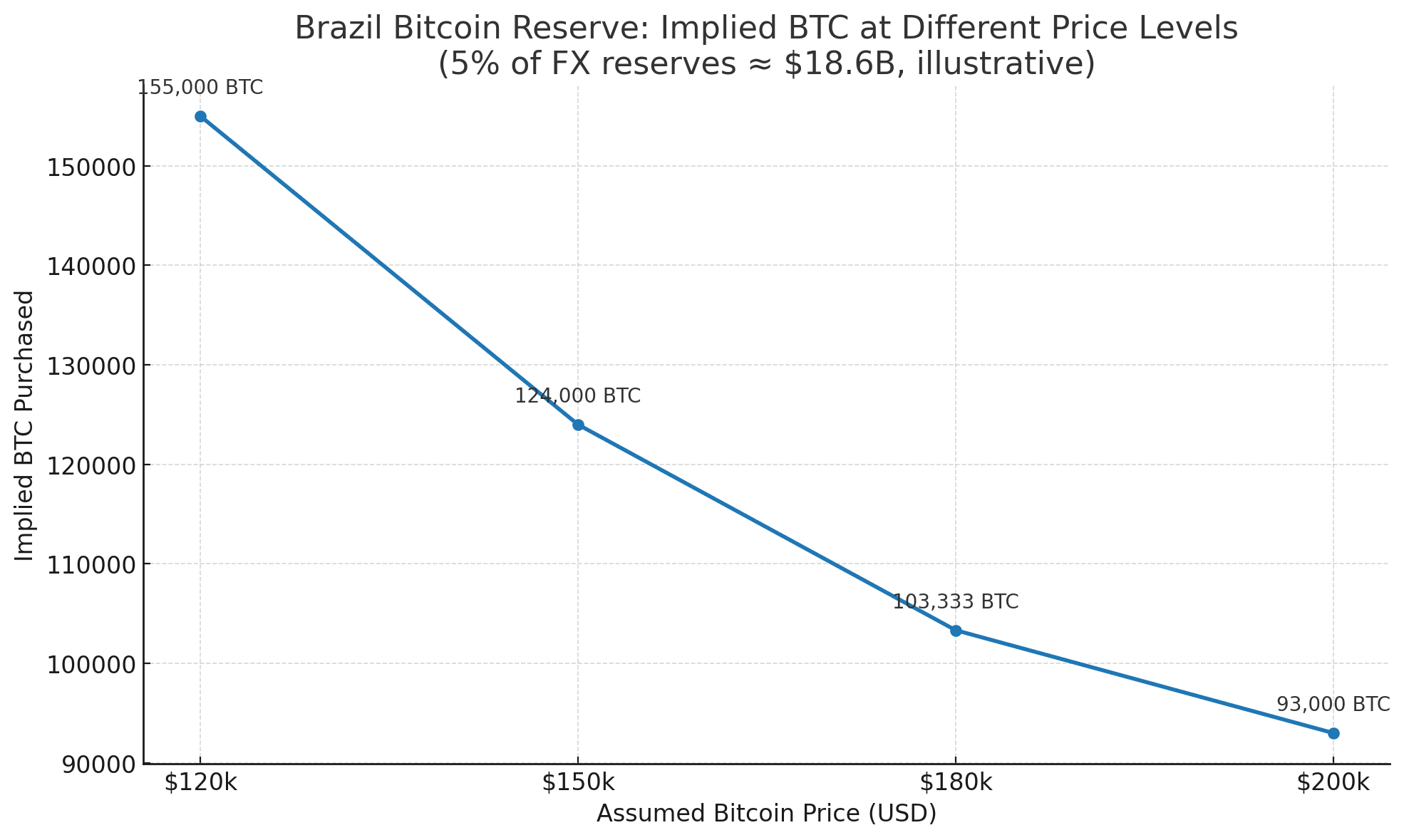
Brazil Bitcoin reserve: Why do the numbers matter?
Supporters say that a Brazil Bitcoin reserve would be a prudent hedge rather than a wholesale flip. Using the bill’s 5% ceiling and Brazil’s reserve base as references, the theoretical envelope is around $18.6 billion.
That size, if implemented gradually, might have an impact on liquidity without disrupting FX management. Initial explainers and local media generally define the cap as 5%, with a “up to” maximum and a phased implementation strategy.
Reserve math: implied BTC demand at different targets
| Assumed BTC price | Notional budget (US$) | Implied BTC if fully allocated |
|---|---|---|
| $120,000 | $18.6B | 155,000 BTC |
| $150,000 | $18.6B | 124,000 BTC |
| $180,000 | $18.6B | 103,333 BTC |
| $200,000 | $18.6B | 93,000 BTC |
Figures are rounded and illustrative; any actual acquisition would be phased and contingent on policy, market conditions, and liquidity windows.
Market tone and professional voices
The hearing comes amid a broader discussion about sovereign BTC risk. A well-known market expert described the event as “a potentially historic public hearing,” using $18.5 billion as a reference amount if the cap was completely utilized.
From the dais, parliamentarians are expected to examine risk controls. Brazil’s central bank maintains that “Ativos virtuais…não são emitidos nem garantidos pelo Banco Central,” a reminder that BTC is not a monetary obligation of the state. This might temper the most ambitious timeframes for a Brazil Bitcoin reserve.
Scenarios and forecasts
Additional hearings, committee views, and potential changes are expected prior to any floor vote. The most practical approach envisions a phased structure that includes feasibility studies, custody and reporting rules, and thresholds that allow acquisitions only under specific macroeconomic situations.


In market words, a Brazil Bitcoin reserve, which has been considered but not implemented, has the potential to impact risk perception throughout Latin America. If the project proceeds with strict guardrails, the base-case scenario is incremental demand from pilots rather than a big, market-moving block bid.
If political impetus picks up and a speedier pace is mandated, upside prospects might include programmatic purchases related to FX accumulation periods. If monetary authorities’ opposition escalates, the bear case becomes an extended committee shelf, but even this keeps the story alive in regional policy debates.
“We understand that it is essential to gather the monetary authority’s technical perspective…”, Deputy Luiz Philippe de Orleans e Bragança, in his formal hearing request.
“Brazil Bitcoin Reserve comes up for its first public hearing August 20th – $18.5b could be allocated.” – An industry analyst on X emphasizes the scope of the topic.
Conclusion
Whatever the conclusion, Brazil’s approach is now transparent, systematic, and data-driven. Brazil is setting a pattern for others to explore by examining the case for a Brazil Bitcoin reserve in open hearings, with input from the central bank and market experts.
That alone reshapes the conversation: sovereign balance sheets, digital infrastructure, and inflation hedges no longer exist in distinct policy folders; they all share the same agenda.
FAQs on Brazil Bitcoin reserve
What is the proposed cap?
Up to 5% of international reserves, implemented gradually and subject to oversight.
Who is leading the proposal?
Federal Deputy Eros Biondini authored the bill; the current hearing was requested by Deputy Luiz Philippe de Orleans e Bragança.
Is there official skepticism?
Yes. The central bank reiterates that cryptoassets are not issued or guaranteed by it, underscoring prudential concerns.
What happens after the hearing?
The committee may issue reports, propose amendments, and schedule further sessions before any floor vote.
Glossary of Key Terms
Brazil Bitcoin reserve: A proposed sovereign allocation to BTC, capped at 5% of national FX reserves.
RESBit: Acronym for Brazil’s Sovereign Strategic Bitcoin Reserve referenced in the bill.
Drex: Brazil’s central bank digital currency project (Real Digital).
FX reserves: Foreign assets held by a country to manage currency stability and external obligations.
Custody standards: Rules for secure storage, auditing, and reporting of digital assets by the state.
Public hearing (CDE): A formal committee session to gather expert testimony and public input before legislative action.