![Sun [New]](https://s2.coinmarketcap.com/static/img/coins/64x64/10529.png)

![BitTorrent [New]](https://s2.coinmarketcap.com/static/img/coins/64x64/16086.png)


This article was first published on TurkishNY Radio.
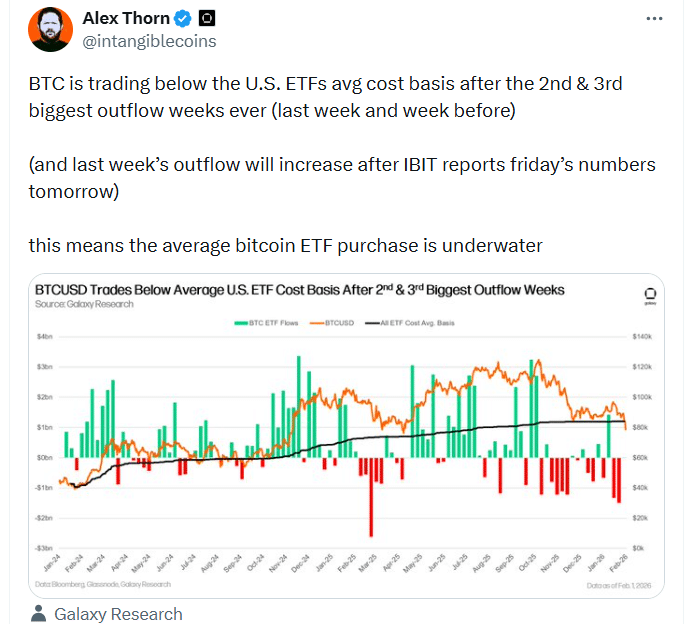
US spot Bitcoin ETFs just learned a tough lesson: liquidity works both ways. As Bitcoin slipped under $80,000 and briefly traded near $74,600, a growing share of recent buyers moved into the red. The pressure is not only about price but about Bitcoin ETF outflows and the way they can ripple through the spot market.


The cost-basis gap is now the story
Spot ETFs look simple on a brokerage screen, but they still have an entry price. When that blended cost sits above the current market, behavior changes. Underwater holders often treat rebounds like an exit ramp.
Galaxy Digital research chief Alex Thorn highlighted the gap in a post, writing that “BTC is trading below the U.S. ETFs avg cost basis.” Estimates cited alongside that observation put the average ETF entry near $90,200, leaving typical holders in paper losses at recent prices.
Macro strategist Jim Bianco made the same point with a quick number:
“With today’s plunge, the AVERAGE $BTC ETF holder is about $5,000 (or ~7% underwater).”
When losses spread across a product designed for easy access, Bitcoin ETF outflows can rise because selling becomes easier to execute.
Bitcoin ETF outflows are doing the talking
Flows are the clearest footprint of demand. When creations lead, ETFs absorb supply. When redemptions lead, the mechanism reverses, and Bitcoin ETF outflows can become incremental supply that the market must absorb.
Daily flow data in late January showed multiple sessions of concentrated withdrawals. Redemptions can translate into selling pressure because Bitcoin moves through the creation and redemption process, not “netted” inside the fund.
K33 Research has argued that net ETF flows and price returns have moved closely together, citing an R² near 0.79 between 30-day returns and 30-day flows. Correlation does not guarantee direction, but it helps gauge whether demand is expanding or shrinking.
Supply math after the halving
After the 2024 halving, the block subsidy sits at 3.125 BTC, implying roughly 450 BTC of new supply per day, or about 13,500 per month. Persistent Bitcoin ETF outflows mean the market must absorb additional coins on top of that baseline.
Strategy’s cushion looks different
The drawdown lands differently on corporate treasuries that were built earlier. Strategy, the public company most associated with long-running Bitcoin accumulation, is estimated to hold an average cost of $76,020. That buffer does not remove risk, but it reduces the pressure that many ETF buyers feel.
Where eyes go next
On-chain analysts are flagging potential floors if selling persists. João Wedson, CEO of Alphractal, wrote: “On-chain metrics now point to the next major support area around $65,500.” Levels are not promises, but they show where liquidity may reappear if fear peaks.


Conclusion
ETFs are not broken. They are transparent. They turn investor appetite into a daily ledger of creations and redemptions, and that ledger has recently tilted toward net selling. If Bitcoin ETF outflows cool, markets often stabilize faster than sentiment. If redemptions stay heavy, support levels matter more.
Frequently Asked Questions
What are Bitcoin ETF outflows?
Bitcoin ETF outflows are net redemptions from spot Bitcoin ETFs, meaning more money leaves than enters, which can lead to Bitcoin being delivered through the redemption process.
Do ETF outflows always push price lower?
No. Outflows can add supply, but price also depends on spot demand, leverage positioning, and macro liquidity conditions.
Why does cost basis matter for ETF holders?
Cost basis is the average entry price paid by holders. When price trades below that level, some investors sell into rebounds, which can cap momentum.
Glossary
Bitcoin ETF outflows: A period when net money exits spot Bitcoin ETFs, resulting in net redemptions.
Cost basis: The average price at which a position was accumulated.
Creation and redemption: The process used to add or remove ETF shares, exchanging shares for cash and or Bitcoin through authorized participants.
Halving: A scheduled Bitcoin event that cuts the block subsidy in half.
References