![Sun [New]](https://s2.coinmarketcap.com/static/img/coins/64x64/10529.png)



This article was first published on TurkishNY Radio.
Bitcoin is beginning to show a repeatable reaction to Federal Reserve policy events, with traders increasingly reducing exposure shortly after each announcement.


What once appeared as scattered market behavior is now shaping into a recognizable Bitcoin FOMC trading pattern, raising fresh questions about how deeply macro forces are influencing crypto.
Bitcoin FOMC Trading Pattern Lacked Early Consistency
Looking back to 2020 and 2021, Bitcoin’s response to Federal Open Market Committee (FOMC) meetings was far from predictable. Some meetings triggered declines, while others were followed by strong rallies.
For instance, Bitcoin dropped after the June 2020 meeting but surged in December of the same year, climbing above $23,000 within days. Similar mixed reactions continued through 2021, where gains and losses alternated depending on broader market sentiment.
Data from Blockchain.com shows that volatility around these events was present, but there was no consistent directional bias. At that stage, the Bitcoin FOMC trading pattern had not yet formed into a reliable signal for traders.


Bitcoin FOMC Trading Pattern Gains Macro Sensitivity
The shift became more visible in 2022, when the Federal Reserve began tightening monetary policy to control inflation. Risk assets across global markets came under pressure, and Bitcoin was no exception.
After the May 2022 Fed meeting, Bitcoin fell sharply, followed by another notable decline in June. These moves reflected tightening liquidity and reduced appetite for risk, factors that also impacted equities and other markets.
Blockchain activity tracked via Etherscan suggests that traders started repositioning more actively around these events. While not every meeting led to losses, the Bitcoin FOMC trading pattern was beginning to take shape as a risk-off response.
2024 to 2026: Pattern Becomes Harder to Ignore
A clearer trend emerged between 2024 and early 2026. During this period, Bitcoin repeatedly declined within one to two days following Fed announcements.
In March 2024, Bitcoin dropped more than 6% shortly after the FOMC decision. Similar declines followed in July and December, creating a cluster of downside reactions that caught traders’ attention.
By 2025, the pattern became more consistent. Several Fed meetings were followed by moderate declines, reinforcing expectations that post-event weakness could be anticipated.
In 2026, early data continues to support this trend. Bitcoin fell nearly 6% after the January meeting, while March saw a slower but extended pullback. These developments strengthen the case that the Bitcoin FOMC trading pattern is now part of market structure rather than coincidence.
Why Traders Are Selling After Fed Decisions
The reasons behind this behavior are becoming clearer. Bitcoin is no longer trading in isolation. As institutional participation has increased, it has become more sensitive to macroeconomic signals.
FOMC meetings act as scheduled risk events. Traders often adjust positions ahead of time and then reduce exposure once the announcement is made. This creates short-term selling pressure, even when the policy outcome is widely expected.
On-chain data supports this explanation. Exchange inflows tracked through Etherscan tend to rise around Fed dates, indicating that traders are preparing to sell or hedge positions.
The Growing Role of Calendar-Based Trading
Another important factor is timing. The Bitcoin FOMC trading pattern is increasingly driven by the calendar itself rather than just the content of the Fed’s decision.
Because FOMC meetings occur regularly throughout the year, they create predictable windows of volatility. This allows traders to build strategies around timing rather than relying solely on macro interpretation.
Even when outcomes match expectations, uncertainty around future guidance and market sentiment often leads to post-event selling. In this sense, the event itself becomes the trigger.
Bitcoin’s Evolution Into a Macro Asset
This shift highlights a broader change in Bitcoin’s role within financial markets. Greater institutional involvement has brought deeper liquidity and wider adoption, but it has also linked Bitcoin more closely to global economic cycles.
The Bitcoin FOMC trading pattern reflects this transition. Bitcoin is increasingly behaving like a macro-sensitive asset, responding to policy expectations, liquidity conditions, and risk sentiment.
A Pattern Worth Watching, Not a Rule
While the trend is becoming more consistent, it is not absolute. There have been instances where Bitcoin moved higher after Fed meetings, reminding traders that no pattern is guaranteed.
Still, the growing frequency of post-FOMC declines suggests that this behavior deserves attention. For short-term traders, it offers a potential tactical edge. For long-term observers, it signals how far Bitcoin has come in its integration with traditional markets.
Bitcoin FOMC Pattern Shapes Market Behavior
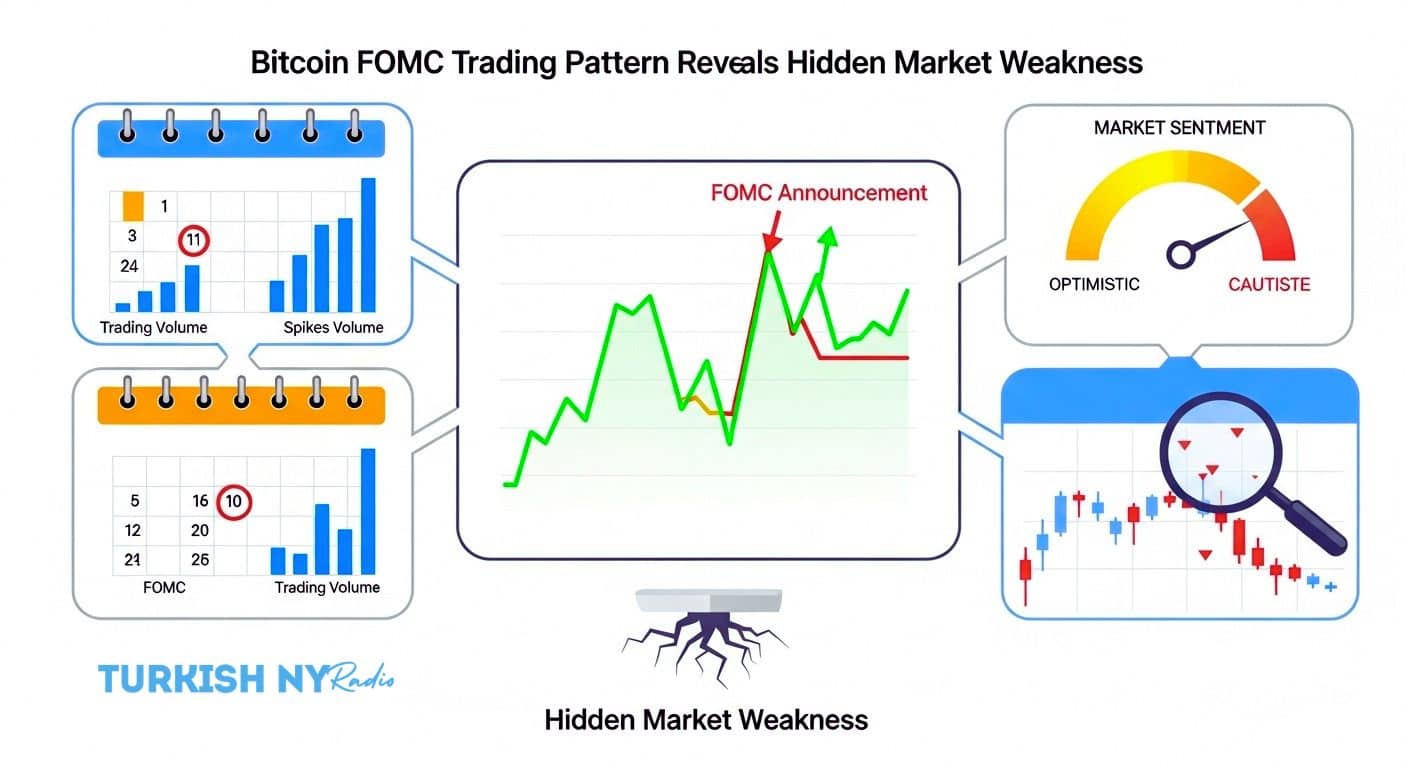
Bitcoin’s reaction to Federal Reserve meetings is no longer random. The Bitcoin FOMC trading pattern has developed into a recurring feature, especially in recent years.
This change reflects Bitcoin’s maturity and its growing connection to global macro forces. As long as monetary policy remains a central driver of risk sentiment, Fed meetings are likely to continue shaping Bitcoin’s short-term price action.
Summary
- Bitcoin is increasingly showing a pattern of dropping after Federal Reserve meetings, suggesting a clear Bitcoin FOMC trading pattern is forming.
- Earlier years lacked consistency, with prices moving in both directions.
- Since 2022, tighter monetary policy has made Bitcoin more sensitive to macro events.
- From 2024 to 2026, post-Fed declines have appeared more regularly.
- On-chain data shows traders often reduce positions around these events.
- Growing institutional involvement is aligning Bitcoin with traditional market behavior.
Glossary of Key Terms
1. Federal Reserve (Fed)
The Fed is the central bank of the United States. It controls interest rates and money flow, which can influence everything from loans to global markets.
2. FOMC (Federal Open Market Committee)
This is the group within the Fed that meets regularly to decide interest rates. Their decisions often move markets, including Bitcoin.
3. Bitcoin FOMC Trading Pattern
This describes a trend where Bitcoin often drops after Fed meetings, as traders react to economic updates and adjust their positions.
4. Interest Rates
Interest rates are the cost of borrowing money. When they rise, people and businesses tend to spend less, which can affect investments like Bitcoin.
5. Liquidity
Liquidity refers to how much money is flowing in the market. When there’s plenty of it, prices tend to rise more easily; when it’s tight, markets can struggle.
6. Risk Appetite
This simply means how comfortable investors feel taking risks. When confidence is high, they invest more. When it’s low, they play it safe.
7. On-Chain Data
This is data recorded on the blockchain, like transactions and wallet movements. It helps show what Bitcoin holders are actually doing behind the scenes.
8. Institutional Investors
These are big players like banks and investment firms. Because they move large amounts of money, their decisions can have a strong impact on Bitcoin prices.
FAQs About Bitcoin FOMC Trading Pattern
1. What is the Bitcoin FOMC trading pattern?
It refers to a trend where Bitcoin often drops after Federal Reserve meetings, as traders step back, reduce risk, and react to changes in economic policy expectations.
2. Why does Bitcoin usually fall after Fed meetings?
After Fed announcements, many traders adjust their positions due to uncertainty around interest rates and liquidity, which often leads to short-term selling pressure in Bitcoin.
3. How can traders make use of this pattern?
Traders can plan ahead by watching Fed dates, managing risk, and adjusting positions before or after announcements to better handle expected volatility and sudden price movements.
4. Is this pattern likely to continue going forward?
It could continue as Bitcoin becomes more tied to global markets, but outcomes may vary depending on economic conditions, policy changes, and overall investor sentiment.