Binance is facing a major legal challenge in London after nearly 1,700 British traders accused the exchange of selling crypto derivatives without UK authorization. The Binance UK derivatives lawsuit seeks at least £150 million, or about $200 million, in damages.
According to a Reuters report, the claimants allege that Binance offered risky leveraged crypto derivative products to UK retail users without securing proper regulatory approval. Some traders named in the filing said their losses reached tens of thousands of pounds.


Binance UK Derivatives Lawsuit Names CZ and Related Entities
The case puts Binance, Co-Founder Changpeng Zhao, and related entities before London’s High Court. It also raises a key legal question over whether contracts tied to unauthorized crypto products can be enforced.
The lawsuit filed against Binance UK derivatives identifies the following defendants: Binance Holdings, Nest Exchange, Zhao, and “persons unknown” potentially connected to operations on the platform.
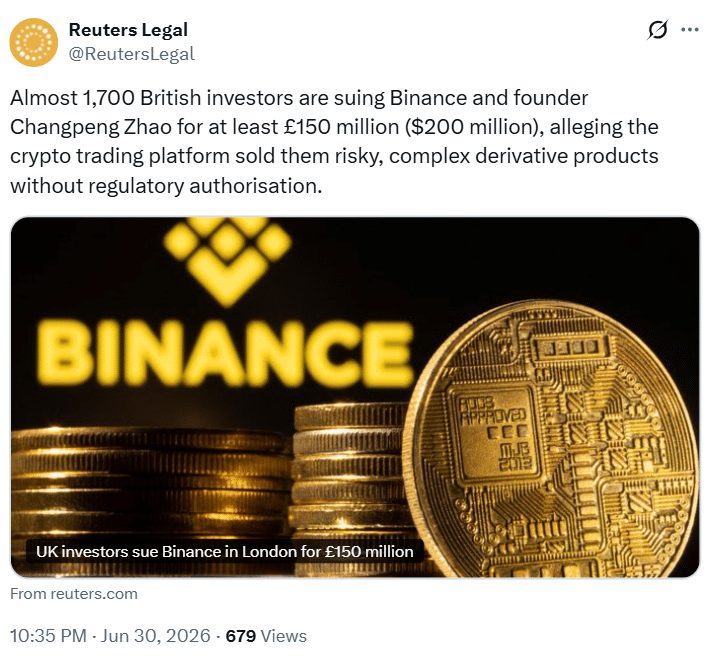
According to the plaintiffs, Binance started marketing complicated crypto derivatives to retail traders in the UK in late 2019. The reason for such actions is the lack of permission for marketing such crypto assets in the UK.
The company claims it will defend itself against the lawsuit. As reported by Reuters, a company representative claimed that the firm remains committed to fulfilling its obligations to users and working under the laws.
The retail traders argue that leveraged crypto derivatives should not be traded by UK retail clients. The main question in this case is the presence of necessary authorizations when offering such crypto derivatives.
The lack of such authorization may affect the validity of contracts between the platform and retail customers. Such an argument may play an important role in the further consideration of the filing.
The lawsuit against Binance UK derivatives is not solely about losing money in the market.
FCA Ban Frames the Timeline
The Financial Conduct Authority banned the sale of crypto derivatives and exchange-traded notes to retail consumers in 2021. The lawsuit claims Binance’s conduct was already problematic before that ban.
The claimants also allege that Binance continued to breach the Financial Services and Markets Act after the ban came into effect. The court may review whether Binance’s later UK changes were enough to meet regulatory expectations.
After the FCA ban, Binance adjusted parts of its UK operations and added extra verification steps for users seeking access to certain services. The court may examine whether those measures came early enough and applied widely enough.
Retail Traders Challenge Product Access
The Binance UK derivatives lawsuit places retail access to leveraged crypto products under direct court review. The claimants say the products carried risks that were not legally available to them through an unauthorized platform.
Their argument is based on authorization. They claim that Binance should not have offered the products if it lacked approval to sell them to UK retail customers.
If the court accepts that position, affected users could seek recovery of their original funds and trading losses. That would raise the financial risk for Binance beyond the headline damages figure.
Court May Test Contract Enforceability
The legal stakes extend beyond the £150 million claim. Under the Financial Services and Markets Act, contracts arranged by an unauthorized firm can potentially be ruled unenforceable.
That issue could make the case important for other crypto disputes. A ruling against Binance may give other retail investors a path to challenge unauthorized crypto product sales.
The Binance UK derivatives lawsuit may therefore become a test case for how UK courts treat crypto derivative contracts offered before and after stricter retail restrictions took effect.
UK Crypto Rulebook Adds Pressure
The case comes as Britain prepares a wider crypto licensing framework. The FCA’s final rulebook will bring exchanges, custodians, stablecoin issuers, and staking providers under one regulatory regime from October 25, 2027.
Firms will be able to apply for authorization between September 30, 2026, and February 28, 2027. Existing anti-money-laundering registrations will not automatically transfer into the new system.
That means firms with a UK presence will need to apply again. The new framework adds pressure as Binance faces a large legal claim tied to earlier product sales.
Europe Setback Raises Scrutiny
The Binance UK derivatives lawsuit also follows a regulatory setback in Europe. Binance withdrew its Greek MiCA application after reports that the bid was close to rejection by Greece’s Hellenic Capital Market Commission.
The withdrawal affected Binance’s European licensing path. Users in several EU markets were told to withdraw funds or wait for the exchange to secure authorization elsewhere.
The timing leaves Binance under pressure in both Britain and Europe. The exchange is defending a major UK investor claim while facing stricter licensing demands across key markets.
Compliance History Remains Relevant
Binance’s wider legal history may remain part of the regulatory backdrop. In 2023, Binance and Zhao pleaded guilty in the United States to anti-money-laundering and sanctions violations.
The company agreed to a $4.3 billion settlement. Zhao served four months in prison and stepped down as chief executive.
Richard Teng later became CEO. Zhao was later pardoned by President Trump in October 2025 and remains a major shareholder, according to the supplied information.
What Happens Next
No court date has been set for the Binance UK derivatives lawsuit. High Court claims can take months or years, especially when defendants are based across several jurisdictions.
 The defendants include entities registered in the Cayman Islands and the UAE. That could complicate enforcement if the claimants win.
For now, Binance says it plans to fight the case rather than settle. The legal process will move forward as UK crypto regulation tightens and Binance faces renewed scrutiny across Europe.
Conclusion
The Binance UK derivatives lawsuit adds another major legal test for Binance as regulators in Britain and Europe tighten oversight of crypto services.
The case will examine whether crypto derivatives allegedly sold without UK authorization can be enforced against retail traders. It may also shape how future claims involving unauthorized crypto products are handled.
Appendix: Glossary of Key Terms
Crypto derivatives: Financial products linked to crypto prices, often used for leveraged trading.
Leveraged trading: A trading method that increases market exposure and can raise both gains and losses.
Financial Conduct Authority: The UK regulator that oversees financial firms and crypto-related rules.
Retail investors: Individual traders who invest through personal accounts rather than institutions.
Financial Services and Markets Act: UK law covering financial services, authorization, and enforceability of certain contracts.
High Court: A senior court in England and Wales that handles major civil and commercial cases.
MiCA: The European Union’s crypto licensing and supervision framework.
Frequently Asked Questions About Binance UK Derivatives Lawsuit
1. Why are UK traders suing Binance?
UK traders allege that Binance sold leveraged crypto derivatives to retail customers without proper authorization in Britain.
2. What is the value of the claim?
The claimants are seeking at least £150 million, or about $200 million, in damages.
3. Why is Changpeng Zhao named in the case?
Changpeng Zhao is named as Binance’s Co-Founder, along with Binance Holdings, Nest Exchange, and “persons unknown” allegedly linked to platform operations.
4. Why does the FCA ban matter?
The FCA banned crypto derivatives and exchange-traded notes for UK retail consumers in 2021.