
Australia has taken a significant step toward shaping the future of digital assets by refining its approach to stablecoins. The Australian Securities and Investments Commission (ASIC) recently introduced new exemptions under the Australian stablecoin rules, allowing intermediaries to distribute the AUDM stablecoin with fewer licensing burdens.
This development signals Australia’s intention to balance innovation with regulatory oversight while boosting market confidence.


ASIC’s Targeted Exemption
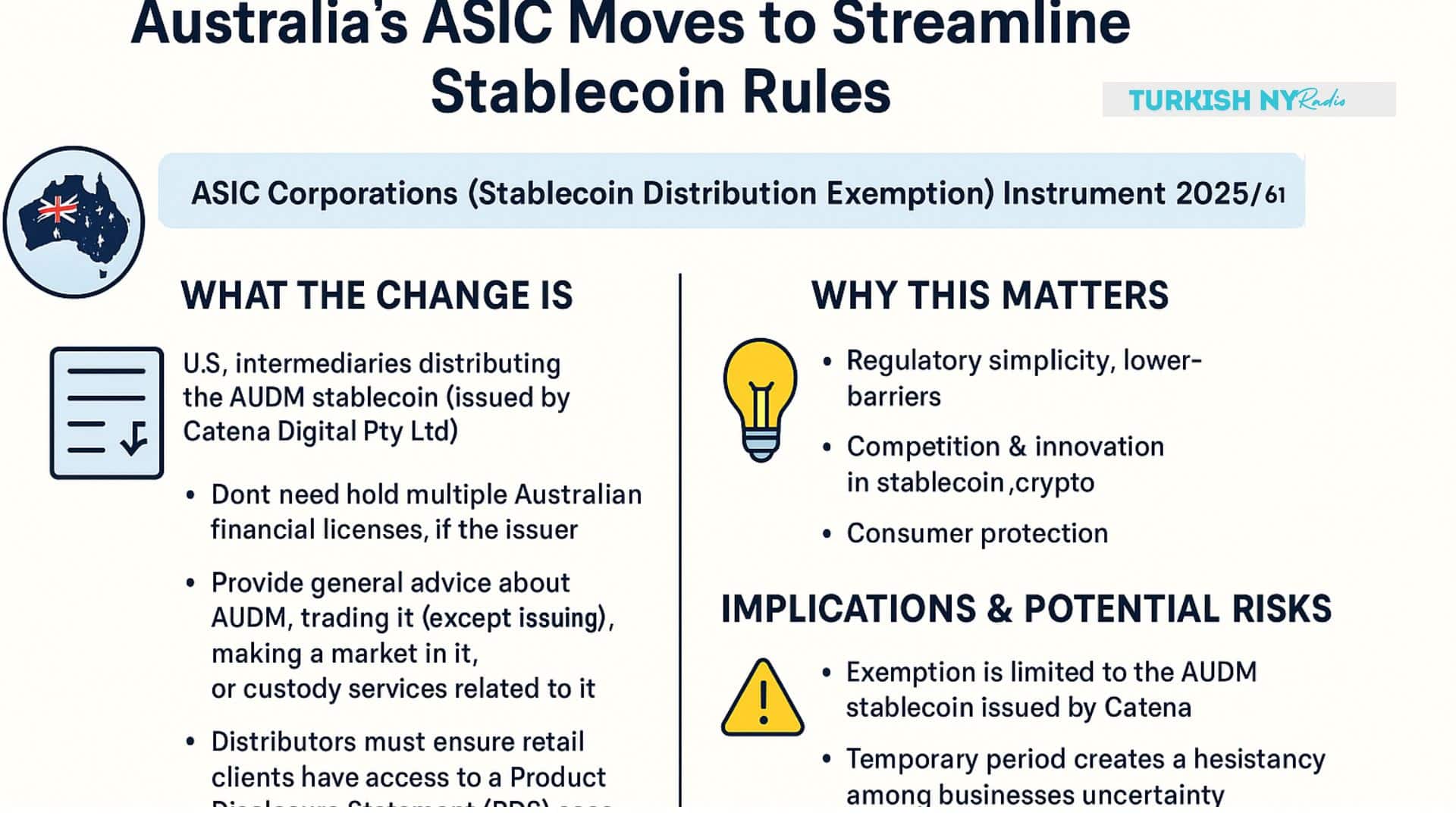
ASIC unveiled the Corporations (Stablecoin Distribution Exemption) Instrument 2025/631, which provides regulatory relief for intermediaries distributing the AUDM stablecoin. Normally, financial market operators, custodians, or advisors must acquire multiple licences.
However, under the updated Australia stablecoin rules, these entities are exempt, provided the issuer holds a valid Australian Financial Services (AFS) licence.
According to ASIC, the measure aims to “remove duplicative barriers without compromising consumer safeguards.” This approach narrows the scope to one issuer, Catena Digital Pty Ltd, and its AUDM token.
Also read: Australia Risks Falling Behind as Crypto Leaders Push for Urgent Legal Clarity
What Changes for Distributors
Under the new framework, distributors no longer need market, clearing, custody, or general advice licences to handle AUDM. The Australia stablecoin rules create an easier environment for intermediaries to bring stablecoins into circulation.
However, there is a safeguard: distributors must issue a Product Disclosure Statement (PDS). This ensures retail clients understand risks, fees, and underlying structures before purchasing stablecoins. By mandating disclosure, ASIC balances efficiency with investor protection.

Mentions Treasury_AU and ASIC Media are working on a draft stablecoin framework. X
“Australia’s #ASIC wants to tighten up rules for stablecoins and wrapped tokens…” formerly Twitter
Industry Reactions
Crypto businesses have welcomed the shift, calling it a milestone for mainstream adoption. “This targeted exemption provides room for innovation while ensuring consumer protections remain intact,” said a Sydney-based digital asset consultant.
Market watchers believe the new Australia stablecoin rules could accelerate the adoption of AUDM, potentially encouraging other issuers to seek similar frameworks. Still, critics argue that the exemption is too narrow since it applies only to a single issuer rather than the entire industry.
Temporary but Strategic Policy
The exemption is not permanent. It will expire on 1 June 2028 unless ASIC renews it. Analysts suggest this four-year period functions as a live test case. By applying the Australia stablecoin rules to a specific issuer, regulators can observe market dynamics, risks, and consumer behavior before broadening reforms.
“This is essentially a sandbox approach dressed as policy,” noted a Melbourne-based fintech researcher. “If successful, it could become the foundation for a comprehensive Australian digital assets law.”


Broader Implications
The policy positions Australia within the global conversation on stablecoins. Countries like the U.S. and U.K. are already moving toward stablecoin regulation, and Australia’s decision to streamline its framework shows a willingness to compete in the global digital economy. The Australia stablecoin rules not only reduce friction for businesses but also highlight a pragmatic approach to consumer protection.
Conclusion
By introducing targeted exemptions, Australia is signaling its commitment to fostering innovation without sacrificing safeguards. The Australia stablecoin rules may be temporary, but they provide a vital test case for the future of digital finance. Whether these measures expand beyond AUDM or remain limited will depend on how well the framework performs in practice.
Also read: Kraken Empowers Australian Investors with Advanced Crypto Trading Options
Summary
Australia has refined its regulatory landscape for stablecoins through ASIC’s new exemption for AUDM distributors. The Australia stablecoin rules simplify licensing by allowing intermediaries to operate without multiple approvals, as long as the issuer is licensed.
While temporary until 2028, this move lowers barriers for adoption, strengthens investor safeguards via mandatory disclosure, and places Australia on the map as a forward-thinking player in digital asset regulation. Its success could shape future policy expansion.
Glossary of Key Terms
ASIC: Australian Securities and Investments Commission, the country’s main financial regulator.
Stablecoin: A digital asset pegged to a stable asset, such as a fiat currency.
AUDM: An Australian dollar-backed stablecoin issued by Catena Digital Pty Ltd.
AFS Licence: Australian Financial Services licence, required for certain financial operations.
Product Disclosure Statement (PDS): A Document outlining the risks, features, and costs of a financial product.
FAQs for Australia Stablecoin Rules
1. What are the Australia stablecoin rules introduced by ASIC?
They are exemptions that allow distributors of AUDM to operate without multiple financial licences, provided the issuer holds an AFS licence.
2. Do these rules apply to all stablecoins?
No, the Australia stablecoin rules apply only to AUDM issued by Catena Digital.
3. How long will these exemptions last?
They are valid until June 1, 2028, unless extended.
4. What protections exist for retail investors?
Distributors must provide a Product Disclosure Statement (PDS) detailing risks, fees, and features.
5. Why is this important for Australia’s crypto market?
The Australia stablecoin rules reduce regulatory burdens, potentially driving adoption and positioning Australia as a competitive hub for digital assets.