![Sun [New]](https://s2.coinmarketcap.com/static/img/coins/64x64/10529.png)

This article was first published on TurkishNY Radio.
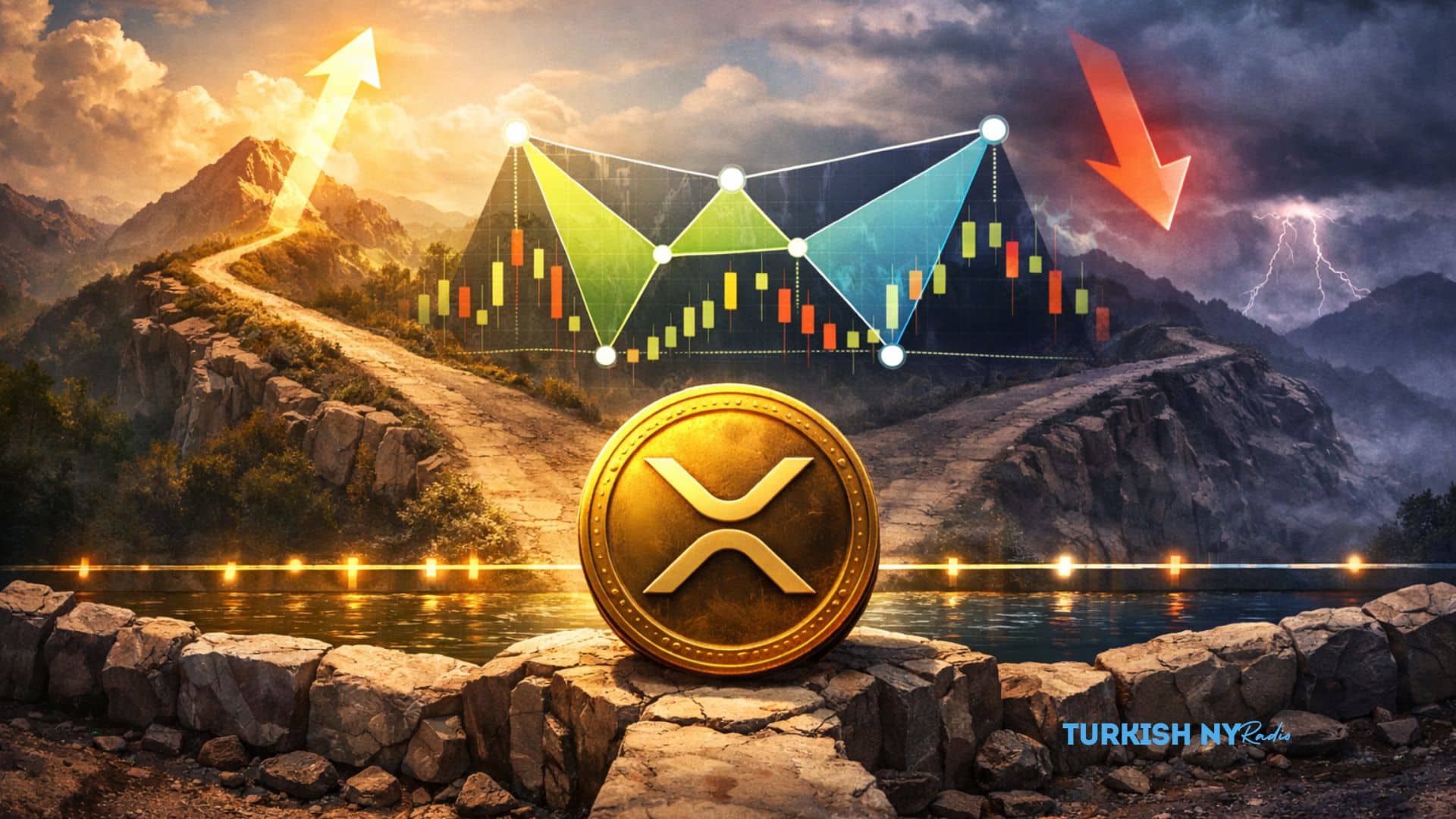
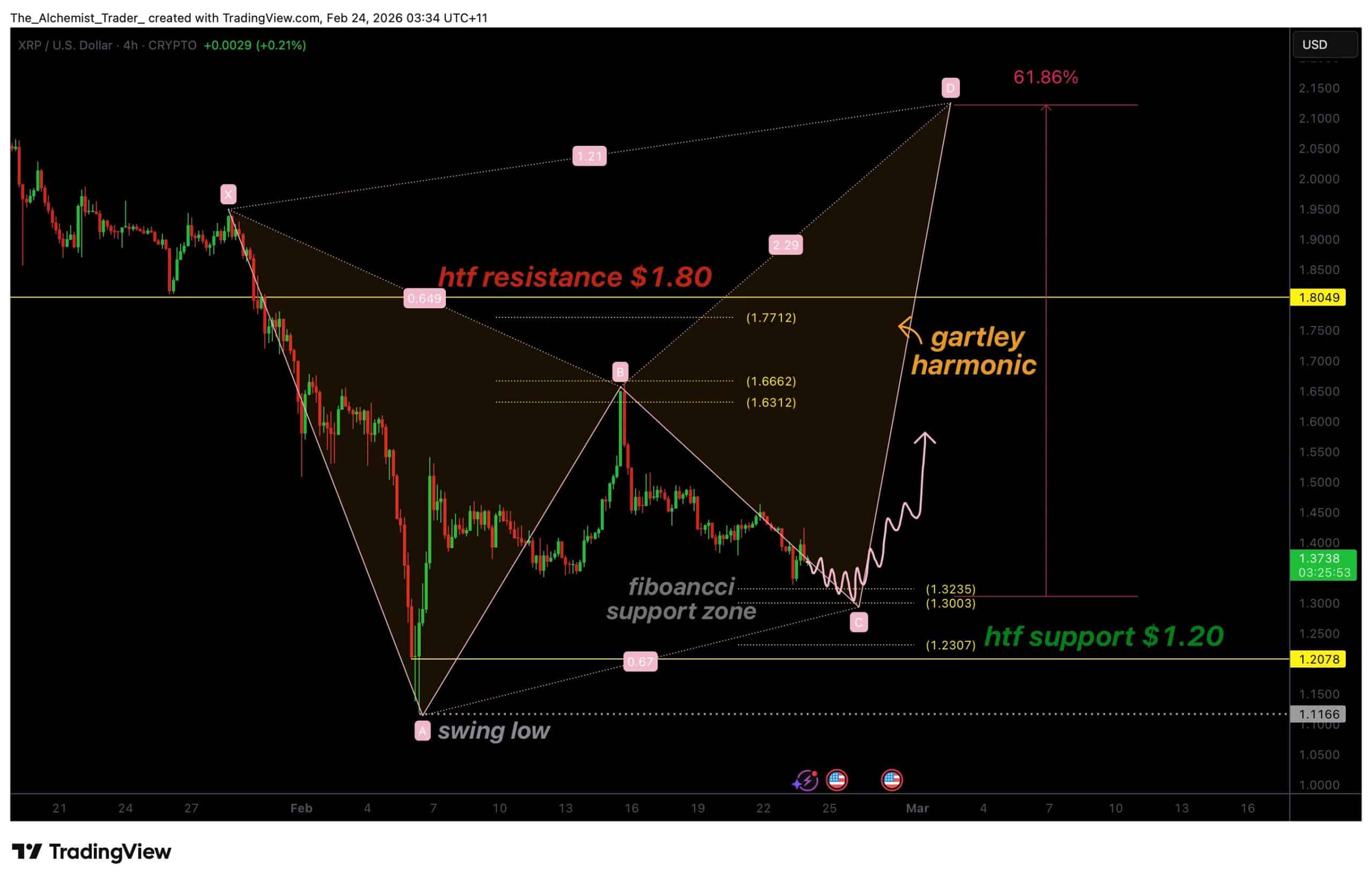
XRP price is starting to move in a more defined way, with a potential Gartley harmonic pattern forming around the $1.30 area. After weeks between $1.80 resistance and $1.20 support, XRP has settled into a quiet, pattern-driven consolidation.


Recent trading has kept XRP confined to a clear range rather than a strong uptrend or downtrend. Within that range, the latest leg lower rejected the 0.618 Fibonacci retracement level, a key ratio for harmonic traders.
XRP Price Eyes 60% Upside If Pattern Holds
If the structure completes, some technical projections point to a possible rally of around 60% from current levels. That scenario depends on buyers defending the $1.20 region and preventing a break of major support.
A Gartley pattern is a type of harmonic setup built around Fibonacci ratios and measured swings, labeled X, A, B, C and D. In the current context, XRP price appears to be working through the later stages of that sequence.
The broader backdrop is a range-bound market. Instead of trending hard in one direction, price has been rotating between clearly defined levels. That kind of environment often gives complex patterns time to develop, as both buyers and sellers test the edges of the range.
Gartley Pattern Forms Around $1.30
Price movement through $1.30 has now become a focal point. The latest corrective leg is failing at the 0.618 Fibonacci retracement, a rejection point that defines an important state in the evolution of a Gartley pattern.
Market has since then been unwinding the internal moves which usually leads to completion of leg C and these swings are hinting that liquidity is stacking ahead of those key fib lines hence waiting where most traders expect reaction to build orders.
Ranging and Market Structure of Price for XRP
XRP has stuck within a wide band between $1.20 and $1.80 for months. That band has major structural support at its lower end, and has capped several rallies at its upper end. Instead of forming a clean trend, XRP price has been jostling up and down within the boundaries of this channel.
| Month | Min. Price | Avg. Price | Max. Price | Change |
|---|---|---|---|---|
| Feb 2026 | $ 1.30 | $ 1.38 | $ 1.50 |
13.05%
|
| Mar 2026 | $ 1.31 | $ 1.37 | $ 1.49 |
11.88%
|
| Apr 2026 | $ 1.39 | $ 1.50 | $ 1.58 |
18.79%
|
| May 2026 | $ 1.40 | $ 1.50 | $ 1.56 |
17.45%
|
| Jun 2026 | $ 1.36 | $ 1.39 | $ 1.46 |
10.23%
|
| Jul 2026 | $ 1.38 | $ 1.69 | $ 1.97 |
48.55%
|
| Aug 2026 | $ 1.80 | $ 1.92 | $ 2.06 |
55.01%
|
| Sep 2026 | $ 1.80 | $ 1.86 | $ 1.97 |
48.38%
|
| Oct 2026 | $ 1.44 | $ 1.54 | $ 1.72 |
29.21%
|
| Nov 2026 | $ 1.55 | $ 1.59 | $ 1.63 |
22.92%
|
| Dec 2026 | $ 1.42 | $ 1.47 | $ 1.53 |
15.55%
|
This need for rotational indecisiveness can be aggravating to traders looking for momentum forward, however this is the area in which a pattern trader attempts to find opportunity. Every test of support and resistance fine-tunes the structure while also defining levels at which risk can be defined going into the next leg.


Fibonacci Levels and Harmonic Validation
The current setup has been shaped by consistent reactions at Fibonacci retracement zones. The rejection at 0.618, followed by trading just below a local support cluster, fits neatly into the textbook template of a developing Gartley pattern.
These measured swings are more than random volatility. They show that market participants are paying attention to shared technical reference points, anchoring their decisions around recurring ratios rather than chasing every move.
Realized Price Adds On-Chain Pressure
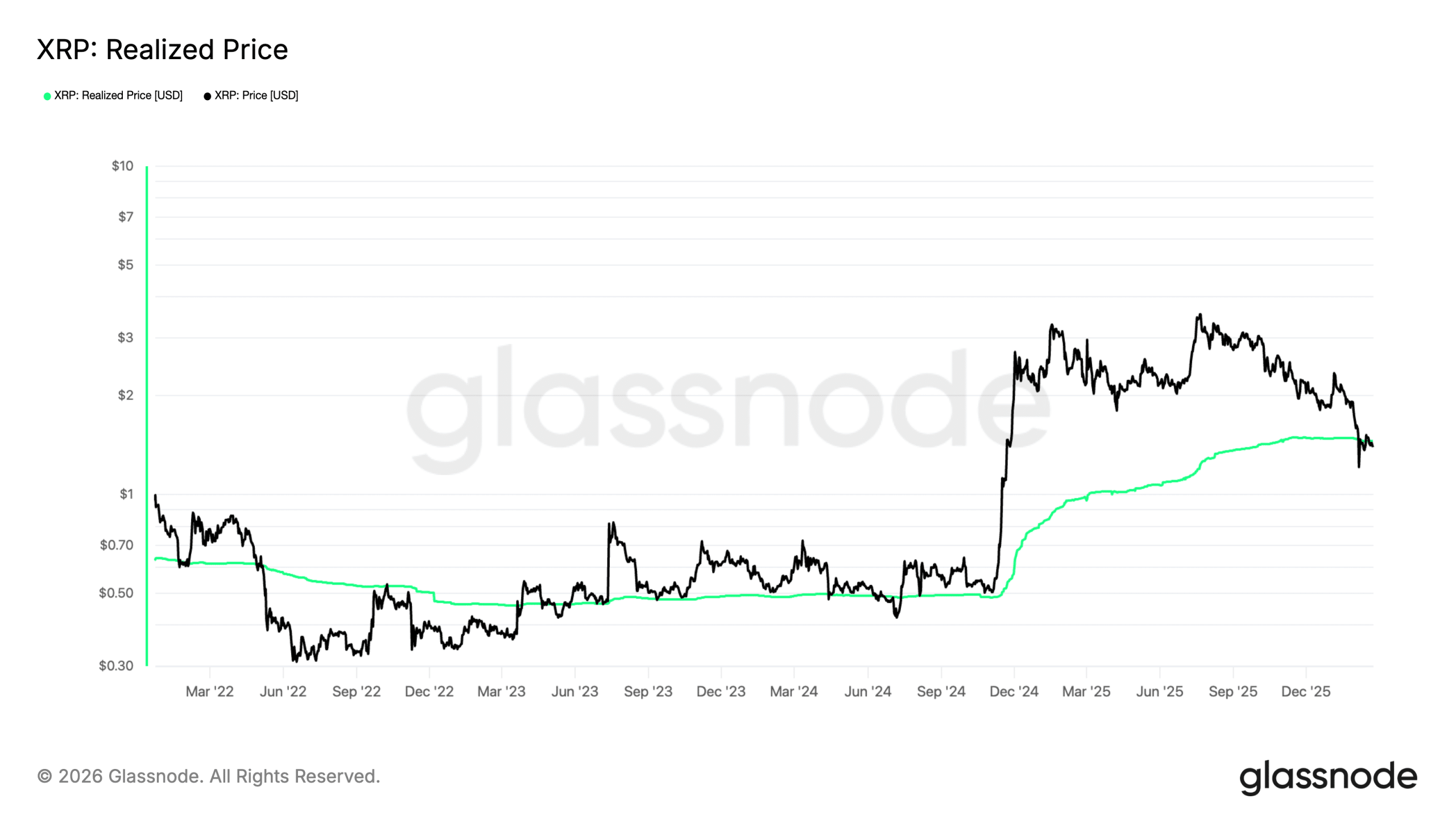
On-chain data adds another layer to the story. XRP price has struggled to reclaim and hold above its realized price of around $1.40. Realized price reflects the average cost at which the current circulating supply last moved on-chain.
When the market trades below that level, many holders are sitting on unrealized losses. In those conditions, rallies often meet heavier sell pressure as investors try to exit near breakeven. That can cap upside until the market can absorb that supply and move firmly back above the realized price.
There is a recent example of this dynamic. In 2022, XRP price fell toward $0.30 roughly a month after it broke below a realized price region near $0.60, during a weaker phase of the broader crypto cycle.
What Could Confirm the Bullish Case
There are few things that need to align for the bullish harmonic scenario to play out. XRP Price Remains Supported A steady support price must remain above the $1.20 range for XRP. That is the real line in the sand for this dynamic.
Second, the formation of an extra leg C is required with higher lows and more inviting trading volume. A continued respect for the 0.618 retracement and reactions still occurring at significant Fibonacci levels would suggest that there was still buying following the same technical map.
Should the pattern complete cleanly and we get up to leg D, technical projections suggest the price could move around 60%, which in this framework takes us back toward the top of the range around $1.80 and perhaps further still.
Conclusion
For now, the chart depicts a mature Gartley harmonic pattern within a wide range, with critical support at $1.20 and realized price at $1.40 on-chain representing significant resistance.
Provided that XRP price continues to hold support and key Fibonacci levels, the setup heavily favours a constructive leg C and pushes higher. A break of these levels would return focus to downside risk and a deeper correction.
Appendix Glossary of key terms
Gartley Pattern: A harmonic chart pattern that is based on Fibonacci ratios pointing to a potential trend reversal following a sequence of measured swings.
Fibonacci Retracement: A technical indicator that indicates potential support and resistance points based on important Fibonacci ratios such as 38.2%, 50% and 61.8%.
Structural Support: Price zone where buying interest has consistently stepped in to halt or slow continued declines.
Resistance Level: A price level at which selling pressure may arise, preventing advances or initiating drawdowns.
Realized Price: This is the average price at which the current circulating supply last moved on-chain, and can be used as a measure of holder cost basis.
Range-Bound Market: A market where price consolidates between defined support and resistance levels, instead of trending.
Harmonic Pattern: A class of advanced chart patterns that within the Fibonacci ratios, connect potential price reversals and objectives (target) areas.
Frequently Asked Questions (FAQ)
1- Why is the $1.20 level so important?
$1.20 is major structural support. Holding above it keeps the bullish harmonic setup intact.
2- What is a Gartley harmonic pattern?
It’s a technical pattern based on Fibonacci ratios and five swings (X, A, B, C, D) used to spot potential reversal zones.
3- What does realized price near $1.40 tell us?
Realized price is the average cost basis of holders. Trading below $1.40 means many are in unrealized loss, which can add sell pressure on rallies.
4- How much upside could the pattern imply?
If the Gartley completes and leg D plays out, XRP price could see roughly 60% upside from current levels.
References