U.S. Bank, the fifth-largest commercial bank in the United States, has announced the creation of a Digital Assets and Money Movement organization. The move signals a strategic shift toward blockchain-based financial infrastructure, integrating stablecoins, tokenized assets, and digital payment systems into its core services.


Jamie Walker, a payments veteran with two decades of experience and current CEO of Elavon, will lead the new division. He will continue to oversee Merchant Payment Services until a new successor is appointed.


The bank’s leadership emphasized that this expansion is designed to bring the reliability of regulated finance into the digital asset economy.
Dominic Venturo, Chief Digital Officer, said the initiative aligns with the growing curiosity among clients about blockchain-based solutions. “Clients increasingly want to understand how digital assets can help them safely move money, store deposits, and use tokenized assets,” Venturo stated in the announcement.
Banking Meets Blockchain
The new division aims to leverage the bank’s background in real-time payments and digital wallets to develop compliant blockchain solutions. While an official launch date has not been disclosed, the groundwork is already being laid for a broad suite of tokenization and settlement products.
This step follows U.S. Bank’s earlier involvement in digital custody operations, including providing reserve custody for payment stablecoins issued by other regulated crypto institutions. The transition from experimental to fully operational blockchain services positions the bank among early institutional adopters of tokenized finance in the United States.
The strategy reflects a broader pattern across the banking industry. Major institutions are redefining their relationship with crypto, shifting from speculative products toward infrastructure-level participation.
By building directly on blockchain rails, these banks are preparing for a financial environment where digital assets interact seamlessly with fiat systems.
Institutional Race Toward Tokenization
Citibank recently confirmed plans to roll out a regulated crypto custody platform in 2026, targeting stablecoin reserves and spot Bitcoin ETF assets.
The difference lies in focus: while Citibank emphasizes fund management, U.S. Bank’s approach centers on money movement and real-world payment networks. This divergence suggests the rise of specialized banking verticals within the digital economy.
The growing acceptance of stablecoins and tokenized money has also caught regulators’ attention. With clearer frameworks emerging from the Federal Reserve and OCC, banks are now racing to integrate compliant digital asset services without overstepping existing restrictions.
As one analyst on X commented, “The real transformation isn’t in speculation. It’s in the infrastructure banks are quietly building under the hood.” That perspective captures the quiet but profound shift happening across Wall Street’s upper ranks.
From Stablecoins to Tokenized Payments
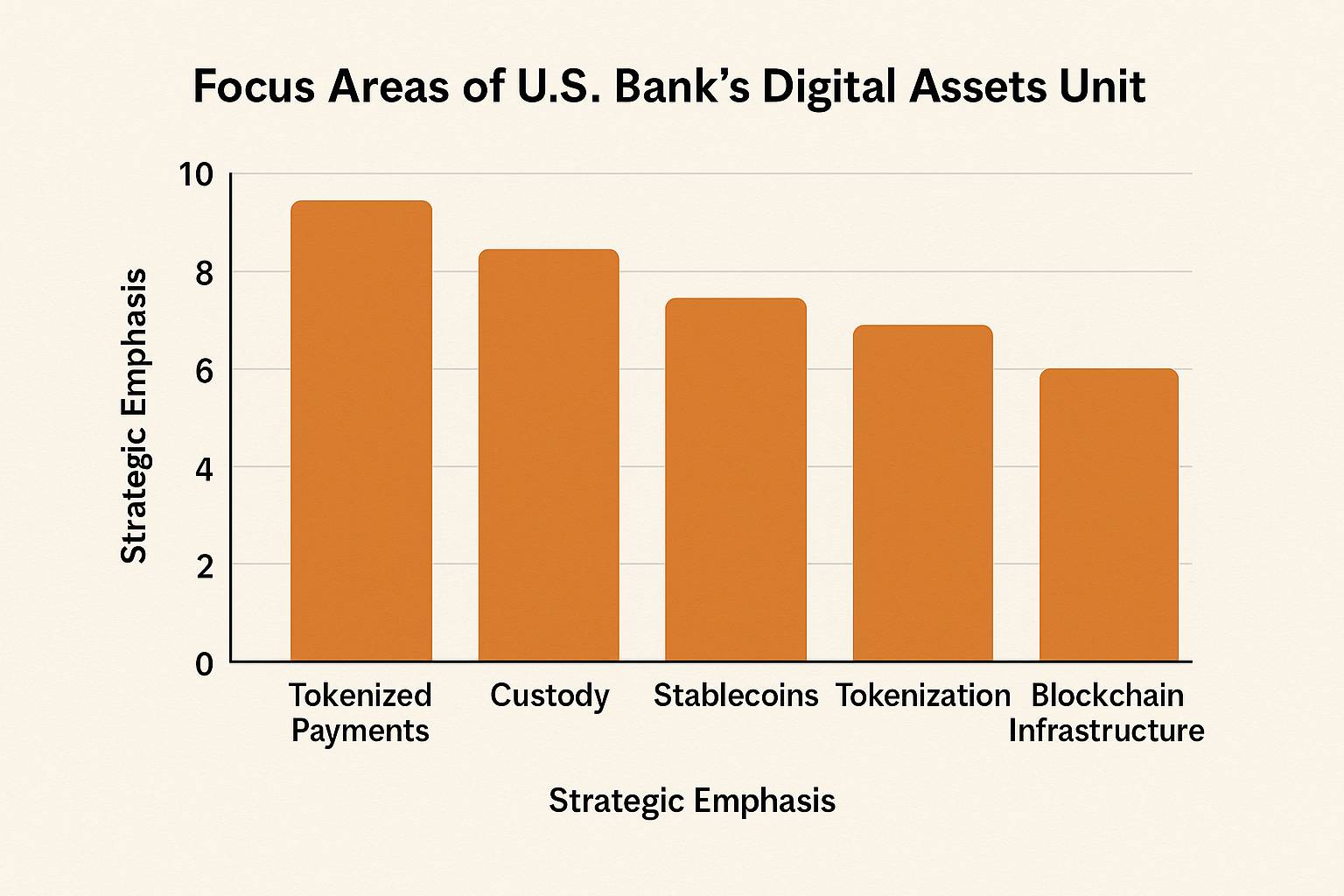
U.S. Bank’s digital assets unit aims to bridge traditional payment networks with blockchain efficiency. The system would allow customers to move funds instantly, settle transactions across borders, and tokenize deposits—all within a regulated structure. Tokenized payments could redefine how corporations handle treasury operations, cutting settlement times from days to seconds.
The bank’s expansion coincides with a broader shift in how traditional finance views digital money. With the rise of regulated stablecoins pegged to fiat currencies, tokenized assets are now being treated less as speculative tools and more as future payment infrastructure.
Conclusion
The creation of U.S. Bank’s Digital Assets and Money Movement organization marks a turning point for mainstream banking. Rather than resisting blockchain integration, major financial institutions are now embracing it as a way to modernize payment systems and enhance client offerings.
If successfully executed, U.S. Bank could become a central player in bridging legacy banking and digital finance, paving the way for tokenized payments to enter everyday use.
Frequently Asked Questions
What is U.S. Bank’s new digital assets unit?
It is a dedicated division that focuses on stablecoin issuance, digital custody, tokenized payments, and blockchain-based financial services.
Why is U.S. Bank entering the digital assets space?
The bank aims to meet growing client demand for regulated digital finance and strengthen its position in real-time payments and blockchain innovation.
Who leads the new unit?
Jamie Walker, the CEO of Elavon and a veteran in payments, has been appointed to lead the initiative.
How does this compare with other banks?
While Citibank focuses on custody and asset management, U.S. Bank emphasizes payment infrastructure and tokenized money movement.
Glossary
Stablecoin: A cryptocurrency pegged to a stable asset like the U.S. dollar to reduce volatility.
Tokenization: The process of converting real-world assets or currencies into digital tokens on a blockchain.
Digital Custody: Secure management and safekeeping of digital assets on behalf of clients.
Real-Time Payments: Instant money transfer systems that enable immediate settlement between financial institutions.
Blockchain Infrastructure: The technological foundation that supports decentralized data and transaction validation.