![BitTorrent [New]](https://s2.coinmarketcap.com/static/img/coins/64x64/16086.png)



This article was first published on TurkishNY Radio.
Stablecoin payments are becoming a preferred settlement method for businesses worldwide. Recent data shows rapid growth across euro- and dollar-backed tokens.


What has seemed like a slow adoption curve is coming to be seen as a structural change in how companies transfer money across borders. In the last year, stablecoin payments surged in transactions between businesses.
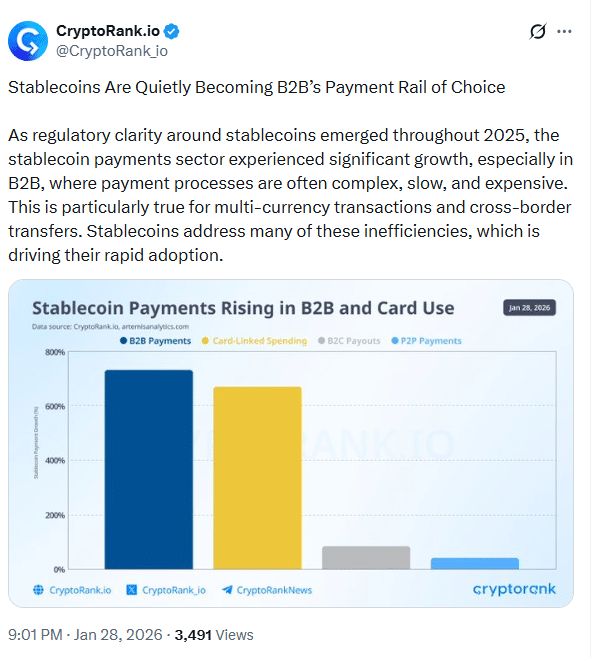
Key markets saw improved regulatory clarity. B2B stablecoin spend now has faster growth in active use case, percentile-wise than card-linked as spend acceleration, peer-to-peer and consumer payouts.
Amid these traditional payment system challenges came the rise of stablecoin transactions, driven in part by the now legacy technology era’s inability to keep pace with business requirements. Cross-border commerce, remote work and digital services added pressure to legacy rails.
In reaction, companies came to stablecoins for the speed, cost certainty and operational streamlining that they provided.


B2B Transactions Lead Stablecoin Adoption
Stablecoin payments are growing fastest in B2B use cases. Recent data show B2B volumes outpacing consumer transactions by a wide margin.
Also Read: Why U.S. Stablecoin Regulation Matters for Banks, Exchanges, and Users
Businesses favor stablecoin payments because they reduce settlement times from days to minutes. Intermediaries are removed. Liquidity becomes available almost instantly.
Regulatory Progress Supports Expansion
Improved regulation over the last year accelerated stablecoin payments. Clearer rules reduced compliance uncertainty for enterprises.
In Europe, updated legal frameworks supported euro-backed stablecoins. In the United States, compliance-focused issuers expanded enterprise access. Regulation shifted stablecoin payments from experimentation to execution.
EURC Growth Signals European Momentum
Circle’s euro-backed EURC recorded strong growth. Its market capitalization rose nearly 300% year-on-year. By January 2026, it approached $400 million.
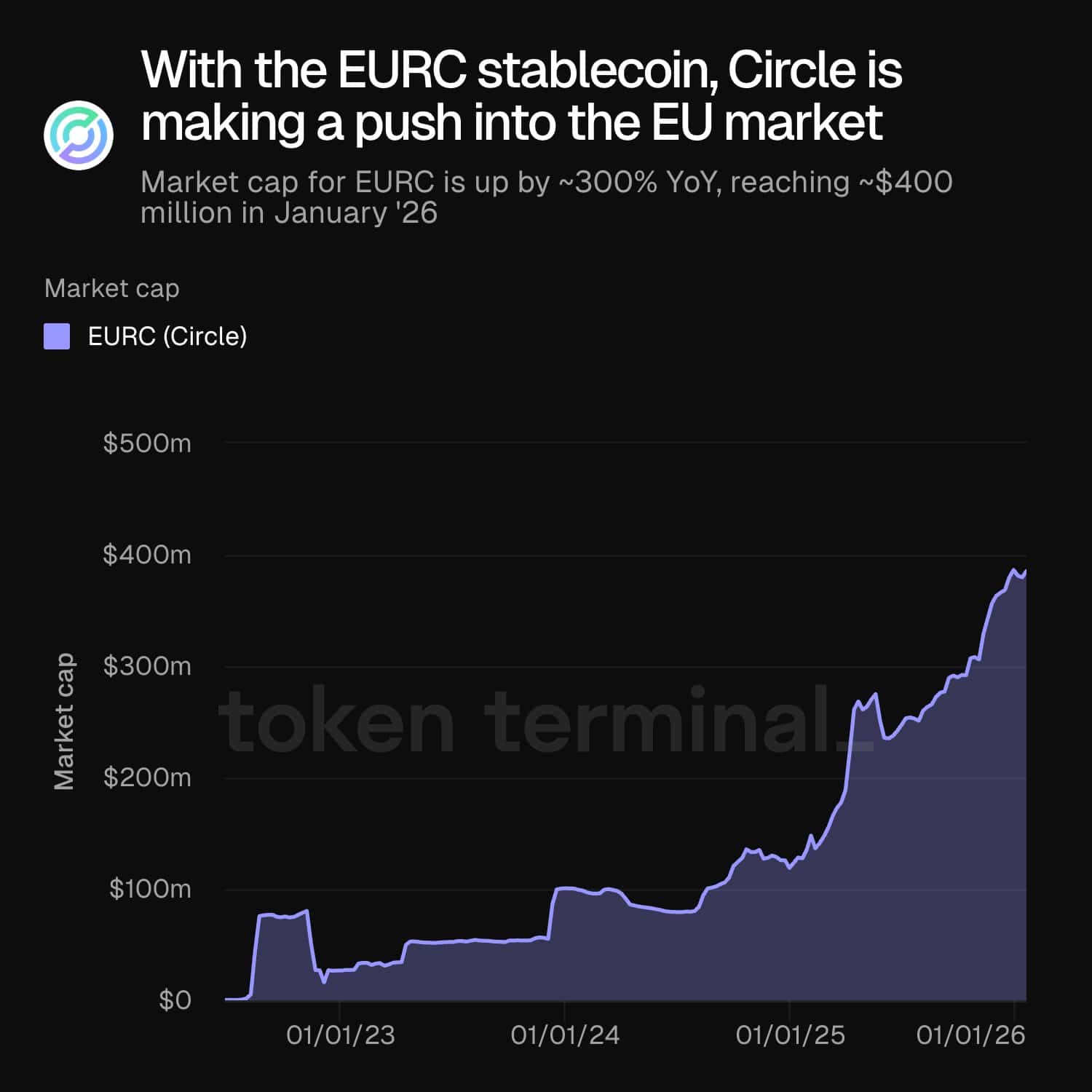
This growth reflects rising stablecoin payments within the European Union. Improved legal clarity made EURC viable for commercial settlement and cross-border trade.
Dollar Stablecoins Dominate Transaction Volume
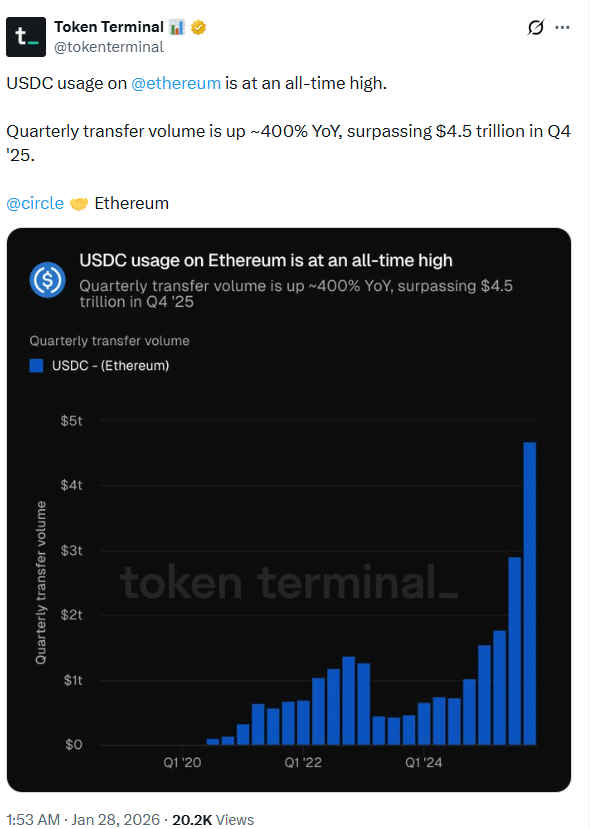
While euro tokens gained ground, dollar-backed stablecoins continue to dominate usage. USDC transfer volumes on Ethereum reached an all-time high.
Quarterly volumes rose nearly 400% year-on-year. They exceeded $4.5 trillion in Q4 2025. These figures confirm that stablecoin payments are now used for real settlement, not passive holding.
New Entrants Gain Market Share
New stablecoins are scaling quickly. USD1, issued by World Liberty Financial, moved rapidly up the market-cap rankings.
At its current pace, USD1 could enter the top tier soon. Its growth highlights continued demand for stablecoin payments across multiple issuers.
Legacy Payment Frictions Drive Adoption
Traditional B2B payments remain slow and costly. Settlement often spans multiple business days. Fees accumulate across banks and intermediaries.
Currency conversion losses are difficult to predict. Reconciliation remains fragmented. Stablecoin payments address these issues directly by offering predictable costs and continuous availability.
What Fueled the Jump From $100M to $3B Monthly
Stablecoin payments scaled once technology matched business needs. Price stability was essential. Fiat-backed tokens allowed accurate invoicing and accounting.
Faster settlement improved cash flow. Transparent fees improved forecasting. These factors drove monthly volumes from under $100 million to nearly $3 billion.
Enterprise-Grade Compliance Enables Scale
Adoption accelerated as infrastructure matured. Payment providers now support KYB checks and transaction monitoring.
Detailed settlement records are standard. Exportable reports simplify audits. These features made stablecoin payments practical for regulated enterprises operating globally.
Real-World Business Use Cases Expand
Stablecoin payments are now embedded in daily operations. Manufacturers pay overseas suppliers faster. SaaS firms receive international revenue instantly.
Marketplaces settle with sellers across regions. Companies use stablecoins for global payroll and contractor payments. Some firms also manage treasury liquidity on-chain.
Conclusion
Stablecoin payments are no longer a niche experiment. Data shows sustained growth driven by B2B demand, regulatory clarity, and operational efficiency. As adoption deepens, stablecoin payments are reshaping global business settlement rather than simply complementing existing systems.
Also Read: Crypto Payroll Regulation Explained: Stablecoins vs Bitcoin
Appendix: Glossary of Key Terms
Stablecoin transactions: Settlements and transfers involving digital tokens backed by fiat.
B2B payments: Payments made to businesses, not consumers.
Fiat-backed stablecoin: A cryptocurrency whose value is based on that of a government-issued currency.
Cross-currency transfer: Transfer of funds between two parties in different countries.
Settlement Time: The time it takes for a payment to be settled fully.
Transaction volume: The combined value of payments processed in a specified time period.
KYB compliance: How to verify businesses’ identities in a digital world.
Frequently Asked Questions About Stablecoin Payments
1- What is driving stablecoin payments growth?
Speed, cost transparency, and global accessibility are key drivers.
2- Are stablecoin payments mainly used by businesses?
Yes. B2B transactions are currently the fastest-growing segment.
3- Which stablecoins lead adoption?
USDC dominates volume, while EURC leads euro-denominated growth.
4- Do stablecoin payments replace banks?
They reduce reliance on intermediaries but often integrate with existing systems.
References