![BitTorrent [New]](https://s2.coinmarketcap.com/static/img/coins/64x64/16086.png)



This article was first published on TurkishNY Radio.
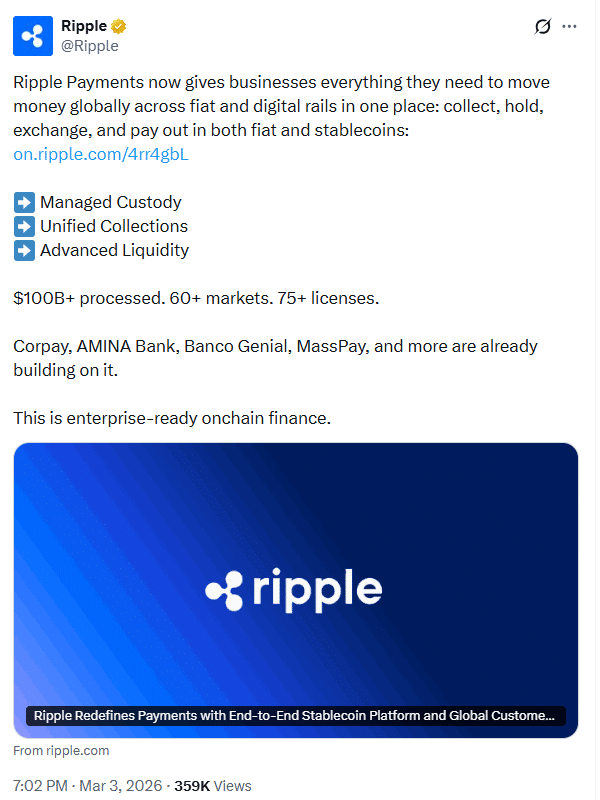
Ripple payments are expanding beyond simple cross-border transfers. The company is turning its platform into a full financial infrastructure for global money movement. Businesses can now manage fiat and stablecoin transactions within a single system.


Ripple announced the expansion in a recent press release. The upgrade allows companies to collect, hold, convert, and distribute funds through one provider. This removes the need to combine several vendors for payments and treasury operations.
The update comes as digital finance grows rapidly. Stablecoins and blockchain-based payments are gaining wider use across the financial sector.
New Enterprise Capabilities Expand Ripple Payments Platform
This expansion brings enterprise capabilities to Ripple payments. It allows businesses to manage collections, treasury management and settlement found in one platform.
Companies may also handle stablecoin payments with the other traditional currencies. This single model enables fintech companies and financial institutions to streamline payment operations.
The new capabilities, Ripple said, stem from two recent acquisitions. These acquisitions bolster the backbone behind the platform.
Blockchain Payments Adoption is Accelerated by Growth of Stablecoin
The global finance landscape continues to grow in terms of blockchain payments. Stablecoins have been a big part of the shift. Industry estimates note that stablecoin transactions topped around $33 trillion in the previous year. These assets represent about 30% of all on-chain transaction volume.
Ripple payments has processed over $100 billion as it expands enterprise infrastructure. The company is expanding infrastructure to meet enterprise demand and financial industry standards.
Ripple Becomes a Full Infrastructure Layer
The updated platform now operates as a full infrastructure layer. Ripple supports collections, custody, conversion, and payouts within one system.
This structure helps companies simplify payment operations. Businesses can manage global financial flows through one integration. The approach reduces technical complexity for cross-border payment systems.
Palisade Strengthens Custody Services
One acquisition supporting the expansion is Palisade. The company specializes in custody management and treasury automation.
Palisade allows businesses to create digital wallets at scale. The system also enables automated transfers into treasury accounts. These features help companies manage liquidity and digital assets more efficiently.
Rail Adds Virtual Accounts and Collections
Ripple also acquired Rail, a virtual accounts and collections platform. Rail enables businesses to receive payments through named virtual accounts.
Companies can accept both fiat and stablecoin payments. The platform also supports automatic currency conversion and settlement. These features expand the functionality of Ripple for global businesses.
Simplifying Cross-Border Payment Infrastructure
Cross-border payment systems are often complex. Businesses usually rely on several providers to complete international transactions.
One provider handles custody. Another manages foreign exchange. Others handle settlement and payouts. Ripple aims to combine these services into a single platform. This consolidation can simplify payment operations for global companies.
Stablecoins are becoming an important part of global finance. Many businesses now use them for faster and cheaper settlements. Ripple integrates stablecoin capabilities directly into its system.
XRP Price Shows Short-Term Weakness
While Ripple expands its infrastructure, XRP price has faced short-term pressure. The asset recently struggled to stay above the $1.40 level.


The price dropped below the $1.3920 and $1.3880 zones. This movement signaled a short-term correction. Market sentiment remains cautious as traders watch key resistance levels.
Key Technical Levels to Watch
XRP is trading below the 100-hour simple moving average. A bearish trend line is forming near the $1.3880 resistance level. If buyers regain strength, the price could test the $1.40 level again. A successful breakout may push the price toward $1.4320 and $1.450.
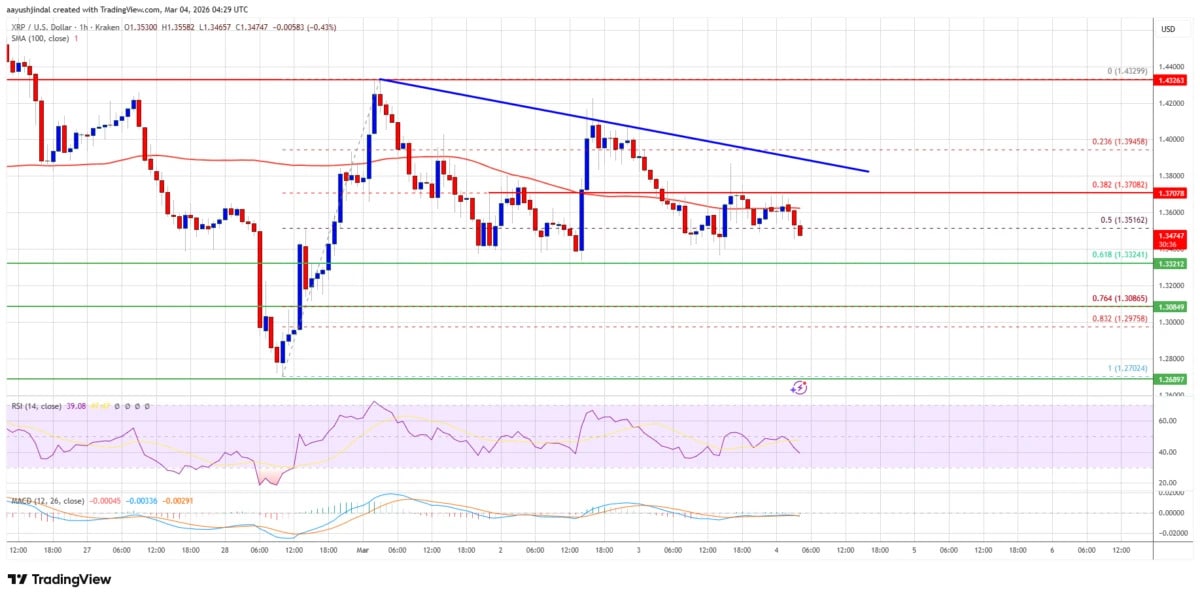
However, failure to break resistance could trigger further declines. Support levels are located near $1.3320 and $1.3085. A drop below these levels could push the price toward $1.2880 or lower.
Conclusion
Ripple is expanding into a comprehensive infrastructure platform for global finance. The company is combining custody, collections, conversion, and settlement into one system.
This strategy embodies the increasing demand for blockchain-based financial services. We now have an opportunity to reshape global payments with stablecoins and digital assets.
Appendix: Glossary of Key Terms
Stablecoin: A type of cryptocurrency that is stable as it’s pegged to an asset such as the US dollar.
Custody: A service that securely stores and manages digital assets for people or organizations.
On-Chain Transactions: Transfers written corresponding to a blockchain network.
Cross-Border Payments: Financial transfers between parties in different nations.
Treasury management: Tools that corporations use to manage their cash flow and liquidity as well as their financial operations.
Settlement: The last stage of a payment process whereby the money is transferred and verified between involved parties.
FAQS Regarding Ripple Payments
1- What is Ripple payments?
Ripple payments is a blockchain-based payment platform that enables businesses to transfer both fiat currencies and digital assets in an interoperable way.
2- What is the reason for Ripple to expand its platform?
Ripple has set out an expansion of the platform to make global payment infrastructure easier, amalgamating multiple financial services in a single system.
3- Who is Palisade and Rail?
Palisade offers custody and treasury automation solutions. Rail powers virtual accounts and payment collection services.
4- Ripple, the payment processor. How much volume have they processed?
Ripple said its payments platform has handled over $100 billion in total transaction volume.
References