![Sun [New]](https://s2.coinmarketcap.com/static/img/coins/64x64/10529.png)



This article was first published on TurkishNY Radio.
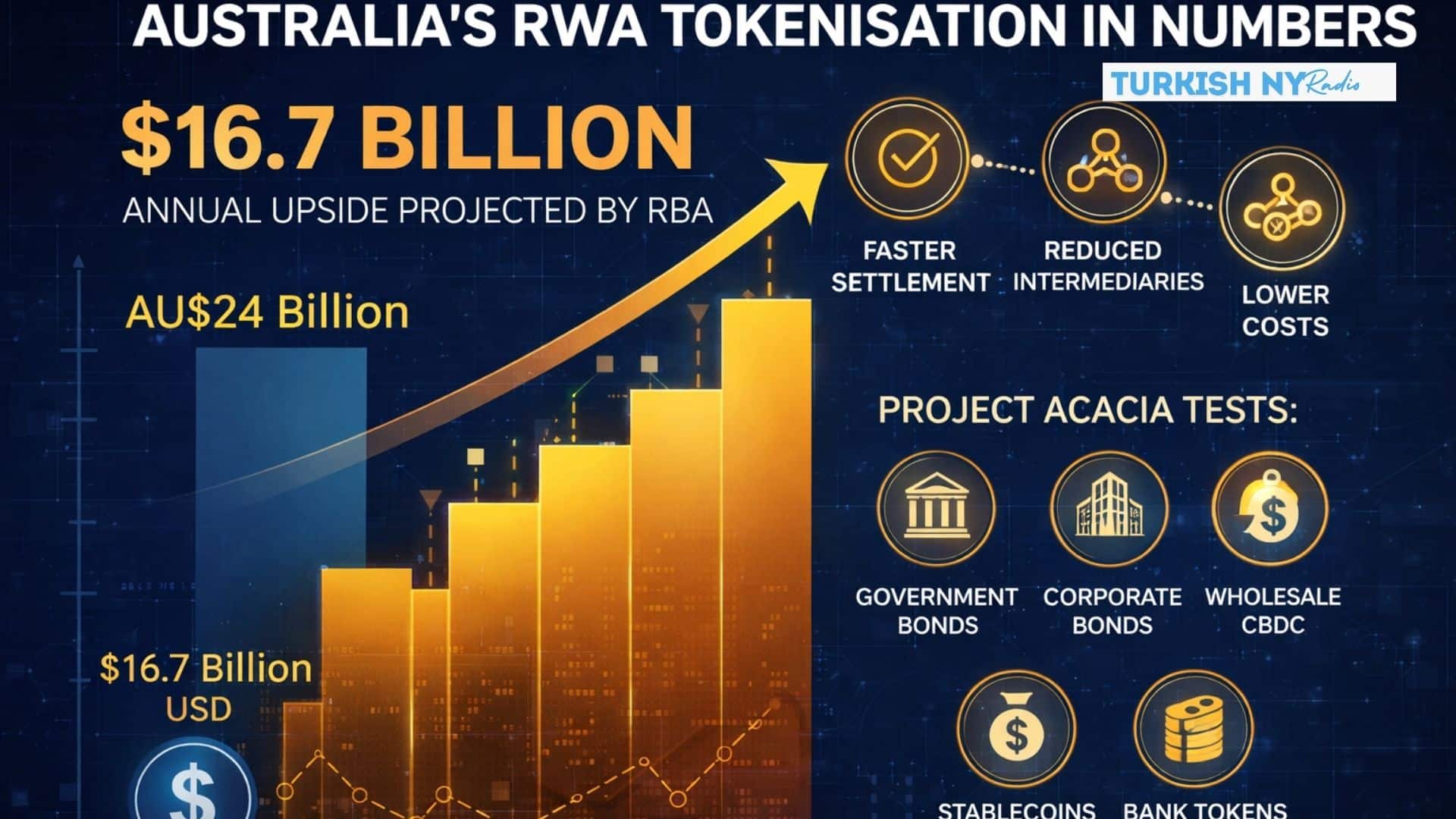
Australia RWA Tokenisation is quickly moving from concept to reality as the Reserve Bank of Australia (RBA) throws its weight behind the technology. A new pilot program has revealed that tokenising real-world assets could unlock up to $16.7 billion annually in economic benefits. This marks a major shift, showing that Australia RWA Tokenisation is no longer experimental, it is becoming a core part of the country’s financial future.


Central Bank Sees Billion-Dollar Potential
The RBA’s latest findings highlight how Australia RWA Tokenisation can reduce costs, improve efficiency, and speed up financial transactions. By converting assets like bonds and funds into blockchain-based tokens, settlement times can drop from days to near-instant.
An RBA official noted that tokenisation could “reshape how financial markets operate,” reinforcing that Australia RWA Tokenisation is now viewed as a serious infrastructure upgrade rather than a niche innovation.
Project Acacia Tests Real Use Cases
At the center of this push is Project Acacia, a large-scale pilot involving multiple financial institutions. The project explored over 20 use cases, including:
- Government bonds
- Corporate bonds
- Repo markets
- Investment funds
The results showed that Australia RWA Tokenisation works across different asset classes, proving its flexibility and scalability.
Importantly, the pilot tested multiple settlement options, including:
- Stablecoins
- Bank deposit tokens
- Wholesale central bank digital currency (CBDC)
This confirms that Australia RWA Tokenisation does not rely on a single system but can operate in a hybrid financial environment.

Digital Finance Sandbox to Accelerate Growth
In order to continue beyond pilot programs, authorities are establishing a digital financial sandbox. This regulated environment will enable organizations to securely test tokenized assets and financial solutions.
The playing field is likely to play an important role in growing Australia RWA Tokenisation by allowing businesses and institutions to develop without immediate regulatory constraint.
Experts think that this measure would help Australia competitive with international contenders like as Hong Kong and Singapore, which are already developing tokenisation systems.
Hybrid Future: Stablecoins and Bank Tokens
One of the most important insights from the pilot is the emergence of a hybrid financial system. The RBA sees a future where:
- Stablecoins support smaller or emerging use cases
- Bank-issued tokens dominate large institutional markets
This dual approach strengthens the case for Australia RWA Tokenisation, making it adaptable to both retail and wholesale finance.
Challenges Still Remain
Despite its promise, Australia RWA Tokenisation faces several hurdles:
- Legal and regulatory uncertainty
- Liquidity fragmentation
- Interoperability between platforms
These issues demonstrate that the problem is no longer technical, but systemic. Authorities and insurance companies must collaborate to guarantee that there is no merger.
Conclusion
The quick advancement of Australia RWA Tokenisation is a watershed moment in finance worldwide. Through strong RBA support, proven pilot outcomes, and a clear path through the digital sandbox, Australia is establishing itself as an industry innovator in tokenised markets.
As the market for securities advances, Australia RWA Tokenisation has the potential to change how equities are issued, transferred, traded, and settled, bringing blockchain-based technologies into the mainstream of finance.
Summary
Australia RWA Tokenisation is gaining traction after the RBA supported its potential to release $16.7 billion every year. Several real-life scenarios demonstrated the market efficiency of tokenized assets through Project Acacia. A proposed digital financial sandbox will help to expedite innovation and acceptance. Although issues such as regulation and accessibility persist, the transition to a hybrid system based on stablecoins and bank vouchers signals a revolutionary future for Australia’s monetary system.
Glossary of Key Terms
RWA Tokenisation: The process of converting real-world assets such as bonds or real estate into a network of virtual currencies.
Stablecoins: Digital currencies tied to stable resources such as fiat currency.
CBDC (Central Bank Digital Currency): An online version of a developing nation’s official currency produced by the central bank.
Repo Market: A market for financial services in which organizations may lend or borrow short-term capital with assets as collateral.
Digital Sandbox: An isolated setting in which financial innovations may be evaluated under regulatory oversight.


FAQs for Australia RWA Tokenisation
1. What is Australia RWA Tokenisation?
It refers to the process of converting real-world assets into digital tokens on blockchain networks within Australia’s financial system.
2. Why is the RBA supporting tokenisation?
The RBA considers it as a means to boost performance, save costs, and update economic architecture.
3. What is Project Acacia?
It is a pilot program testing real-world applications of tokenised assets across multiple financial markets.
4. Will Australia launch a CBDC for tokenisation?
Not necessarily. The RBA is exploring a hybrid model using stablecoins, bank tokens, and possibly CBDCs.
5. What are the risks of RWA tokenisation?
Key hazards including a lack of regulation segmented liquidity, and a lack of compatibility among systems.