![BitTorrent [New]](https://s2.coinmarketcap.com/static/img/coins/64x64/16086.png)


This article was first published on TurkishNY Radio.
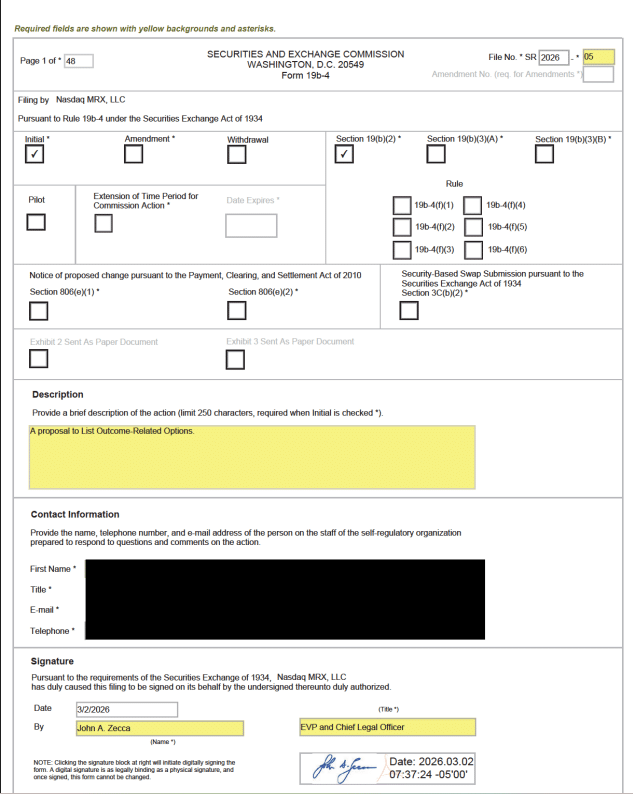
Nasdaq has officially filed to enter the burgeoning prediction market sector. The exchange operator filed with the U.S. Securities and Exchange Commission as it seeks regulatory approval to offer binary-style options based on the Nasdaq-100 Index.


If approved, the proposal would permit traders to make structured yes-or-no bets on specific market outcomes. The move signals that the big Wall Street players are redoubling their efforts to expand into prediction markets, which have long been dominated by crypto-native platforms.
Nasdaq’s application details plans to launch “Outcome-Related Options” via its Nasdaq MRX exchange. The contracts would be price between 1 cent and $1 and be cash-settled
Their focus would be entirely on financial benchmarks like the Nasdaq-100 and Nasdaq-100 Micro indexes. It also puts Nasdaq on the same trading floor as platforms like Polymarket and Kalshi.
This has driven rapid growth in the broader prediction market ecosystem. SEC approval remains pending, but industry analysts say the filing reflects rising institutional confidence in event-based trading structures.
How Prediction Market Contracts Differ From Traditional Trading
Prediction market products allow traders to speculate on specific outcomes rather than traditional price movement alone. Instead of buying or shorting an asset, participants take binary positions tied to defined events.
Nasdaq’s approach differs from crypto platforms that offer markets on politics, sports, or cultural events. The exchange intends to limit contracts to financial benchmarks. This narrower focus may help address regulatory concerns while still tapping into a rapidly expanding segment of the derivatives industry.
Nasdaq’s Proposed Binary Contracts
According to the proposed model, traders would purchase contracts that settle at either $1 or $0 depending on if a specific condition is met. Those contracts would be linked to changes in the Nasdaq-100 index.
Nvidia, Apple, Microsoft, Amazon, Alphabet, Meta and Tesla are top components of the Nasdaq-100. Nasdaq seeks to use established benchmarks to render the prediction market mechanics within a well-known equity framework.
SEC Review and Regulatory Landscape
The filing now awaits review from the SEC. Regulatory scrutiny has intensified as the prediction market sector grows. Some policymakers argue that event-based trading blurs the line between investing and gambling.
However, exchange operators maintain that structured contracts tied to financial indexes fall squarely within derivatives regulation. Nasdaq’s financial-only model may improve its approval prospects compared to broader event-driven platforms.
Competition From Crypto Platforms
Crypto-native platforms have fueled much of the recent expansion in the prediction market industry. Polymarket and Kalshi have reported monthly volumes exceeding $10 billion at times.
Major crypto exchanges are also expanding. Coinbase integrated prediction market products last December. Crypto.com has signaled similar ambitions. Meanwhile, MetaMask incorporated Polymarket access into its mobile application, enabling seamless user participation.
These developments show that digital asset platforms see event contracts as a high-growth category. Nasdaq’s entry signals that traditional finance does not intend to remain on the sidelines.
Wall Street’s Growing Interest
Nasdaq is not alone. Intercontinental Exchange, CME Group, and Cboe Global Markets have also invested in event-based trading strategies or signaled plans to launch related offerings.
CME Group partnered with FanDuel to enable betting-style contracts beyond financial markets. Cboe’s focus remains primarily on finance and economic indicators.
These moves indicate a broader shift. Established exchanges are testing how prediction market products can fit within regulated derivatives frameworks.
ETF and Institutional Expansion
Institutional asset managers are also exploring the trend. Bitwise filed with regulators to launch “PredictionShares” ETFs tied to the 2028 U.S. presidential election. GraniteShares and Roundhill submitted similar filings.
Such applications suggest that structured exposure to event outcomes may soon appear within exchange-traded fund products. If approved, this could further legitimize the prediction market model within traditional portfolios.

Exchange Structure and Incentives
Nasdaq plans to list its contracts initially on Nasdaq MRX. That venue operates on a first-come, first-served execution model and does not pay liquidity incentives.
Other Nasdaq exchanges, including Nasdaq NOM and Nasdaq PHLX, use pricing structures that reward liquidity providers. The company has indicated it may expand Outcome-Related Options across these platforms.
This multi-exchange strategy could strengthen Nasdaq’s competitive position in the prediction market sector.
Market Growth Outlook
Strong growth potential, according to industry forecasts. In 2025, the global prediction market was valued at $17.49 billion. Analysts predict that it could hit $21.24 billion in 2026 and soar to $113.46 billion in the year 2035.
Both crypto and traditional finance are widely adopting outcome-based financial products. Nasdaq’s filing suggests it is confident the model can scale while remaining under regulatory scrutiny
Conclusion
Nasdaq’s proposal marks a pivotal moment for Wall Street’s entry into the prediction market arena. By focusing on financial benchmarks and regulated exchange infrastructure, the company seeks to merge event based trading with established derivatives markets.
Approval from the SEC would place Nasdaq among leading operators in a sector that has rapidly evolved from niche crypto experiment to mainstream financial innovation.
As institutional participation rises and regulatory clarity improves, the prediction market industry appears poised for continued expansion.
Appendix: Glossary of Key Terms
Binary Contract: Financial contract that ends with a predetermined value, usually 0 or 1, depending on whether an event happens.
Outcome-Related Options: Nasdaq ground-up contracts with yes or no positions based on particular events occurring for the index.


Cash-Settled: A contract that defaults on cash when it expires instead of physical settlement.
Nasdaq-100 Index: Stock market index composed of 100 of the largest non-financial companies listed on Nasdaq
Open Interest: This represents the total number of open, active derivatives contracts that have not yet been settled.
Liquidity Provider: A trader that provides buy and sell orders to enhance the volume on trade and price in market.
Frequently Asked Questions Prediction Market
1- What is a prediction market?
A prediction market is a platform on which users can purchase contracts whose payoff depends on whether the events they expect to occur actually happen.
2- What is Nasdaq proposing?
Nasdaq is seeking to launch cash settled binary options based on the Nasdaq-100 index.
3- Are these contracts related to politics or sports?
No. Nasdaq’s proposal focuses only on financial benchmarks.
4- How are these contracts priced?
They would trade between 1 cent and $1 and settle at either $0 or $1 depending on the outcome.
References