

This article was first published on TurkishNY Radio.
Most countries approach crypto with noise, but Bhutan chose silence and structure. Without fanfare, the Himalayan nation is building a green Bitcoin economy grounded in energy economics, fiscal discipline, and carefully designed regulation. This effort does not chase hype or retail speculation. It focuses on infrastructure, long-term value, and national priorities.


Bhutan started with one straightforward inquiry. What to do if a country has more electricity from renewable sources than it can currently consume? Bhutan decided not to waste energy or sell it for next to nothing, but instead convert its surplus power into a digital asset of global reach. Bhutan Bitcoin mining does not function as trade. Policymakers treat it as infrastructure tied directly to the energy system.
This decision reshaped how analysts view crypto adoption at the state level. Bhutan did not invite speculation. It built a framework.
Energy Reality Comes Before Crypto Ideology
Bhutan’s economy depends on hydropower. Rivers fed by glaciers and monsoon rains generate almost all domestic electricity. During peak seasons, power generation rises far above local demand. Utilities often export that surplus at thin margins or reduce output when buyers disappear.


Public energy planning data shows that Bhutan holds about 33 gigawatts of technically viable hydropower capacity. Domestic demand remains close to one gigawatt. This gap creates inefficiency. Every unused unit of electricity loses value the moment generation exceeds consumption. Bhutan’s leadership understood that computation could absorb this surplus better than transmission alone.
Studies on renewable-heavy grids show that flexible demand systems reduce curtailment and improve efficiency by converting excess generation into computation rather than waste. Bhutan aligned its digital strategy with this principle. The country did not adopt crypto ideology. It followed energy logic.

Turning Surplus Power Into a Digital Export
Bhutan Bitcoin mining operates under the country’s sovereign investment arm. This decision defines the strategy. The government did not open mining to unregulated private actors. It structured operations as a state-aligned industrial activity.
Bhutan started mining Bitcoin with surplus hydroelectric power a few years ago, according to figures released in public financial reports. Without increasing taxes or adding to public debt, the proceeds were intended to provide foreign-currency liquidity. Mined Bitcoin would, over time, balance public finances, supplementing as necessary routine government expenditure in periods of fiscal difficulties.
Independent reporting on Bhutan’s fiscal position confirms that crypto-related revenue helped stabilize public accounts when traditional sources tightened. The distinction matters. The government did not purchase these assets using public funds. It produced them from energy that would otherwise deliver limited economic returns.
This approach places Bhutan Bitcoin mining closer to energy monetization than speculative finance.
Bitcoin as a Seasonal Energy Buffer
Hydropower systems face a timing mismatch. Rivers run strong in summer and weaken in winter. Large-scale battery storage remains costly and limited. Bhutan chose a different solution.
In January 2025, planning material linked to Gelephu Mindfulness City described Bhutan’s use of green Bitcoin as a way to monetize surplus summer hydropower and later convert that value into imports when electricity supply tightens, with officials comparing Bitcoin to a strategic battery.
Energy economists describe this model as demand response. Flexible computation adjusts to supply instead of forcing consumption to match output. Research on renewable integration shows that this approach can stabilize grids when governments enforce strict oversight and scale controls.
Bhutan integrated Bitcoin into its energy rhythm instead of treating it as an external system.
Scaling Without Losing Control
Bhutan avoided rapid expansion. Authorities scaled mining capacity gradually through structured partnerships focused on renewable-powered infrastructure. The country restricted retail participation and blocked speculative inflows.
This restraint prevented grid stress and policy backlash seen in other regions. Mining remained tied to national energy planning rather than market sentiment. For developers and analysts, the lesson is clear. Infrastructure-first systems age better than hype-driven ones.
Bhutan Bitcoin mining reflects patience. The country built slowly, tested carefully, and adjusted policy as conditions evolved.

Regulation by Design
Bhutan regulated crypto before problems appeared. The central bank introduced a phased framework that allows mining and related services only through approved entities within a defined jurisdiction. This structure ensures oversight, reduces consumer risk, and limits exposure to financial crime.
Research in international policy consistently shows that a regulatory sandbox regime is much better able to manage risk in digital assets than prohibition or laissez-faire management. Bhutan followed this route.
By concentrating activity inside a controlled environment, regulators maintained visibility while preserving innovation. The country did not confuse openness with recklessness.
Transparency and Its Limits
Blockchain explorers identified wallets linked to Bhutan’s mining operations. These findings suggest that holdings came from mining rather than enforcement actions. However, on-chain visibility does not replace audited disclosure.
Wallet attribution can change. Markets shift. Analysts stress that just as much as technology, openness depends on management. Bhutan has recognized this fact and charted plans to strengthen public reporting over time.
Global crypto governance research supports this view. Blockchains reveal data. Institutions build trust.
Environmental Claims Under Scrutiny
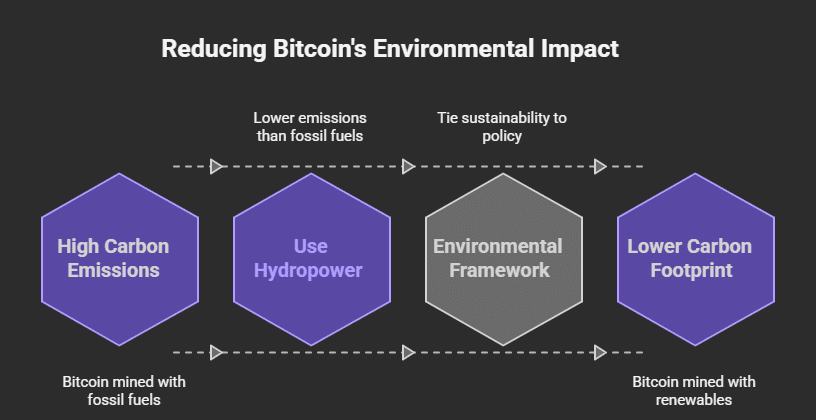
Officials stress that Bitcoin mined with hydropower carries a lower emissions profile than fossil-fuel-based mining. Energy studies back up this conclusion. Shifting computation toward renewables reduces overall carbon intensity.
Still, environmental risks remain. Hardware manufacturing carries a footprint. Infrastructure development affects ecosystems. Hydropower expansion changes river systems. Bhutan applies its broader environmental framework to mining-related projects, tying sustainability to policy rather than branding.
This discipline supports the credibility of the green Bitcoin economy narrative.
Understanding the Wider Crypto Context
Although Bhutan focuses on Bitcoin, analysts track broader crypto indicators to assess systemic risk. Network difficulty adjusts regularly to reflect global competition. Hash rate trends reveal how miners respond to energy prices and policy shifts.
Developer communities also influence long-term narratives. Discussions around high-throughput networks continue across technical forums and social platforms. Analysts often cite verified network data rather than price action when debating scalability and security trade-offs.
These indicators explain why Bhutan chose Bitcoin. The network’s security model and settlement history make it suitable for sovereign experimentation despite volatility.
Risks That Remain
Bitcoin price swings remain the biggest challenge. Even when mining uses surplus energy, sudden market moves can complicate planning and limit how quickly digital assets can support public needs. Bhutan manages this by treating Bitcoin as a long-term reserve rather than a source of short-term funding.
Regulatory shifts also matter. Policy changes in larger economies can affect liquidity and settlement conditions across global markets. Bhutan reduces this exposure by keeping crypto activity tightly regulated and limited to approved entities.
Cybersecurity risks persist as well. Mining and custody systems face constant technical threats. Bhutan limits this risk by centralizing operations, avoiding retail participation, and scaling carefully instead of expanding fast.
These risks explain the country’s cautious stance. Bitcoin mining does not have a single point of reliance. It assists in a broader perspective of energy and industrial strategy.
Final Thoughts
Bhutan’s green Bitcoin economy did not emerge from ideology or speculation. Real constraints shaped it. A surplus of clean energy, low domestic demand, and the need for fiscal resilience guided every decision.
By integrating mining operations with national energy infrastructure and regulatory planning, Bhutan challenges accepted wisdom. Yet whether this pioneering experiment can stand up in the long run depends on a few key factors: transparency, expanding energy, and above all, rule-based discipline.
So far, Bhutan Bitcoin mining is a rare instance where digital assets not only have been integrated into the physical economy carefully, but they have also achieved their own economic model.
Glossary
-
Bitcoin mining: This is the method of utilizing state-of-the-art computers to strengthen the Bitcoin system, while getting new coins as a reward.
-
Hydropower: Electricity generated from flowing water. It is usually renewable and low-carbon.
-
Green Bitcoin economy: Renewable energy powers Bitcoin mining under ecological and regulatory oversight conditions.
-
Sovereign investment arm: A state-owned body that manages the nation’s investments and assets.
-
Regulatory sandbox: A controlled environment where financial innovation can be tried, and then, if necessary, regulated.
-
Hash rate: The total computing power that supports the Bitcoin network.
-
Network difficulty: A mechanism that keeps Bitcoin block production steady.
-
Foreign-currency liquidity: International payments and financial stability are underpinned by the assets needed today for those ends.- only Society needs
FAQs About Bhutan Bitcoin Mining
1. Why did Bhutan choose Bitcoin mining instead of exporting all surplus electricity?
Export markets often offer limited returns. Mining converts surplus power into a globally transferable asset.
2. Is Bhutan Bitcoin mining environmentally sustainable?
Hydropower supplies the energy, though the infrastructure still requires environmental oversight.
3. Does Bhutan allow citizens to trade or mine Bitcoin freely?
No. Authorities restrict activity to approved entities to limit financial risk.
4. Can other countries replicate this model?
Only nations with surplus renewable energy and strong governance could adapt it successfully.