![Sun [New]](https://s2.coinmarketcap.com/static/img/coins/64x64/10529.png)




This article was first published on TurkishNY Radio.
Money has always powered the creator economy, but how it moves is now the real story. YouTube stablecoin payouts introduce a subtle yet meaningful shift in how creators interact with their earnings, not by changing how income is generated, but by changing how value is delivered.


By allowing eligible US creators to receive payouts through a dollar-backed stablecoin, YouTube is quietly testing a future where digital dollars sit alongside banks and payment apps. This development raises more profound questions about speed, control, and financial flexibility in creator monetization, and why payment infrastructure may matter more than algorithms in the years ahead.
This move places stablecoins inside one of the world’s largest digital income machines. For financial students, crypto builders, and market analysts, the decision signals something more profound than a new payout button. It shows how digital dollars are sliding into mainstream platforms as settlement tools, not speculative assets. The long-term effects could reshape creator monetization, treasury habits, and global payment design.
A Familiar Earnings Model With a New Exit Door
YouTube’s revenue engine remains intact. Advertising revenue, channel memberships, Super Chats, and other features still generate income in US dollars. Creators still see dashboards denominated in fiat terms. Taxes, reports, and statements remain dollar-based. The platform did not add crypto rewards or token incentives.
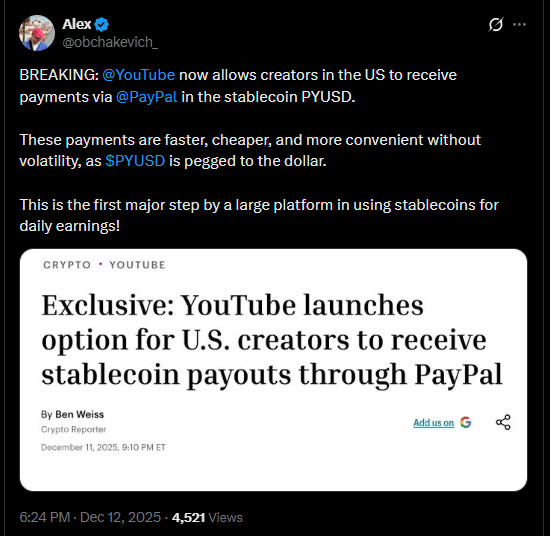
The change appears at the final step. Instead of sending earnings only to a bank account or a standard PayPal balance, creators can opt into YouTube stablecoin payouts. These payouts are paid in PayPal PYUSD, a stablecoin pegged to the US dollar. This option remains voluntary and limited to US creators. No global rollout timeline exists yet.
This design choice matters. It avoids forcing creators into new risk models. It also keeps YouTube outside direct crypto custody. The platform does not touch blockchains. It relies on PayPal’s existing payout infrastructure to manage conversion and delivery.
How the Payout Plumbing Actually Works
Understanding the mechanics clarifies the impact. First, a creator earns revenue on YouTube. Second, YouTube routes that revenue through PayPal’s Hyperwallet system, the same backbone used for many global payouts. Third, PayPal handles disbursement.
With the stablecoin option enabled, PayPal converts US dollars into PayPal PYUSD at the payout stage. The creator receives PYUSD inside PayPal’s ecosystem. From there, the stablecoin can remain in PayPal, be redeemed for dollars, or be moved to supported blockchains and wallets, subject to PayPal’s terms and fees.
This flow shows why the update is not a crypto experiment by YouTube. It is an infrastructure choice. PayPal sits between traditional finance and blockchain rails. YouTube allows creators to choose which rail they prefer at the exit point.
What a Stablecoin Payout Means in Real Life
A stablecoin payout does not, by default, expose creators to sudden price swings. PayPal PYUSD is designed to track the US dollar at a 1:1 ratio. According to PayPal and Paxos disclosures, reserves include US dollar deposits, short-term US Treasurys, and cash equivalents, with regular attestations published by Paxos. These disclosures appear in Paxos’ transparency reports and PayPal’s official documentation.
For a creator, the experience can feel similar to holding a PayPal balance. The difference lies in portability. PYUSD represents a digital dollar that can move across specific blockchain networks. That portability creates optionality rather than obligation. Creators can stay entirely within PayPal and never touch on-chain transfers.
Why Creators and Analysts Should Pay Attention
For creators, speed and access often matter more than ideology. Traditional bank payouts follow business hours. Settlement pauses on weekends and holidays. Stablecoins, by design, operate around the clock once issued. While PayPal’s internal processes still apply, the underlying asset supports continuous transfer.
This matters for teams managing payroll, editors, and contractors. It also matters for creators who operate across time zones. If expanded globally, stablecoin rails could reduce reliance on slow correspondent banking networks. For now, that remains a future scenario rather than a current benefit.
From an analyst’s view, YouTube stablecoin payouts show how digital dollars gain legitimacy through quiet integration. No token launch exists. No speculative narrative exists. Utility drives adoption.
Fees Remain Part of the Equation
Stablecoins do not erase costs. PayPal may still charge payout fees. Moving PYUSD on-chain can trigger network fees, also known as gas fees. Converting PYUSD back to fiat may incur spreads or off-ramp fees. The cost structure depends on behavior, not marketing promises.
Studies from Chainalysis and Messari often highlight that stablecoins reduce friction in specific corridors, not universally. Savings are evident in cross-border contexts or in high-frequency settlement use cases. Creators who cash out immediately to banks may see little difference.
Treasury Choices Expand, Complexity Follows
Receiving PYUSD introduces a new asset type into creator finances. For solo creators, this may add minimal complexity. For larger operations, treasury management becomes more nuanced. Holding stablecoins can support faster internal transfers or integration with decentralized finance tools, though such use introduces new risks.
Accounting also becomes more complex. Earnings originate in dollars. Subsequent movements of PYUSD can create taxable events depending on the jurisdiction. The Internal Revenue Service treats crypto transactions differently from simple bank transfers. Professional tax guidance remains essential.

Risks Deserve Equal Attention
No payment system is risk-free. Stablecoins rely on issuers, custodians, and regulators. PayPal PYUSD depends on Paxos for issuance and reserve management. Although Paxos operates under regulatory oversight in the United States, counterparty risk remains.
Regulation also continues to evolve. In the US, stablecoin frameworks appear in ongoing legislative discussions. In Europe, the Markets in Crypto-Assets regulations require that any stablecoin issuer wishing to operate in the euro area comply with exceptionally stringent standards. Financial Stability Board and FATF reports underscore the importance of adherence and transparency as current priorities Shifts in policy could affect performance data, or provide support for certain actions.
A Signal Aligned with Broader Payment Trends
YouTube’s update fits a pattern seen across finance. Payment networks and banks increasingly explore stablecoins as settlement tools. Visa has tested stablecoin settlement with Circle’s USDC, as documented in Visa’s public statements. These initiatives focus on efficiency, not speculation.
In this context, YouTube stablecoin payouts represent normalization. Digital dollars coexist with bank deposits. Users choose based on convenience, speed, and integration.
Developer and Crypto Community Reactions
Blockchain developers often view this move as validation. Stablecoins gain relevance when large platforms adopt them without hype. Discussions in developer forums emphasize interoperability and compliance rather than price action.
Social media communities also link the trend to broader blockchain adoption. Analysts discussing Solana price potential often reference real-world usage signals rather than transaction speed alone.
Solana’s block explorer shows high throughput, with thousands of transactions per second under certain conditions, according to Solana Labs’ documentation. While YouTube payouts do not rely on Solana specifically, such discussions show how utility narratives influence market sentiment.
What this Means for the Future of Creator Monetization
The immediate impact remains modest. Only US creators qualify. Opt-in adoption will vary. Yet the structural implication runs deeper. Monetization no longer defaults to a bank account. It ends in a choice.
Over time, platforms may offer multiple payout rails. Digital wallets, stablecoins, and traditional accounts may coexist. Creators could select rails based on geography, speed, or financial strategy. This flexibility could reshape how digital labor connects to global finance.
A Quiet Shift with Lasting Implications
YouTube did not market this change as a revolution. That restraint matters. True infrastructure shifts often arrive quietly. By embedding stablecoins into payouts, the platform normalizes digital dollars without forcing ideology or risk.
For financial students, the case illustrates how payment systems evolve. For crypto enthusiasts, it shows utility beating hype. For developers, it highlights integration over disruption. For analysts, it signals that the future of money may arrive through settings menus rather than headlines.
Conclusion
The arrival of stablecoins in YouTube’s payout system does not guarantee an instant financial transformation. It does something more important. It offers choice. YouTube stablecoin payouts show how digital platforms can modernize money movement without forcing creators into speculation or complexity.
For creators, the shift invites more innovative thinking about cash flow, access, and financial structure. For analysts and developers, it signals that the future of blockchain adoption may not arrive through bold disruption, but through quiet integration.
The ongoing expansion of digital labor among different countries and platforms could give real benefits to those who know not only the earning routes but also the traveling ones.
This article is for informational purposes only and does not constitute financial advice. Readers should conduct their own research and consult qualified professionals before making financial decisions.
Glossary
Stablecoin: A digital asset created to maintain a stable value, typically pegged against a fiat money.
PayPal PYUSD: A stablecoin in US dollars issued by Paxos in collaboration with PayPal.
Hyperwallet: PayPal’s global payout infrastructure used by platforms for creator payments.
On-chain transfer: Movement of digital assets recorded on a blockchain network.
Settlement: The final transfer of funds that completes a payment transaction.
FAQs About YouTube Stablecoin Payouts
1. What are YouTube stablecoin payouts?
YouTube stablecoin payouts allow eligible US creators to receive their earnings in a US dollar–backed stablecoin instead of a traditional fiat payout, without changing how revenue is earned.


2. Does receiving payouts in PayPal PYUSD change creator earnings?
No. Creator earnings remain calculated and reported in US dollars. The stablecoin option only changes the payout method, not the monetization structure.
3. Are there additional risks with stablecoin payouts?
Stablecoin payouts may introduce platform, accounting and delivery risks. Areas of pain include exposure to fees, reliance upon custodians and increased tax reporting complexity.
4. Can creators switch back to traditional payout methods?
Yes. The stablecoin payout option is voluntary, and creators can revert to standard bank or PayPal fiat payouts at any time.