This article was first published on TurkishNYR.
The idea of building on-chain used to feel like a club with a password. Today it looks more like publishing on the early internet: the tools are real, the audiences are real, and mistakes are very public. A first dApp build usually fails for ordinary reasons, not exotic cryptography.


The contract logic is vague, the wallet flow is confusing, the test coverage is thin, or the team ships to mainnet before they can explain the risk in plain English. The good news is that a solid first release does not require a giant budget or a celebrity audit. It requires a disciplined build path that treats reliability like a product feature, because that is what users quietly judge.
Building a Decentralized Application: what “first” should mean
A first decentralized application (dApp should aim for a narrow promise that can be explained in 1 sentence without hand-waving. Think “deposit, earn, withdraw” or “mint, list, buy” instead of “reinvent finance.” The simplest mental model is a vending machine with transparent rules: inputs go in, a deterministic outcome comes out, and the machine cannot be sweet-talked into doing something different.
That is the advantage of a decentralized application when done right, and also the trap when requirements are fuzzy, because code is literal and does not care about intention.
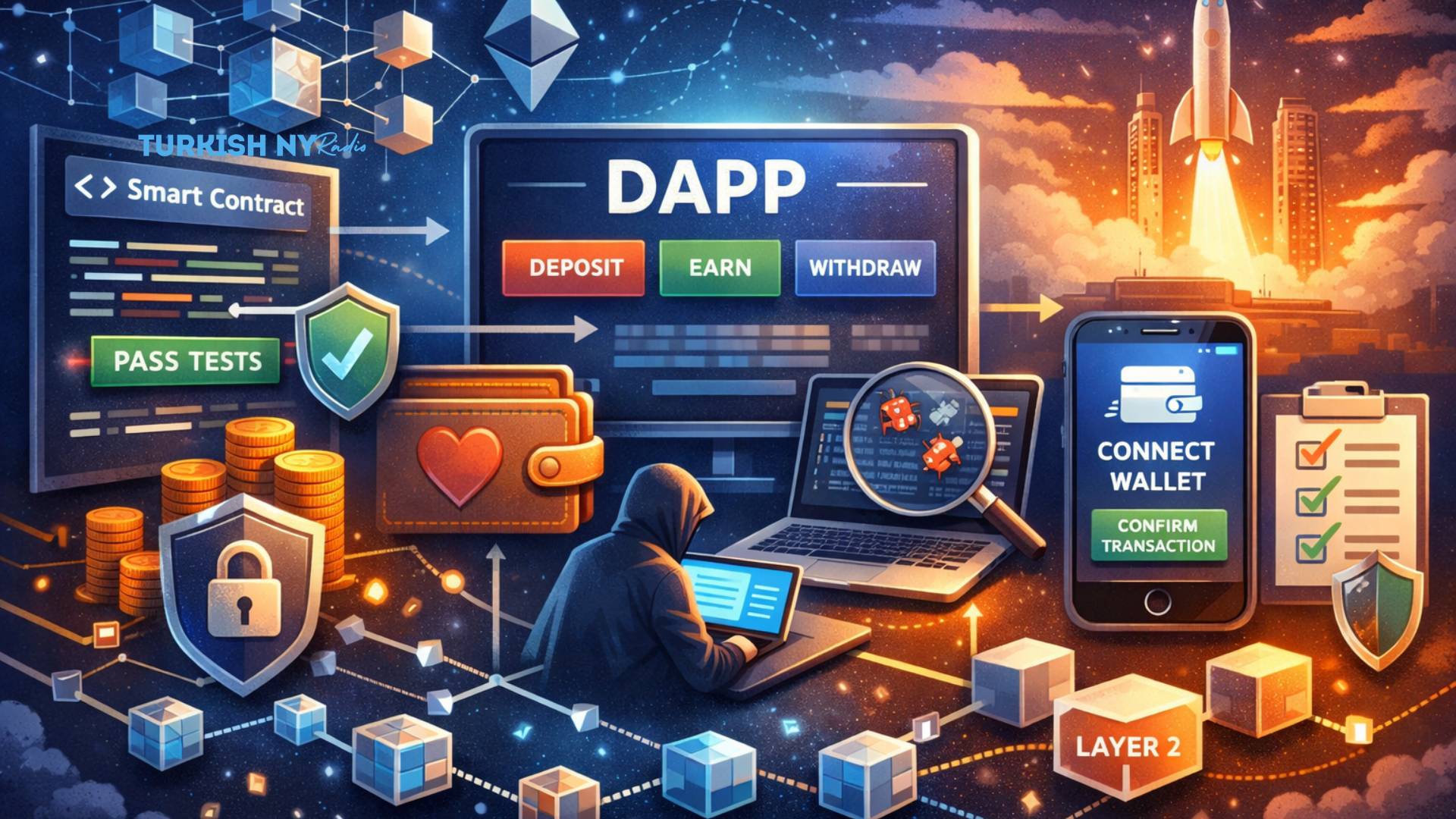
A practical starter scope has 3 layers. First is the smart contract, which defines state and rules. Second is a wallet connection, which is the identity and signature layer. Third is a frontend that reads data, prompts actions, and tells the truth when something fails. In 2026, the best teams treat that “telling the truth” part as core UX, since crypto users are tired of vague spinners and mystery errors.

Pick a use case that fits on one page
A strong beginner project can be described as a single screen with one primary action. Examples include a tip jar, a simple on-chain poll, a time-locked savings vault, or an NFT mint that has one supply rule and one price rule. If the project needs a governance system, a referral loop, and a cross-chain bridge on day 1, it is no longer a first build; it is a stress test.
This is also where compliance and reputation enter early. A decentralized application that touches deposits, yields, or pooled funds is instantly held to a higher standard, even before regulators are mentioned. A smaller feature set is not “less ambitious” in the real world, it is how software survives first contact with users.
Choose a chain by measuring friction, not hype
Chain selection sounds political, but it is mostly operational. Fees, wallet support, tooling quality, and block explorers matter more than slogans. Many first builds lean toward Ethereum-compatible networks because Solidity tooling and libraries are mature. Layer 2 networks can reduce transaction fees and make testing with real users less painful, especially when a single interaction might otherwise cost more than a casual user wants to spend.
Wallet UX is the hidden deciding factor. A decentralized application that requires 5 approvals and a confusing network switch will bleed users, no matter how clever the contract is. Modern wallet standards also keep evolving, especially around “smart accounts” that can enable features like batching, session keys, and sponsored fees. Account abstraction via ERC-4337 is one prominent approach, designed to enable smart contract wallets without changing Ethereum’s base protocol.
Write the contract as if it will be attacked, because it will be
A first contract should be small enough to audit with human eyes. Common rookie mistakes are not dramatic; they are boring and costly. Access control is unclear. Inputs are not validated. State changes happen in the wrong order. The contract assumes an external call will behave nicely. The fix is not fear, it is method.
Start by writing the contract interface in plain language. What functions exist, who can call them, what state changes, and what events should be emitted for indexing.
Then implement, then test, then try to break it on purpose. Many teams use development frameworks such as Hardhat for testing, deployment, and debugging workflows in Solidity projects. A decentralized application feels trustworthy when its contract behavior is predictable under stress, not just correct in a happy-path demo.

Test locally, then test in public on a test network
Local testing is where logic mistakes should die quietly. Unit tests should cover success paths and failure paths. If a function is supposed to revert, the test should prove it. If balances should remain conserved, the test should enforce it. After local tests, deploy to a public test network and run the whole flow with a real wallet, because local simulations can hide UX friction.


This phase also reveals whether the frontend is honest. A user should see what they are signing, what it costs, and what the contract will do next. Many teams use JavaScript libraries to interact with contracts and chain data, and the v6 documentation for one widely used Ethereum library explicitly frames it as a tool for building dapps, wallets, and scripts. The real takeaway is simple: the decentralized application must present blockchain actions in a way that does not feel like reading a legal document at 2 a.m.
Connect wallets with a flow that respects user patience
Wallet connection is not a checkbox, it is the start of trust. A clean flow uses a familiar connection method, shows the network clearly, and fails gracefully when the user cancels. Many apps integrate WalletConnect to support mobile wallets and remote signing flows across devices, using the protocol’s SDKs and documentation as the integration reference.
Once connected, the frontend should do 3 things well: read on-chain state, format it clearly, and submit transactions only when the user’s intent is explicit. A decentralized application that triggers unexpected signature requests feels suspicious, even if it is technically safe.
Indexing and data: make it fast without making it fake
Most dApps need history: deposits, withdrawals, mints, transfers, votes. Reading directly from the chain every time can be slow and expensive. A common approach is to emit events from contracts and index them with a lightweight backend or an indexing service, then treat on-chain calls as the source of truth for balances and critical state.
This is also where teams earn credibility. If the UI shows “claimed” before the transaction is confirmed, users will remember. If it shows accurate statuses and links to transaction hashes, users relax. That relaxed feeling is what separates a hobby build from a decentralized application that people actually return to.
Security basics that matter more than flashy features
Security is not only about exploits, it is also about minimizing user regret. A starter release should include rate limits where appropriate, clear admin boundaries, and a pause mechanism only if it is transparently governed and documented. If upgrades are planned, that needs to be explained in plain language because upgradability changes trust assumptions.
Before any mainnet launch, the contract should be reviewed by someone who did not write it, even if that person is a senior developer friend doing a structured walkthrough. A decentralized application does not need perfection to launch, but it does need humility and guardrails.
Launch like a product team, not like a gambler
A clean launch has staged exposure. Start with a small cap or a limited feature flag. Monitor transactions and error logs. Watch how users behave, not what they claim in comments. If a transaction regularly fails due to slippage or gas limits, fix that before adding new features. The earliest weeks are where a decentralized application earns its long-term reputation, and reputations in crypto stick longer than anyone admits.
Conclusion
Building a first decentralized application (dApp) is less about chasing the newest narrative and more about shipping a small system that behaves the same way every time. The winning formula is ordinary: a narrow scope, a readable contract, real tests, a respectful wallet flow, honest UI states, and security decisions that are explained without theatrics. When those pieces are in place, the project stops feeling like an experiment and starts feeling like software.
Frequently Asked Questions (FAQs)
What is the fastest path to a working first release?
A working first release usually comes from shrinking the scope until the core action fits on one screen, then building the contract, wallet flow, and UI in that order, with testing at each step.
Should the first project launch on mainnet immediately?
A first project is typically safer when it runs on a test network first, then launches with limits and monitoring, since early user behavior exposes hidden edge cases.
How much should users expect to pay in fees?
Fees vary by network and congestion. Many teams choose lower-fee environments for early adoption, but users should still be warned that transaction costs can change quickly.
Is an audit required for a small project?
A formal audit is ideal for high-stakes contracts, but at minimum, there should be an independent review and strong testing, especially for contracts holding funds.
What is the biggest UX mistake beginners make?
The most common UX mistake is unclear signing prompts and confusing transaction states, which makes users feel unsafe even when the code is fine.
Glossary of Key Terms
Smart contract: A program deployed on a blockchain that enforces rules and stores state.
Wallet: Software or hardware that holds keys and signs transactions.
Gas fee: The network fee paid to process a transaction.
Test network: A public blockchain environment used for testing without real asset risk.
Account abstraction: A design approach that allows programmable wallet behavior, often enabling features like batching and sponsored fees.
Indexing: Collecting and organizing blockchain events and data so an app can query history efficiently.
RPC provider: Infrastructure that allows an app to read from and send transactions to a blockchain network.
Layer 2: A scaling network that settles to a base chain while offering lower fees or higher throughput for users.
Sources
Disclaimer
This article is for informational and educational purposes only and does not constitute financial, legal, or investment advice.