![Sun [New]](https://s2.coinmarketcap.com/static/img/coins/64x64/10529.png)




This article was first published on TurkishNY Radio.
Stablecoins once promised simplicity as each token claimed steady value and instant redemption into real currency. That promise now faces a deeper legal test shaped by lawmakers in the United States and Europe. New rules are transforming stablecoin regulation from a technical debate about reserves into a constitutional question about rights, liquidity, and survival during panic.


The GENIUS Act in the United States and the MiCA framework in the European Union are drawing a sharp boundary inside the digital-dollar universe. Some stablecoins will function as constitutional cash protected by enforceable redemption and strong reserves. Others will resemble shadow deposits that appear stable in calm markets but reprice like credit when fear spreads.
This divide marks a turning point for digital finance. The next crisis will not hinge on whether assets exist somewhere on a balance sheet. It will hinge on whether holders can legally and practically reach those assets when the trust collapses.
Reserve Access Matters More Than Reserve Existence
For years, stablecoin safety centered on collateral backing. Issuers published attestations to prove every token matched real assets. Financial history shows a different pattern. Panic rarely begins because assets disappear. Panic begins when assets become unreachable.
Stablecoin resilience therefore, depends on two linked forces. First, holders must possess a clear legal right to redeem at face value. Second, redemption infrastructure must function even during banking disruption. Without both protections, a fully backed token can still trade below one dollar in secondary markets.
This shift in thinking now guides policymakers. Stablecoin regulation increasingly focuses on legal priority, custody design, and emergency liquidity, not just reserve totals. Digital money is moving from marketing assurance toward enforceable financial architecture.
The Silicon Valley Bank Shock That Changed the Debate
A real-world stress test arrived in March 2023. During the collapse of Silicon Valley Bank, part of the reserves supporting a major dollar-pegged stablecoin became temporarily trapped inside the failed institution. Markets reacted instantly, pushing the token below parity despite sufficient overall collateral.
Later financial stability analysis in the United States clarified the episode’s meaning. The instability reflected friction in redemption rails, not insolvency. In other words, reserves existed but could not be accessed quickly. Secondary-market pricing captured delayed liquidity rather than missing backing.
Policymakers aim to ensure redemption remains reachable even when financial plumbing breaks. The events surrounding Silicon Valley Bank became a blueprint for the next generation of stablecoin safeguards.

The GENIUS Act Draws a Bright Line Around Digital Cash
The United States responded by defining payment stablecoins within a strict legal perimeter. The GENIUS Act requires high-quality liquid reserves, transparent reporting, and supervisory oversight designed to anchor digital dollars inside traditional monetary safety.
Its most consequential rule is the absolute prohibition on yield for simply holding a payment stablecoin. Economists view this as run prevention, not moral judgment. When an instrument that behaves like cash begins paying interest, users treat it like an uninsured bank deposit. History shows such structures accelerate panic withdrawals.
Issuers may attempt to replicate yield through rewards programs, token wrappers, or indirect benefits engineered to mimic interest without naming it. These gray-zone incentives test whether substance or marketing defines compliance. The durability of the U.S. framework depends on closing those hidden pathways while preserving innovation.
MiCA Turns Redemption Into a Statutory Right
Europe chose a different path rooted in legal certainty as the MiCA regime classifies crypto assets and embeds redemption rights directly into statute for qualifying tokens. Holders gain an enforceable claim to repayment at face value at any time, transforming stablecoin promises into legal obligations rather than discretionary assurances from private issuers.
European authorities also recognize that scale changes financial physics. When a stablecoin grows into a dominant payment rail, transaction volume itself becomes a stability concern capable of influencing liquidity conditions, cross-border capital movement, and even monetary transmission. Supervisors can slow expansion or impose limits to protect the monetary system, ensuring innovation does not outpace financial resilience or consumer protection.
This philosophy treats stablecoin regulation as part of the constitutional financial order. Legal clarity and systemic safety take priority over rapid experimentation. In contrast to the boundary-driven approach of the GENIUS Act in the United States, Europe’s framework centers on enforceable redemption as the foundation of trust, signaling that the future of digital money may ultimately depend more on statutory rights than technological design alone.
Cross-Border Multi-Issuance Could Become a Run Magnet
Many stablecoin brands operate through multiple legal entities across jurisdictions while presenting a single interchangeable token. Calm markets hide this complexity. Crisis conditions expose it. Under emerging stablecoin regulation shaped by the GENIUS Act and Europe’s MiCA framework, this structural ambiguity is becoming harder to ignore.
During panic, rational holders will seek redemption where legal protection is strongest. That migration can overwhelm local reserves even if global backing appears sufficient. The Bank of Italy has urged clear standards for multi-issuance, while European institutional debates warn that interchangeability itself may embed systemic risk. These concerns reflect a broader fear that fragmented legal claims could fracture confidence at the exact moment stability matters most.
Without coordination, stablecoins could recreate the contagion dynamics once seen in shadow banking. Geography, not technology, may determine survival during stress. As lawmakers refine stablecoin regulation, cross-border redemption rights and supervisory alignment are likely to become central tests of credibility in the next financial shock.
A Two-Tier Stablecoin System Is Taking Shape
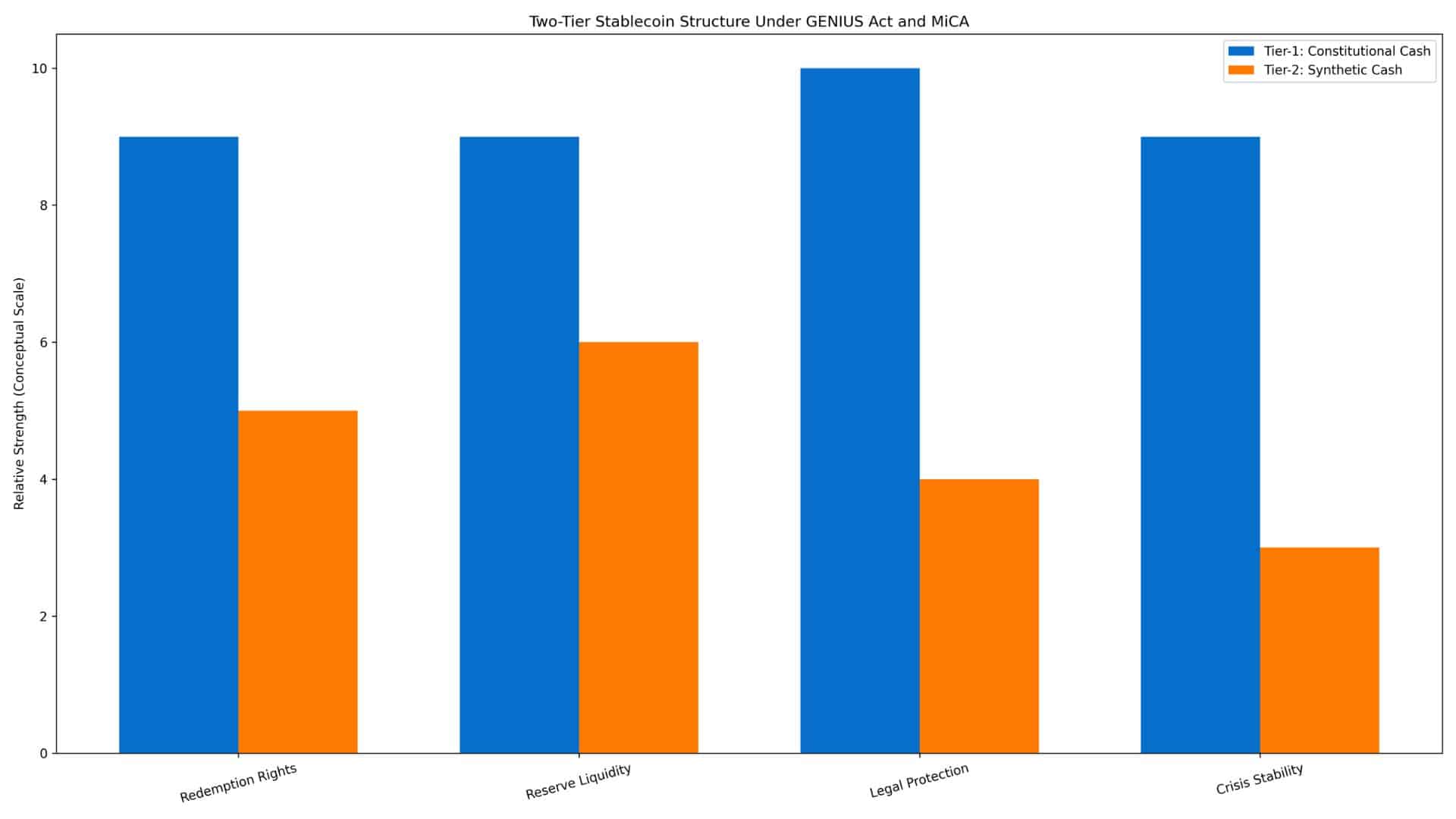
Regulatory convergence now points toward a structural hierarchy. The GENIUS Act in the United States and MiCA in Europe are quietly steering stablecoin regulation toward a model that separates legally protected digital money from risk-sensitive substitutes.
Tier-1 stablecoins will function as constitutional cash. They combine statutory redemption rights, high-quality liquid reserves, continuous supervision, and strict prohibition of yield or yield-like incentives. Their architecture aims to preserve one-to-one convertibility even during systemic panic. If successful, these instruments could become a foundational payment infrastructure for institutions, markets, and cross-border settlement.
Tier-2 stablecoins will behave as synthetic cash that reprices like credit. These tokens may rely on weaker legal claims, jurisdictional arbitrage, or incentive structures such as wrappers, rewards, and indirect yield engineering. They can appear stable in normal conditions yet fall sharply when redemption demand surges. In periods of stress, market pricing may begin to reflect perceived legal strength rather than simple reserve backing.
Financial history repeatedly shows that assets resembling deposits reveal hidden fragility during crises. Stablecoins are unlikely to escape that pattern. The direction of future stablecoin regulation suggests that durability will depend less on branding and more on enforceable rights, transparent liquidity, and coherent legal design across jurisdictions.
Stablecoins Must Now Be Rated Like Credit Instruments
Evaluating a stablecoin increasingly resembles rating a bond or bank liability. Observers must ask whether every holder holds a legal right to redeem at par at any time.
Reserve assets must remain liquid under fire-sale stress. Operational access must persist even if banks fail or payment wires freeze, concerns that have moved to the forefront of policy debates shaped by the GENIUS Act.
Hidden yield mechanisms require scrutiny because they alter withdrawal behavior during panic. Cross-border issuance must also be assessed to determine whether one jurisdiction becomes a redemption magnet.
Only tokens that satisfy all these conditions can credibly function as money rather than fragile credit.
Law Is Becoming the Code That Determines Survival
Early crypto culture asked whether code could replace law. Stablecoins now reveal the inverse. Law is becoming the code that determines whether a digital peg survives crisis. Courts, statutes, and supervisory authority shape outcomes more than algorithms.
The GENIUS Act and MiCA therefore stand as competing constitutional blueprints for internet-native settlement. Each reflects distinct instincts about yield, scale, and cross-border spillovers. Yet both pursue the same objective: preserving credible redemption when confidence disappears.
Future market stress will reward the issuer whose convertibility survives the longest night, not the one with the loudest narrative.
Conclusion
Stablecoins are evolving from experimental tokens into regulated monetary instruments. The decisive shift from reserve existence to reserve access marks a profound change in how digital money is judged. Under the GENIUS Act and broader stablecoin regulation, legal priority, liquidity engineering, and supervisory clarity now define trust.
A durable two-tier system is emerging as constitutional cash will anchor payments and institutional finance. Synthetic alternatives may persist but will carry visible credit risk during turmoil. Policymakers, developers, and investors must think like legal architects rather than software optimists as stablecoin regulation continues to mature.
The future of digital money will not be decided by code alone. It will be decided by the strength of the legal promises standing behind every digital dollar shaped by the GENIUS Act.
Glossary
Stablecoin: A digital token designed to maintain a fixed value relative to fiat currency.
Redemption right: Legal ability to exchange a token for reserves at face value.
Constitutional cash: Stablecoin with statutory protection and strong liquidity.


Synthetic cash: Stablecoin behaving like credit during stress.
Shadow deposit: Deposit-like asset lacking full legal safeguards.
Fire-sale liquidity: Ability to sell reserves quickly without heavy loss.
Multi-issuance: Same token issued across multiple jurisdictions.
Yield engineering: Rewards or wrappers designed to mimic interest.
Systemic risk: Potential for failure to spread across the financial system.
Legal priority: Order of repayment during insolvency.
FAQs About GENIUS Act
What determines stablecoin safety now?
Enforceable redemption rights, liquid reserves, and reliable access during crisis conditions define true stability.
Why was Silicon Valley Bank important for stablecoins?
Reserve funds trapped during its failure showed that access to liquidity matters more than collateral existence.
How do U.S. and European rules differ?
The United States emphasizes yield prohibition and monetary boundaries, while Europe embeds statutory redemption and scale controls.
Will all stablecoins survive future crises?
Only those structured as constitutional cash with strong legal and liquidity protections are positioned for resilience.