![BitTorrent [New]](https://s2.coinmarketcap.com/static/img/coins/64x64/16086.png)



This article was first published on TurkishNY Radio.
Vitalik Buterin said artificial intelligence may significantly speed up the Ethereum roadmap while raising security standards. His remarks followed a recent AI-driven experiment that attempted to replicate key elements of Ethereum’s long-term plans within weeks, drawing attention across the developer community.


Buterin replied to a project in which one developer “vibe-coded” Ethereum’s 2030 development outline via AI tools. Such progress would have seemed unlikely even six months ago, he said.
“Based on what we’re seeing today, well within one year may soon prove to be too long of a time-frame for roadmap changes to happen,” Buterin said. He also tried out AI-aided coding himself and, within an hour, built a version of his blogging software.
Strengthening the Ethereum Roadmap Through AI Verification
The broader message was clear: AI could help remove the traditional trade-off between development speed and security. Buterin emphasized that gains in productivity should not come at the exThink of robustness. Instead, some of the acceleration should be redirected to strengthen verification systems linked to the Ethereum roadmap.
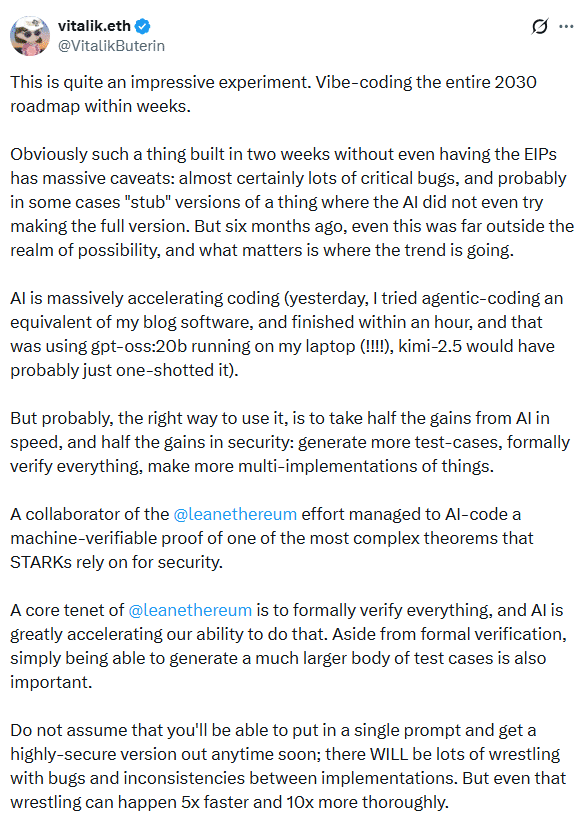
He cautioned, however, that optimism must be balanced with realism. Production-ready, highly secure code still requires significant review and debugging.
AI Experiment Sparks Developer Debate
The experiment that triggered Buterin’s response attempted to model large portions of the Ethereum roadmap in a short timeframe. While impressive, he described it as containing major caveats.
He warned that such rapid outputs likely include critical bugs and incomplete components. Some elements, he said, may only function as placeholders rather than finished implementations.
Balancing Speed and Security
Buterin proposed splitting AI-driven gains between faster coding and deeper security review. Half of the efficiency boost, he suggested, should be invested in expanded test cases and formal verification.
This approach aims to ensure that the Ethereum roadmap progresses more quickly without lowering technical standards. Security, he stressed, must scale alongside development.
Lean Ethereum and Formal Verification
The Lean Ethereum initiative was highlighted as an example of this philosophy in action. A collaborator reportedly used AI to generate a machine-verifiable proof for a complex theorem underlying STARK-based cryptographic security.
The project’s objective is to formally verify all critical components of Ethereum. AI tools may help developers reach that goal faster by improving proof generation and validation processes tied to the Ethereum roadmap.
Expanding Test Coverage Beyond Proofs
Buterin noted that generating a larger body of test cases is as important as formal proofs. Verification systems reduce risk, but broader testing can catch inconsistencies between implementations.
He emphasized that developers should expect discrepancies and debugging challenges. AI can assist, but it does not eliminate human oversight
Bug-Free Code as a Long-Term Goal
One of Buterin’s most ambitious remarks concerned the possibility of near bug-free software. He described it as a concept long viewed as unrealistic.
With AI-assisted tooling, he suggested that high-assurance software may become a practical expectation within crypto systems. For the Ethereum roadmap, this could translate into stronger trust assumptions and reduced systemic risk.
The Limits of Absolute Security
Despite optimism, Buterin acknowledged that total security remains impossible. Achieving perfect correspondence between code and human intent would require immense informational precision.
However, he argued that specific, verifiable guarantees can eliminate the majority of risks tied to faulty code. In practical terms, that means reducing over 99% of negative consequences through structured validation.

Removing the Speed-Safety Trade-Off
Historically, developers faced a choice between moving quickly and ensuring deep verification. Buterin’s framework suggests AI could help remove that constraint.
With rapid iteration backed by strong safeguards, AI could allow the Ethereum roadmap to progress even faster while retaining resilience. Such a change could alter the expectations around blockchain infrastructure building.
Conclusion
Buterin’s statements indicate the role of AI as a facilitator and a protector. Though he warned about the need to avoid assumptions, he was optimistic about the potential of artificial intelligence to speed up the Ethereum roadmap.
The main idea is to harness artificial intelligence in a disciplined manner to ensure that it can facilitate the development of Ethereum without compromising the high level of security required in a decentralized environment.
Appendix: Glossary of Key Terms
Artificial Intelligence (AI): Systems that can be machine-produced code, analyze data, over-regulate developers.
Formal verification: A method to use maths to show software operates correctly under a set of conditions.
Lean Ethereum: An effort to formal verify the fundamental building blocks of Ethereum for improved security, resilience and reliability.


STARKs: Scalable Transparent Argument of Knowledge — a cryptographic proof designed to boost the scalability and security of a blockchain ecosystem.
Test Cases: A collection of scenarios to validate correctness of code in various situations.
Frequently Asked Questions (FAQ)
What did Vitalik Buterin say about AI?
He stated that AI could accelerate Ethereum development while improving security verification standards.
How does AI affect the Ethereum roadmap?
AI may help speed coding, expand testing, and support formal verification processes tied to the roadmap.
What is Lean Ethereum?
It is an initiative aimed at formally verifying Ethereum’s core components to improve reliability and security.
Can AI produce secure code instantly?
No. Buterin warned that AI-generated code requires extensive debugging and review.
Is bug-free crypto software possible?
Absolute security is unattainable, but AI may help reduce most practical risks through verifiable guarantees.
Reference