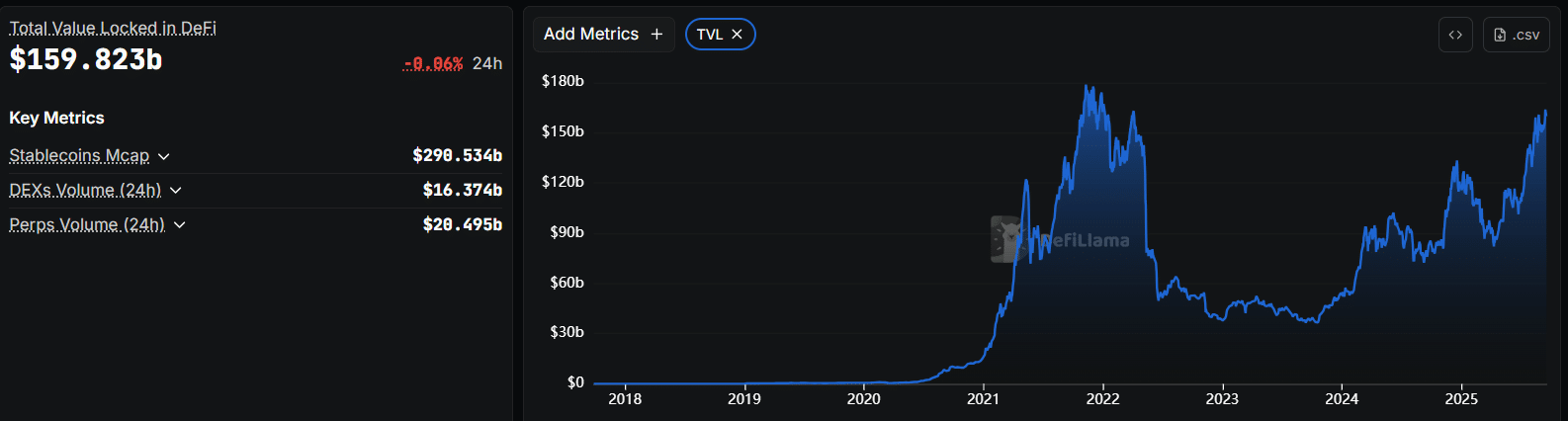
The DeFi market has stabilized at $159.82 billion in total value locked (TVL). However, recent data shows a split in liquidity between spot and derivatives. Collateral remains concentrated in a few major venues, signaling a market dominated by select players.
Stablecoin Market Growth and DeFi Market Expansion
The market cap of stablecoins reached $289.67 billion last week, up 1.32%. Tether (USDT) continues to dominate, holding 58.9% of the market share. This stable base allowed both spot and perpetual markets to grow by nearly $20 billion each.


Spot trading volumes reached $114.13 billion, while perpetuals stood at $124.66 billion. This close split indicates that traders are engaging with DeFi through both speculative leverage (perps) and settlement-driven flows (spot markets).
Liquidity Distribution: A Few Key Players Dominate
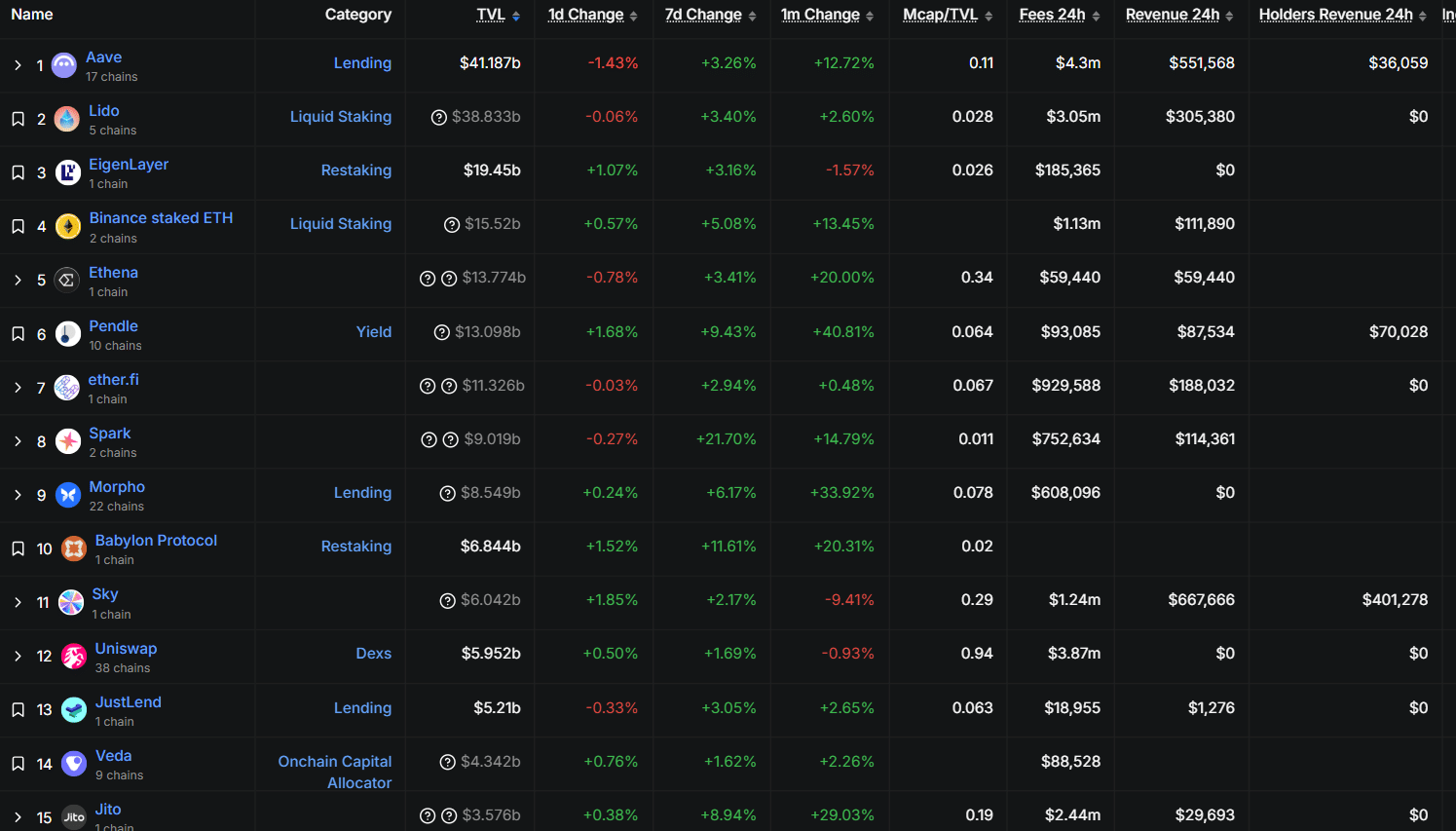
Liquidity in the DeFi space is not evenly distributed. Major platforms like Aave, Lido, and EigenLayer account for more than $100 billion of TVL, or 62% of the market. Adding Binance-staked ETH and Ethena brings this share to over 80%.
Also Read: What Are Altcoins? The Secret Force Behind DeFi, NFTs, and Digital Assets
This concentration highlights how much of DeFi is tied to lending, liquid staking, and restaking. Weekly inflows have been particularly strong into Aave (+$1.9B), Lido (+$1.6B), and Spark (+$1.8B), while Maker’s Sky system saw a contraction of $160 million.
Spot and Perpetuals: Growing Side by Side
The spot and perpetual markets have grown in parallel. Uniswap continues to lead, processing $23.47 billion in weekly trades, or 20.6% of all spot volume. PancakeSwap saw a 129% increase in its weekly flow, reaching $15.48 billion.
Other platforms, such as Solana-based Meteora, experienced even higher growth. Meteora grew 170% to $7.51 billion, and Hyperliquid’s spot DEX posted a 178% increase, reaching $6.82 billion.
These rising platforms show the shifting dynamics within the DeFi market. Traders tend to flock to platforms offering better incentives or more efficient liquidity routing. This movement of liquidity indicates that innovation and incentives are key drivers in the market.
The Role of Stablecoins in DeFi Liquidity
Stablecoins are the backbone of the DeFi market. With nearly $290 billion in circulation, they serve as the primary settlement layer for both centralized and decentralized exchanges. Tether alone, with $170 billion in circulation, remains the dominant stablecoin.
Revenue concentration is also linked to stablecoin issuers. Tether and Circle together generated $863 million in revenue last month, making up 72% of all protocol-level income among the leading DeFi platforms. This concentration underscores the outsized role stablecoins play in DeFi liquidity.
Concentration of Liquidity in Lending and Staking
The concentration of liquidity in lending and staking services raises concerns about the market’s future growth. Most of the collateral in DeFi is either Ethereum or liquid staking tokens, which depend heavily on ETH’s security. This increases the systemic risks in the market.
In times of liquidity shocks in ETH markets, these disruptions could cascade across multiple DeFi layers. While the DeFi market is growing, its concentration in a few areas means that much of the market’s innovation has been limited to staking and lending.
Fee-Intensive Derivatives and Growth in Perpetuals
Perpetual markets, like Hyperliquid and Pump.fun, have seen significant growth. These platforms have been able to monetize activity more effectively than lending platforms. For example, Pump.fun generated $57.9 million in revenue from only $320 million of TVL, implying a high fee intensity.
In comparison, platforms like Aave, with $41.8 billion of TVL, earned just $13.2 million in revenue, highlighting the difference in fee models. Derivatives platforms seem to be able to “print” revenue from volatility, while lending and staking protocols earn passive income.
Systemic Risk from Stablecoin Dependence
DeFi liquidity is increasingly dependent on stablecoin issuers. Tether and Circle, along with the revenue from derivatives platforms like Hyperliquid, make up the majority of DeFi’s financial flow.
This concentration means that disruptions to stablecoin policies or regulatory changes could have an immediate and significant impact on the entire DeFi market.


As most DeFi activity is quoted in stablecoins, any issues with USDT or USDC would ripple through the market, affecting both spot and derivative volumes. The fact that alternative settlement units outside of ETH are seldom used only adds to the risk.
Conclusion
The DeFi market continues to expand; however, liquidity is being further consolidated in a few actors. Lending, staking and stablecoin assets make up much of the market share.
Stablecoins are integral to DeFi liquidity, changes in issuance or policy would have a significant impact on the market. The future growth of DeFi will come down to whether new, innovative use cases develop beyond the core lending and staking segments.
Also Read: The Rise of DeFi: How Decentralized Finance Is Changing the Economy
Summary
The DeFi economy is also split, with the blue chips like Aave and Lido currently leading at $159.82B in TVL. Stablecoins are a critical part of the market, and their growth drives the expansion of the market.
But the massive concentration of liquidity in certain high-interest-yielding applications, including lending and staking, has brought questions about systemic risk. Perpetual markets provide strong incomes, and lending platforms concentrate on the passive one.
Appendix – Glossary of Key Terms
DeFi (Decentralized Finance): A blockchain-based form of finance that eliminates centralized intermediaries like banks.
TVL (Total Value Locked): The total amount of assets locked in a DeFi protocol, representing its size.
Spot Trading: The buying or selling of assets for immediate delivery and settlement.
Perpetual Markets: Trading markets for derivatives without an expiration date, allowing leveraged positions.
Stablecoins: Cryptocurrencies pegged to stable assets, like the US Dollar, offering price stability.
Lending Protocols: DeFi platforms where users can borrow or lend assets, earning interest or paying fees.
FAQs for DeFi Market Growth
1- What drives the dominance of major DeFi Marekt Growth?
Dominance stems from liquidity concentration, strategic incentives, and strong capital inflows into key players like Aave and Lido.
2- How has stablecoin growth impacted DeFi in recent weeks?
Stablecoin growth fuels market expansion, with Tether leading the charge, enabling both spot and perpetual markets to thrive.
3- What are the risks of liquidity concentration in DeFi?
Concentrated liquidity increases systemic risk, as disruptions in major platforms or assets can trigger widespread market instability.
4- How do perpetual markets differ from spot markets in DeFi?
Perpetual markets offer leveraged trading without expiry, while spot markets settle trades immediately, reflecting price stability.