
This article was first published on TurkishNY Radio.
Copy trading sits between education and delegation. It allows a follower to mirror the trades of a leader automatically, but the follower still decides the budget, the risk limits, and when the relationship ends.


That structure makes it appealing in a market where 1 hour can erase a week of gains, yet it also creates a problem: the follower may treat borrowed decisions as guaranteed expertise.


The basic mechanics, explained without the fluff
In most systems, the leader trades normally, while the follower’s account replicates the same actions at a scaled size. Copy trading can be set to mirror every trade, mirror only new positions, or mirror a subset such as spot trades without leverage. The detail that matters is execution.
The follower’s fill price can differ from the leader’s fill price, and that gap is often the hidden reason two accounts show different results despite copying the same idea.
2025 trend: more transparency and more performance theater
The industry has pushed toward more visible track records, public statistics, and richer leader profiles. That is helpful, but it also increases performance theater. Copy trading can reward leaders who take high risk early, climb leaderboards quickly, then reduce risk once followers arrive. A careful follower looks for steady behavior, not just a high number on a monthly chart.
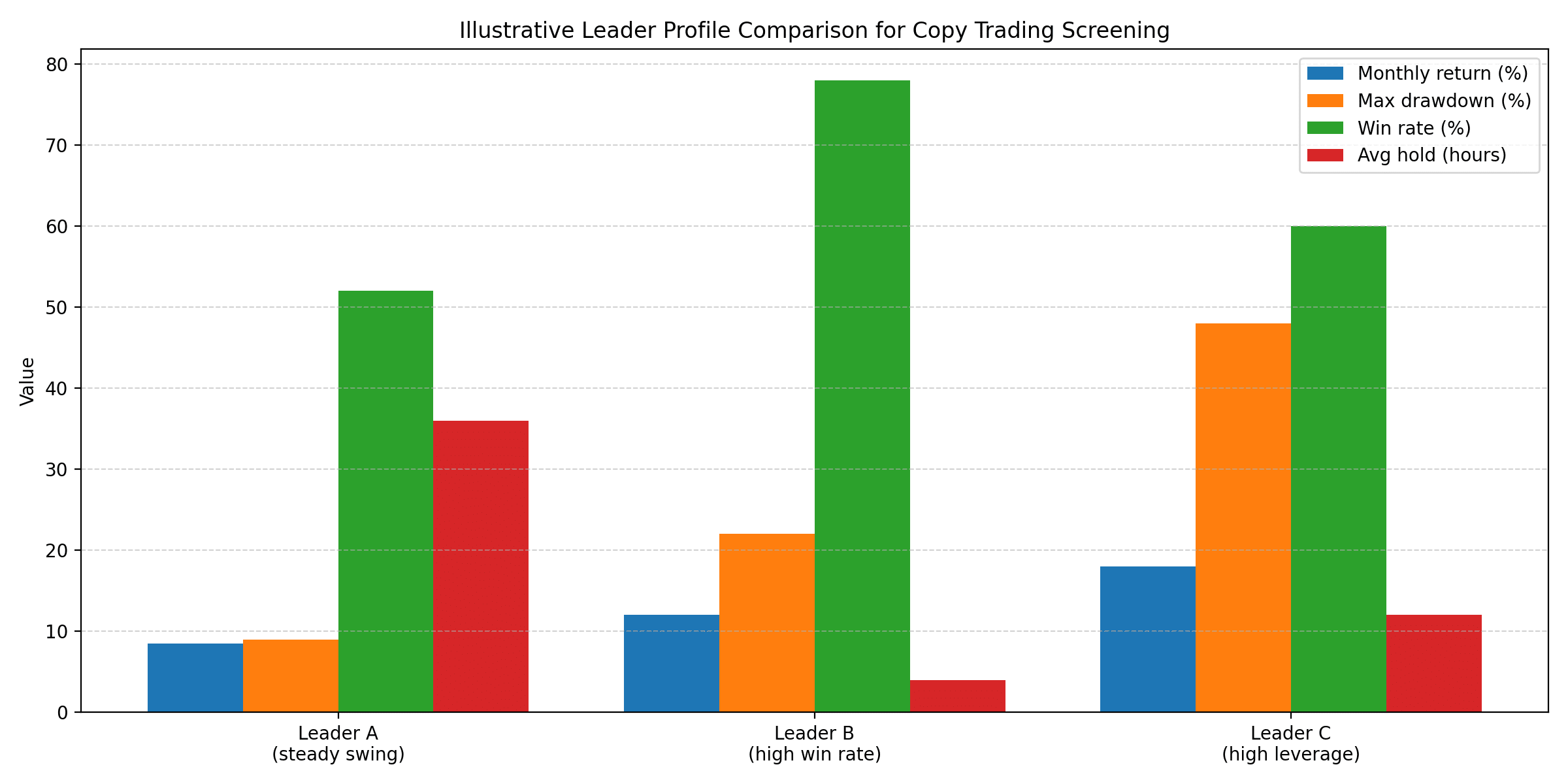
The performance stats that deserve attention
Returns are the headline, but they are rarely the truth. When evaluating a leader, Copy Trading decisions are stronger when they lean on risk-adjusted metrics that describe how returns were earned.
-
Max drawdown: The most important pain metric. A leader with a 60% drawdown is running a different business than a leader with a 12% drawdown.
-
Consistency of monthly results: A steady pattern suggests process, while jagged results can suggest luck or hidden leverage.
-
Win rate versus payoff ratio: A high win rate can still lose money if losses are huge; a lower win rate can be profitable with a strong payoff.
-
Average holding time: Short holding times increase the follower’s exposure to slippage and spread.
-
Leverage profile: Even “small” leverage can be dangerous in high volatility assets.
A follower can also watch the recovery pattern after losses. Leaders who cut risk after a drawdown often survive longer than leaders who double down.
Market-structure indicators that change whether copying works
Copy trading outcomes depend on microstructure, not just strategy. A follower should understand the market conditions that magnify tracking error:
-
Order book depth and liquidity: Thin depth increases slippage and turns stops into worse fills.
-
Bid-ask spread: Wide spreads are a quiet drain, especially for frequent trading.
-
Funding rates and open interest: Extreme funding and crowded open interest can signal a fragile trade.
-
Volatility regime: In high volatility, a strategy can look brilliant on 1 day and collapse the next.
-
Correlation clusters: Many assets move together, so a leader “diversified” across 10 coins may still be taking 1 big bet.
Mirroring is often most stable when leaders focus on liquid pairs, moderate leverage, and clear stop placement.

The psychology problem nobody puts on the leaderboard
Followers often assume that copying removes emotion. It does not. Copy Trading simply moves emotion to a new place: allocation decisions, switching decisions, and panic decisions during drawdowns.
Three psychological traps show up repeatedly:
-
FOMO chasing: Followers join after the best month, right when mean reversion is waiting.
-
Loss aversion: Followers stop copying at the bottom, then rejoin after a rebound.
-
Halo effect: A leader with good communication is assumed to be a good trader, even when the stats disagree.
A healthier mindset treats copying as a monitored partnership with a clear review schedule, not a marriage.
Fees, friction, and the math that quietly flips profitability
Copy Trading costs arrive in layers: trading fees, spread, funding payments in derivatives, and sometimes performance sharing. The follower should pay extra attention to the strategy type. A low-margin scalping approach can be destroyed by a small increase in slippage, while a slower swing approach can absorb friction more easily.
The simplest rule is that the follower should prefer strategies where the average win is meaningfully larger than the average cost of entry and exit. Otherwise, copying becomes a treadmill.
A risk-filter framework that is easy to apply
A follower does not need complex math to make a safer choice. Copy Trading becomes more rational when the follower applies a few hard filters:
-
Minimum history: Prefer leaders with months of data across at least two market moods.
-
Drawdown ceiling: Decide a maximum tolerable drawdown before copying begins.
-
Leverage cap: Avoid leaders whose edge depends on extreme leverage.
-
Position concentration: Watch for leaders who bet too much on a single asset or direction.
-
Rule clarity: Leaders who can explain why they enter and exit are easier to trust than leaders who rely on vague intuition.
If Copy Trading is used for learning, it also helps to mirror with a small allocation while manually writing down the reason each trade makes sense. That process builds independent judgment over time.
Due diligence questions that reduce unpleasant surprises
A follower can improve outcomes by treating the leader profile like a mini due diligence file. It helps to check whether the leader trades mostly spot or mostly derivatives, whether positions are typically held overnight, and whether stop losses are used consistently or only “sometimes.” It also helps to look for sudden changes in behavior, such as a sharp increase in leverage after a period of flat results.
If a platform offers a demo environment, a follower can run the same settings in simulation for a short period, then compare fills and fees. That small rehearsal often reveals whether the strategy is robust or just sensitive to perfect execution.
When copying can be the wrong tool
Copy trading is a poor fit in three common situations. First, when the leader uses very fast execution strategies that rely on near-instant fills. Second, when the market is dominated by sudden news spikes, where delays can cause followers to enter at the worst moment. Third, when the follower cannot tolerate drawdowns, because even good systems lose.
In those cases, a follower may be better served by education, slower strategies, or a simple long-term plan.
Conclusion
Frequently Asked Questions
Does a follower keep control of funds while copying?
In most setups, the follower keeps custody and can stop copying, close positions, or change allocation at any time.
Is high win rate a reliable sign of skill?
Not by itself. A high win rate can hide rare, massive losses, so payoff ratio and drawdown matter.
Why do follower results differ from leader results?
Execution timing, slippage, spread, and different account settings can create tracking error.
How often should a follower review a leader’s performance?
Many followers use a weekly check for behavior and a monthly check for deeper metrics such as drawdown and consistency.
Glossary of key terms
Correlation: A measure of how similarly assets move, relevant for real diversification.
Max drawdown: The largest peak-to-trough decline, often the clearest risk snapshot.
Open interest: Outstanding derivatives contracts, often used to gauge crowding.
Payoff ratio: Average win compared with average loss, a core profitability metric.
Tracking error: The difference between leader results and follower results due to execution and settings.
References