![Sun [New]](https://s2.coinmarketcap.com/static/img/coins/64x64/10529.png)



This article was first published on TurkishNY Radio.
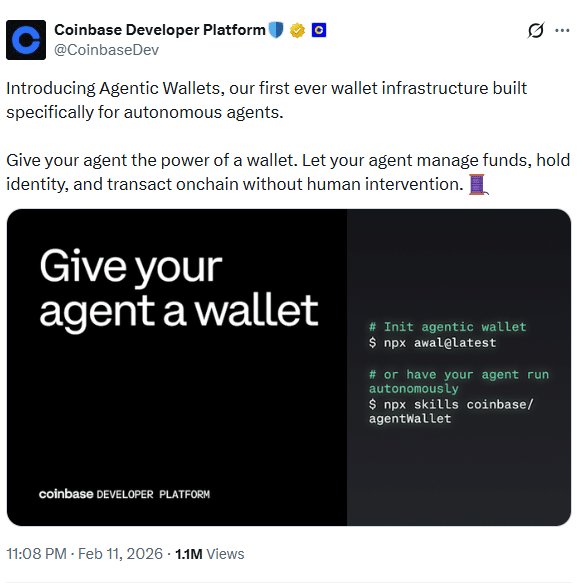
Agentic Wallets launched through the Coinbase Developer Platform on Wednesday. The infrastructure gives autonomous AI agents direct access to on-chain financial tools. It enables software to manage funds, execute payments, and hold identity without human control.


The rollout signals a shift in how AI systems interact with blockchain networks. Agentic Wallets operate on Coinbase’s Base layer-2 network. The system supports gasless transactions. It also includes programmable spending limits and non-custodial identity features.
Developers can deploy Agentic Wallets in minutes using command-line tools such as npx awal. Coinbase stated that the framework removes the need for agents to manage ETH balances for gas fees.
Agentic Wallets Move Beyond Human-Centered Payments
The platform is built to support secure, permissioned execution. It aims to reduce risks linked to automated access to funds.
Agentic Wallets are designed to move beyond human-centered finance. Instead of users clicking approve, autonomous agents can execute financial actions based on coded rules. These rules define how much an agent can spend and under what conditions.
The infrastructure supports payments, trades, treasury management, and decentralized application interaction. By removing gas friction and embedding safety controls, Agentic Wallets simplify AI-driven financial automation.
Gasless Transactions on Base
The wallets function on the Base network. Transactions are gasless for the AI agent. This eliminates the need to hold ETH for fees.
Gasless design lowers technical barriers. It also allows machine-speed execution without constant developer oversight. The structure supports scalable automation.
Programmable Spending Controls
Agentic Wallets include programmable spending policies. Developers can define limits before deployment. These limits restrict how much capital an agent can use.
Spending rules reduce the risk of misuse. They also create predictable financial behavior. This structure replaces manual approval processes with coded safeguards.
On-Chain Identity for Agents
Each wallet includes a blockchain-based identity. The identity is non-custodial. It gives the agent a recorded presence on-chain.
Identity anchoring supports trust and verification. It may allow agents to join decentralized autonomous organizations. It also enables traceable activity within smart contract systems.
Secure Permissioned Execution
Security remains central to Agentic Wallets. Traditional automated scripts often relied on custodial services. Those models introduced risk.
Agentic Wallets use permissioned execution. Developers do not need to configure each payment individually. Instead, predefined policies govern financial behavior. This model reduces exposure while maintaining flexibility.
Machine-Speed Financial Activity
Autonomous agents can handle tasks at machine speed. They may process API micropayments. They could manage investment portfolios or execute trades.
Such activity may increase transaction volume on Base. Unlike human users, agents operate continuously. Agentic Wallets are structured to support this scale.
Broader Ecosystem Developments
The launch comes amid wider AI-blockchain growth. Lightning Labs announced tools that enable AI agents to transact over the Bitcoin Lightning Network. The update includes automatic L402 payments and scoped spending controls.
Ethereum activity has also expanded. More than 13,000 AI agents registered on-chain in one day after the ERC-8004 standard launched.
The standard provides portable identities and trust features for agents. These developments show rising infrastructure support for autonomous systems.
Market Signals and AI Tokens
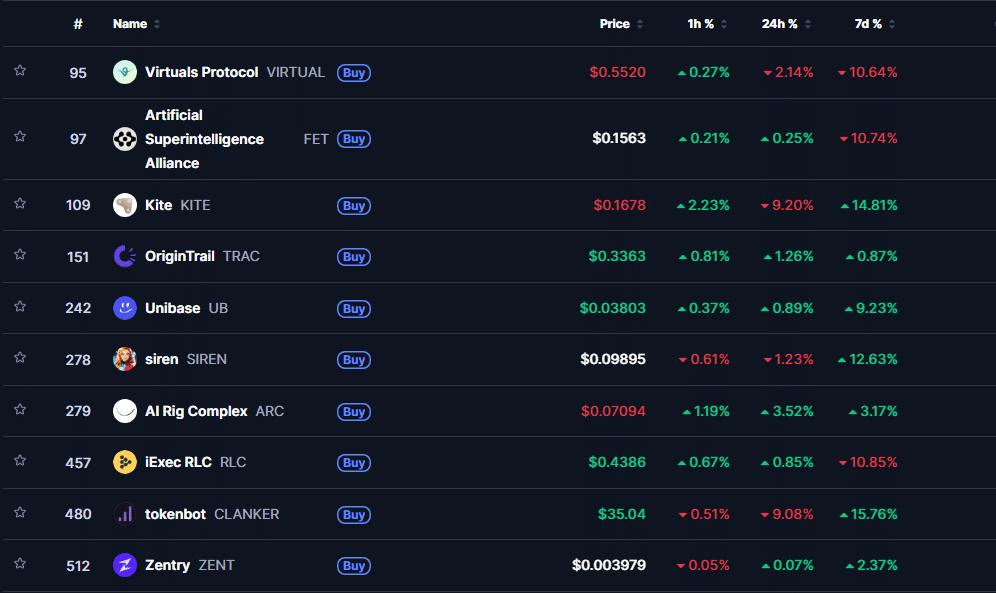
AI-related crypto tokens recorded weekly gains. Kite increased nearly 15 percent. Tokenbot rose more than 15%. Siren advanced over 12 percent. Unibase gained more than 9 percent.
Some tokens remain volatile on shorter time frames. However, investor interest suggests growing focus on AI-integrated blockchain solutions.
Strategic Implications
Coinbase has positioned Base as a developer-friendly network. Agentic Wallets strengthen that position. The framework supports agent-to-agent commerce and automated services.
The company has stated broader goals of onboarding large numbers of users on-chain. Autonomous agents may represent a new growth segment. Agentic Wallets could help expand blockchain participation beyond human users.
Conclusion
Agentic Wallets introduce a structured model for AI-driven finance. The system combines gasless execution, programmable limits, and non-custodial identity. It addresses technical and security challenges tied to automation.
As AI systems gain financial capabilities, they may act as independent economic participants. Agentic Wallets provide the infrastructure to support that shift.
Appendix: Glossary of Key Terms
Gasless Transactions: Transactions that remove the need for users or agents to pay network fees directly.
Programmable Spending Limits: Predefined rules that control how much an agent can spend and under what conditions.


Non-Custodial Identity: A blockchain-based identity controlled by the wallet owner, not a third party.
Permissioned Execution: A system where actions are allowed only within approved and coded parameters.
Layer-2 Network: A secondary blockchain built on top of a main network to improve speed and reduce costs.
Smart Contract: Self-executing blockchain code that enforces agreements automatically.
Autonomous Agent: AI-driven software capable of making decisions and executing actions without human input.
Frequently Asked Questions (FAQs) About Agentic Wallets
1- What are Agentic Wallets?
Agentic Wallets are blockchain wallets designed for autonomous AI agents to transact independently.
2- How do Agentic Wallets reduce transaction friction?
Gasless execution removes the need for manual network fee management.
3- Why are programmable spending limits important?
Spending limits restrict fund usage under predefined conditions.
4- Can AI agents manage funds without human approval?
Autonomous agents operate within coded permission rules.
References