
This article was first published on TurkishNY Radio.
Bitcoin treasuries kept buying despite sharp price swings. New data shows corporate wallets are absorbing supply faster than miners can produce it. Glassnode reports public and private companies added a net 260,000 BTC in the last six months.


Over the same period, miners produced about 82,000 BTC. The trend highlights how Bitcoin treasuries are reshaping market supply. Corporate buyers added more than three times the new BTC supply created by miners.
Bitcoin Treasuries Surge as Structured Holdings Hit 4.06M BTC
Based on current estimates, monthly net inflows into Bitcoin treasuries are around 43,000 BTC. That amount is valued near $25 billion at current prices. Company-held Bitcoin treasuries increased from roughly 854,000 BTC to about 1.11 million BTC in just six months.
Structured entities now hold about 4.06 million BTC across multiple treasury categories. ETFs and funds hold the largest portion at around 1.49 million BTC.
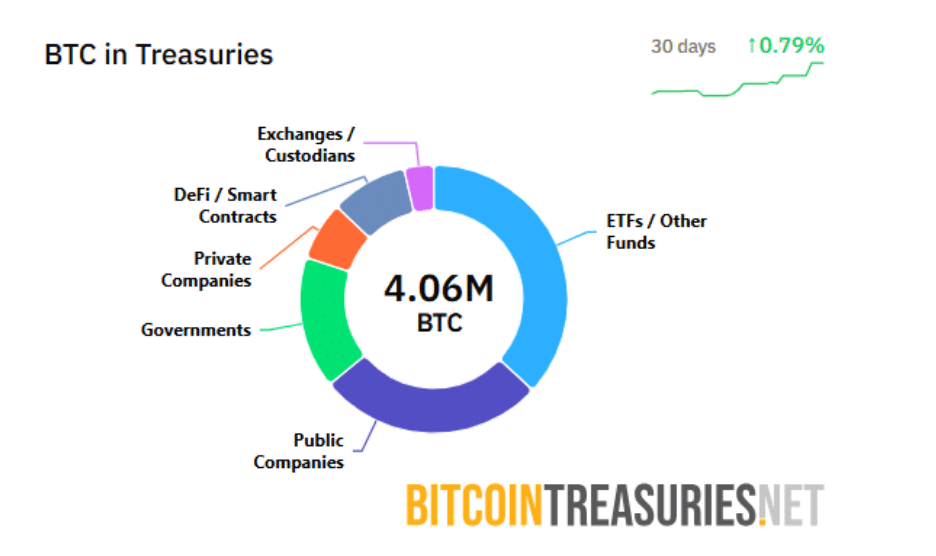
Public companies hold the second-largest share at more than 1.1 million BTC. Governments, private firms, DeFi contracts, and custodians hold the remaining amount.
Bitcoin treasuries are becoming a major market force. Firms are moving BTC from exchanges into long-term custody. That reduces liquid circulation and increases supply tightness. This trend can amplify moves in both directions. However, long-term holders may also sell less during panic periods.
Bitcoin Treasuries Outpace Miner Supply by a Wide Margin
Bitcoin miners add about 450 BTC per day to the circulating supply. That equals roughly 13,500 BTC per month. Bitcoin treasuries are absorbing much more than that on a net basis. The six-month gap is large enough to signal a structural shift.
Also Read: Bitcoin vs. Real Estate in China: A New Store-of-Value Battle in 2026
Glassnode data shows a net 260,000 BTC addition by corporate holders. Miner output in the same timeframe was near 82,000 BTC. This suggests demand is not only strong, but also consistent. Bitcoin treasuries are becoming a steady buyer segment.

Corporate Holdings Expanded at One of the Fastest Rates on Record
Company-held Bitcoin treasuries rose from about 854,000 BTC to around 1.11 million BTC. That is an increase of roughly 256,000 BTC in six months. Few periods show similar growth speed. This adds to evidence that BTC is being treated as a balance-sheet reserve.
This accumulation trend matters for market depth. Fewer coins remain available for active trading. That can change how fast price moves during demand spikes. It can also raise sensitivity to sudden selling events.
Strategy Leads Bitcoin Treasuries With Majority Share of Corporate Holdings
Strategy remains the largest holder among corporate Bitcoin treasuries. BitcoinTreasuriesNet data places its holdings at 687,410 BTC. That equals close to 60% of Bitcoin held by public and private companies. The size gap between Strategy and the rest remains extreme.
The firm continues funding purchases through equity issuance and convertible debt. This model has allowed repeated buying regardless of short-term market swings. Strategy’s behavior has become a benchmark for corporate BTC adoption.
MARA Builds Treasury Strength Through Mining Retention
MARA Holdings ranks second among corporate Bitcoin treasuries with 53,250 BTC. Unlike Strategy, MARA acquired much of its BTC through mining production. The firm has increasingly retained output rather than selling. This approach reduces sell pressure from miner treasuries.
Miner retention has become a major market variable. When miners sell less, supply tightens further. That strengthens the impact of corporate accumulation. It also shows miners may now act more like long-term holders.
Twenty One Capital Enters the Top Tier of Corporate Holders
Twenty One Capital sits in third place with 43,514 BTC. The company began accumulating at launch in December 2025. This followed its merger with Cantor Equity Partners. The rapid rise suggests structured firms are entering the space aggressively.
New entrants increase competition in Bitcoin treasuries. They also widen institutional participation. More corporate buyers can spread demand across many balance sheets. This could make treasury buying less dependent on one dominant firm.


Metaplanet Signals Growing Global Demand for Bitcoin Treasuries
Japan-based Metaplanet holds 35,102 BTC. It began accumulating BTC in 2024. The firm framed its strategy as inflation protection and long-term exposure. Its holdings show that this trend is not limited to U.S. markets.
International treasury adoption expands the base of buyers. It also creates regional demand cycles. In some regions, BTC is treated as currency protection. In others, it is viewed as a growth asset. Both drivers support Bitcoin treasuries expanding further.
Structured Entities Hold 4.06 Million BTC Across Major Categories
Across treasury categories, about 4.06 million BTC is now held by structured entities. ETFs and funds hold about 1.49 million BTC. Public companies hold more than 1.1 million BTC. Governments, private firms, DeFi contracts, and custodians account for the rest.
This distribution matters for supply behavior. ETFs can see faster inflows and outflows. Corporate treasuries usually move slower. Governments and custodians vary by policy and liquidity needs. Bitcoin treasuries sit inside this broader institutional holding shift.
Supply Tightening Could Influence Volatility in 2026
Bitcoin treasuries keep pulling BTC out of liquid circulation. That could create stronger support levels during declines. It could also increase upside pressure when demand rises fast. With fewer liquid coins, the price can react quickly to inflows.
Some market observers believe volatility could decline over time. The view is that institutional holders sell less during panic events. If that pattern holds, Bitcoin treasuries may stabilize market behavior. The trend also reinforces BTC’s status as an institutional asset.
Conclusion
Bitcoin treasuries added a net 260,000 BTC in six months, far above miner output of about 82,000 BTC. Company-held balances rose from around 854,000 BTC to roughly 1.11 million BTC.
Strategy still dominates corporate holdings with 687,410 BTC, while MARA, Twenty One Capital, and Metaplanet follow. If buying continues, Bitcoin treasuries may keep tightening liquid supply and shaping market structure into 2026.
Also Read: The New Climate Pitch for Bitcoin Mining: Flexible Demand, Cleaner Power, Verifiable Data
Appendix Glossary of Key Terms
Bitcoin Treasuries: BTC held by companies as a reserve asset on balance sheets.
Net Inflow: The net amount of BTC added after buys minus sells over a period.
Miner Supply: New BTC entering circulation through mining rewards each day.
Structured Entities: ETFs, funds, firms, or institutions holding BTC in regulated form.
Liquid Supply: BTC available for active trading on exchanges and markets.
Open Interest: Total active futures contracts that remain open in derivatives markets.
Convertible Debt: Debt that can be converted into company shares, used to raise funds.
Custodian: A regulated service that stores digital assets securely for institutions.
Frequently Asked Questions About Bitcoin Treasuries
1- What are Bitcoin treasuries?
Bitcoin treasuries are BTC held by companies and structured entities as part of reserve strategy.
2- How much BTC did companies add recently?
Companies added a net 260,000 BTC over the last six months, based on Glassnode data.
3- Who holds the most BTC among corporate treasuries?
Strategy holds the most with 687,410 BTC.
4- Why do Bitcoin treasuries impact price?
They reduce liquid supply and can strengthen long-term demand pressure.