![Sun [New]](https://s2.coinmarketcap.com/static/img/coins/64x64/10529.png)



This article was first published on TurkishNYR.
The next halving is not a rumor or a headline hook. It is code doing what it has always done, quietly and on schedule. Sometime around April 2028, when Bitcoin reaches block 1,050,000, the block subsidy is expected to drop again, reducing new issuance per block from 3.125 BTC to 1.5625 BTC. The exact day can shift because block times are not fixed, but the trigger is the block height, not a calendar date.


That simple change is why Bitcoin halving 2028 will dominate investor conversations long before it arrives. Yet the smarter approach is not to treat it like a guaranteed price launch button. It is better understood as a structural supply change that collides with real-world demand, liquidity, regulation, and risk appetite, sometimes in messy ways.
The Bitcoin Halving Mechanism
Bitcoin halvings occur every 210,000 blocks, cutting the subsidy paid to miners in half. The most recent halving occurred on April 20, 2024 at block 840,000, taking the subsidy from 6.25 BTC to 3.125 BTC.
For markets, the key point is that halvings lower the pace of new supply entering circulation. That is not the entire story of price, but it is a material part of the long-term scarcity design.
Why 2028 will not behave like a copy-paste of prior cycles
A familiar mistake shows up in every cycle: people overlay past charts and call it a forecast. The problem is that Bitcoin does not trade in a vacuum anymore. The investor base is broader, derivatives are deeper, and macro liquidity can swing sentiment fast, like a tide that changes the whole shoreline overnight.
By 2028, the market will likely be shaped by three forces that can either amplify or mute the halving effect:
First, institutional access and products can compress the timeline of demand. Second, macro conditions like rates and dollar liquidity can dominate short-term pricing even if supply is tightening. Third, miner economics may look very different depending on energy prices, hardware efficiency, and fee revenue.
This is where Bitcoin halving 2028 becomes less about a single day and more about a multi-quarter setup.
Bitcoin Halving 2028 and the supply shock math
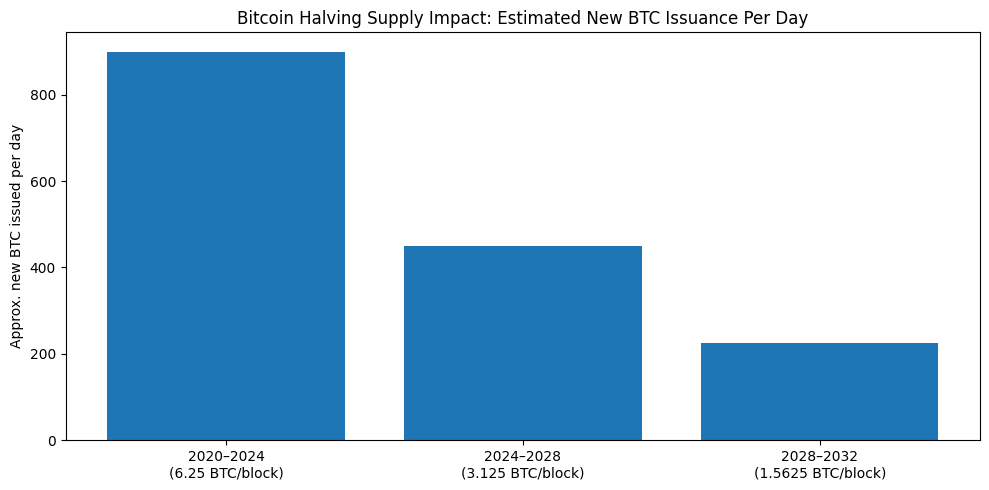
When the subsidy drops to 1.5625 BTC, fewer new coins are created per day than the market was accustomed to in the prior epoch. That is the measurable, mechanical part.
The market question is what happens if demand stays flat, rises, or falls while new supply declines. In a steady-demand world, reduced supply pressure from newly mined coins can matter. In a strong-demand world, it can matter more. In a weak-demand world, price can still slide because liquidity and sentiment set the marginal price, not ideology. So the responsible way to talk about Bitcoin halving 2028 is in scenarios, not promises.
Price expectations: scenario thinking, not fortune-telling
Analysts typically frame halvings as bullish because issuance drops, but even mainstream coverage of prior events notes that outcomes vary, and “priced in” narratives can appear well before the halving date.
A practical scenario set looks like this:
In a “tight liquidity” scenario, risk assets struggle, speculative leverage unwinds, and Bitcoin can trade heavily even with favorable supply mechanics. In that case, the halving may show up later as a slower grind rather than an explosive move.
In a “neutral liquidity” scenario, Bitcoin tends to respond to internal fundamentals more cleanly. Reduced issuance can support a higher clearing price over time if spot demand holds.
In an “easy liquidity plus adoption” scenario, demand outpaces the new supply flow and the post-halving period can become reflexive, meaning price attracts attention, attention attracts flows, and flows push price again. That cycle can still break suddenly, but it is the classic conditions for a strong upside.
None of these outcomes are guaranteed as what is guaranteed is that Bitcoin halving 2028 reduces issuance at the protocol level. Everything after that is market structure.
The miner story: the hidden driver most traders ignore
They are consistent sellers because they pay real-world bills in fiat terms. When rewards are cut, margins get squeezed, and that can trigger a shakeout. That is why watching miner behavior is not a niche hobby; it is risk management.
One reason miner economics stay stable is Bitcoin’s difficulty adjustment, which recalibrates roughly every 2,016 blocks to keep block production near the 10-minute target. If miners drop off after a halving, difficulty can adjust downward, helping the remaining miners.
For Bitcoin halving 2028, the market should expect a tug-of-war: weaker operators may capitulate, stronger operators may consolidate, and the network adapts. If fee revenue rises with usage, it can offset some of the subsidy cut. If fees remain low, miners lean harder on efficiency and cheap power.
Key indicators to track before and after the Bitcoin halving 2028
A clean strategy does not start with price targets. It starts with signals that reveal whether demand is real, whether leverage is fragile, and whether miners are under stress.
For Bitcoin halving 2028, the most useful indicators usually fall into five buckets.
Network health metrics, such as hash rate trends and difficulty changes, help explain whether mining participation is expanding or contracting. Miner stress often shows up when operators sell reserves, shut down older rigs, or see profitability compress sharply.
Liquidity and leverage metrics, such as futures funding and open interest, indicate whether the market is leaning too far in one direction. When positioning becomes crowded, moves can reverse fast, even if the long-term thesis sounds solid.

Spot demand signals, including exchange balance trends and large-holder accumulation patterns, can suggest whether buyers are absorbing supply or merely trading noise.
Macro context, including rate expectations and broad risk sentiment, matters because Bitcoin often trades like a high-beta asset during liquidity shocks.
Behavioral signals, like retail mania or extreme fear, matter because the halving narrative can create crowded trades on both sides.
This framework keeps Bitcoin halving 2028 grounded in evidence rather than vibes.
Market strategies that match real risk, not fantasy
A sensible playbook typically includes three ideas: pacing, diversification of entry points, and discipline around drawdowns.
Pacing matters because halving narratives heat up early, cool off, then heat again. Buying all at once because of a date on a countdown clock is how many portfolios get punished. Staged exposure, with rules tied to liquidity and trend signals, often reduces regret.
Risk control matters because Bitcoin can move like a fast car on a wet road. Upside is real, but so is the downside. Investors who plan exits, rebalancing, and position sizing tend to stay in the game longer than those chasing a perfect top.


And for long-term holders, the smartest “strategy” can be boring: keep custody secure, avoid over-leverage, and treat rallies as opportunities to reduce concentration risk rather than only adding.
That is not glamorous, but it is how professionals approach Bitcoin halving 2028 without turning it into a lottery ticket.
Conclusion
The halving is not a marketing event; it is a protocol rule that steadily tightens Bitcoin’s issuance over time. The next one is expected around April 2028 at block 1,050,000, when the subsidy is projected to fall to 1.5625 BTC.
What happens to price, volatility, and market structure after that will depend on demand, liquidity, and miner economics, not on nostalgia for earlier cycles. A solid plan treats Bitcoin halving 2028 as a slow-building structural shift, then uses indicators and risk discipline to navigate the messy human part of the market.
Frequently Asked Questions (FAQs)
When is the next Bitcoin halving expected to happen?
The next halving is expected around April 2028, triggered at block height 1,050,000. The exact date can move because block times vary.
What changes at the halving?
The block subsidy paid to miners is cut in half. For 2028, it is expected to drop from 3.125 BTC to 1.5625 BTC per block.
Does a halving guarantee a price rally?
No. The halving reduces new supply, but price depends on demand, liquidity, leverage, and macro conditions.
Why do miners matter so much after a halving?
Miner revenue drops immediately from the subsidy cut, which can force inefficient miners to shut down or sell reserves, affecting market supply dynamics.
Glossary of key terms
Block subsidy: The newly issued BTC paid to miners for adding a block, which is cut at each halving.
Block height: The number of blocks mined so far. The 2028 halving is tied to block 1,050,000.
Difficulty adjustment: A network mechanism that adjusts roughly every 2,016 blocks to keep block production near the target pace.
Hash rate: The total computational power securing the Bitcoin network, often used as a proxy for mining participation and security.
Market liquidity: How easily Bitcoin can be bought or sold without moving price sharply, influenced by macro conditions and market structure.
Disclaimer: This article is for informational and educational purposes only and does not constitute financial, investment, or legal advice.
Sources