Bhutan Digital ID
Bhutan has officially become the first nation in the world to anchor its digital ID system on the Ethereum blockchain.
For a country known for preserving identity beyond GDP, this leap signals a new era of trust, sovereignty, and citizen empowerment.


As the Himalayan kingdom transitions its National Digital Identity (NDI) from earlier platforms to Ethereum, it stakes a claim not simply in blockchain experimentation but in reimagining governance itself.
From Polygon to Ethereum: Why Bhutan Re-Anchors Its Digital ID
Bhutan’s NDI system was initially built using Hyperledger Indy, then migrated to Polygon in August 2024. But now, the government is shifting again this time to Ethereum.
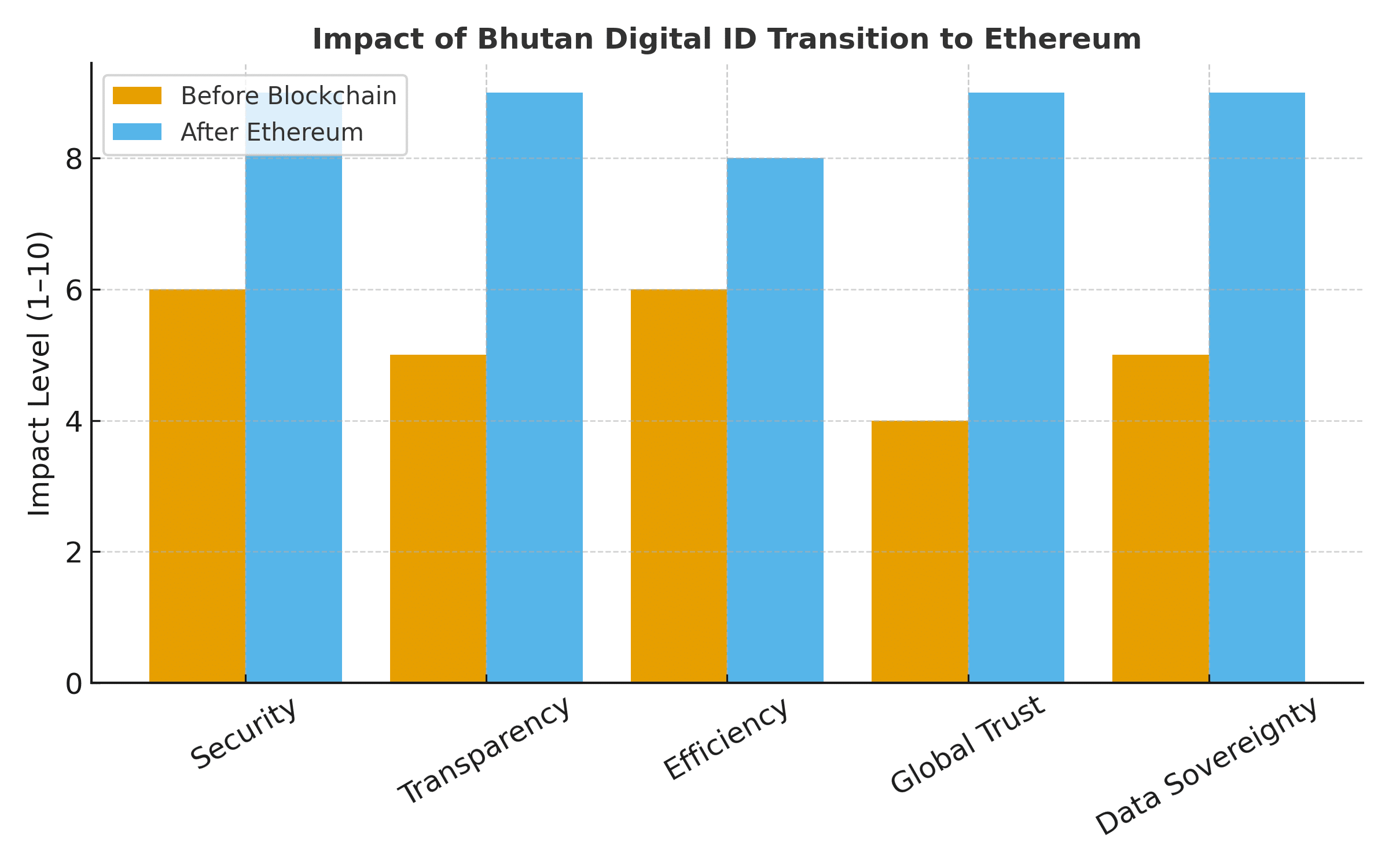
The move isn’t capricious: officials cite the need for greater security, decentralization, and global interoperability.
Jigme Tenzing, Secretary of Bhutan’s GovTech Agency, framed it plainly:
“By transitioning to Ethereum, we further strengthen the security of our digital identification.”
Ethereum offers a robust, battle-tested, globally maintained infrastructure that Bhutan sees as foundational when anchoring something as sensitive and identity-defining as a national digital ID.
What Happens When a Country Anchors Its Digital ID on Ethereum?
When Bhutan anchors its digital ID on Ethereum, it means that credentials issued to citizens are cryptographically verifiable on a public, decentralized ledger.
It does not mean all personal data is exposed on-chain. Instead, cryptographic proofs like zero-knowledge proofs allow citizens to verify attributes (e.g. “I am over 18”) without revealing extraneous data.
This approach empowers citizens in two ways:
-
Sovereignty over data: The individual controls when and how credentials are shared.
 ADVERTISEMENT
 -
Tamper resilience: Because credentials anchored on Ethereum are immutable, they resist fraud and unauthorized alteration.


Bhutan expects the full migration of all ~800,000 resident credentials by Q1 2026.
Voices from the Launch: Ethereum Meets the Kingdom
The launch ceremony saw high-profile attendance:
-
Aya Miyaguchi, President of the Ethereum Foundation, posted on X (formerly Twitter):
“Today, Bhutan celebrates a historic milestone, becoming the first nation to anchor its national digital identity system on Ethereum.”
-
Vitalik Buterin, Ethereum co-founder, praised the move, calling decentralized digital identity a building block for a more open future.
-
Prime Minister Tshering Tobgay emphasized that the shift would strengthen national security and digital infrastructure.
These voices lend both prestige and legitimacy making sure the narrative isn’t just technical, but human and political.
Risks & Challenges: Navigating Privacy, Costs, and Trust
Even as the world watches Bhutan’s bold experiment, challenges loom:
-
Privacy risks: Public chains are permanent. Even with zero-knowledge proofs, critics argue that cryptographic traces may be linkable over time.
-
Gas/transaction costs: Ethereum’s transaction fees (gas) can vary widely. Bhutan must manage costs at national scale.
-
Adoption barriers: Citizens must feel confident in using wallets, managing keys, and trusting the system.
-
Governance complexity: Questions of who upgrades code, intervenes in crises, or resolves disputes must be settled transparently.
Bhutan’s emphasis on cryptographic protection and decentralized governance attempts to mitigate these, but global observers will watch closely to see how theory meets practice.
Global Implications: Will Others Follow?
Bhutan has set a powerful precedent by being the first to anchor a digital ID at a national scale on Ethereum.
This might inspire other nations considering identity modernization to explore public blockchains, especially those with an emphasis on data sovereignty and citizen trust.
Already, countries like Brazil and Vietnam are experimenting with blockchain-based identity systems, though often with permissioned or hybrid models, not fully public ones.
If Bhutan’s rollout succeeds without major failures, it could become a proof point not just for Ethereum, but for a new architecture of governance.
Conclusion
Bhutan’s decision to anchor its digital ID on Ethereum is audacious, visionary, and purposeful. It’s more than a tech experiment it’s a bet on citizen empowerment, privacy, and the future of trust in a digital age.
While risks abound, Bhutan’s leap invites the world to reconsider how identity might be anchored in code, not just bureaucracy.
As this Himalayan kingdom writes that chapter, every nation curious about digital sovereignty will be watching.
For more news, visit our platform.
FAQs about the Bhutan digital ID
Q: What does “anchoring a digital ID on Ethereum” mean?
It means issuing cryptographically verifiable identity credentials stored in a system where proofs are verified via Ethereum’s blockchain—providing tamper resistance without exposing personal data.
Q: Will all citizens’ personal data be on-chain?
No. Only cryptographic proofs or hashes will live on-chain. Sensitive personal data remains off-chain, protected.
Q: When will the full migration be completed?
Bhutan plans to finalize the migration of all resident identities by the first quarter of 2026. o Ethereum?
Though Polygon offered lower costs, Bhutan opted for Ethereum for stronger decentralization, security, developer ecosystem, and long-term resilience.
Glossary of Key Terms
| Term | Meaning |
|---|---|
| Digital ID | A digital representation of a person’s identity used to access services or verify credentials. |
| Self-sovereign identity (SSI) | A model where individuals control their own digital identity rather than centralized authorities. |
| Zero-knowledge proof (ZKP) | A cryptographic technique allowing one party to prove a statement (e.g. “I’m over 18”) without revealing underlying data. |
| Public blockchain | A blockchain whose ledger is openly visible and maintained by many decentralized nodes (e.g. Ethereum). |
| Anchor / Anchoring | The act of recording a cryptographic credential or proof onto a blockchain for verification and immutability. |