![Sun [New]](https://s2.coinmarketcap.com/static/img/coins/64x64/10529.png)



This article was first published on TurkishNY Radio.
Brazil’s regulated financial industry has made another step towards blockchain financing. Banco Braza is now fully operational with its Brazilian real-backed virtual currency on Polygon, adding additional force to the BBRL Stablecoin Polygon growth.


The move ties traditional banking infrastructure to a fast, low-cost blockchain network. The addition of BBRL Stablecoin Polygon to Brazil’s burgeoning digital asset ecosystem represents a trend toward acceptable, institutionally owned stablecoins that operate at scale.
Banco Braza Brings Real-Backed Stability On-Chain
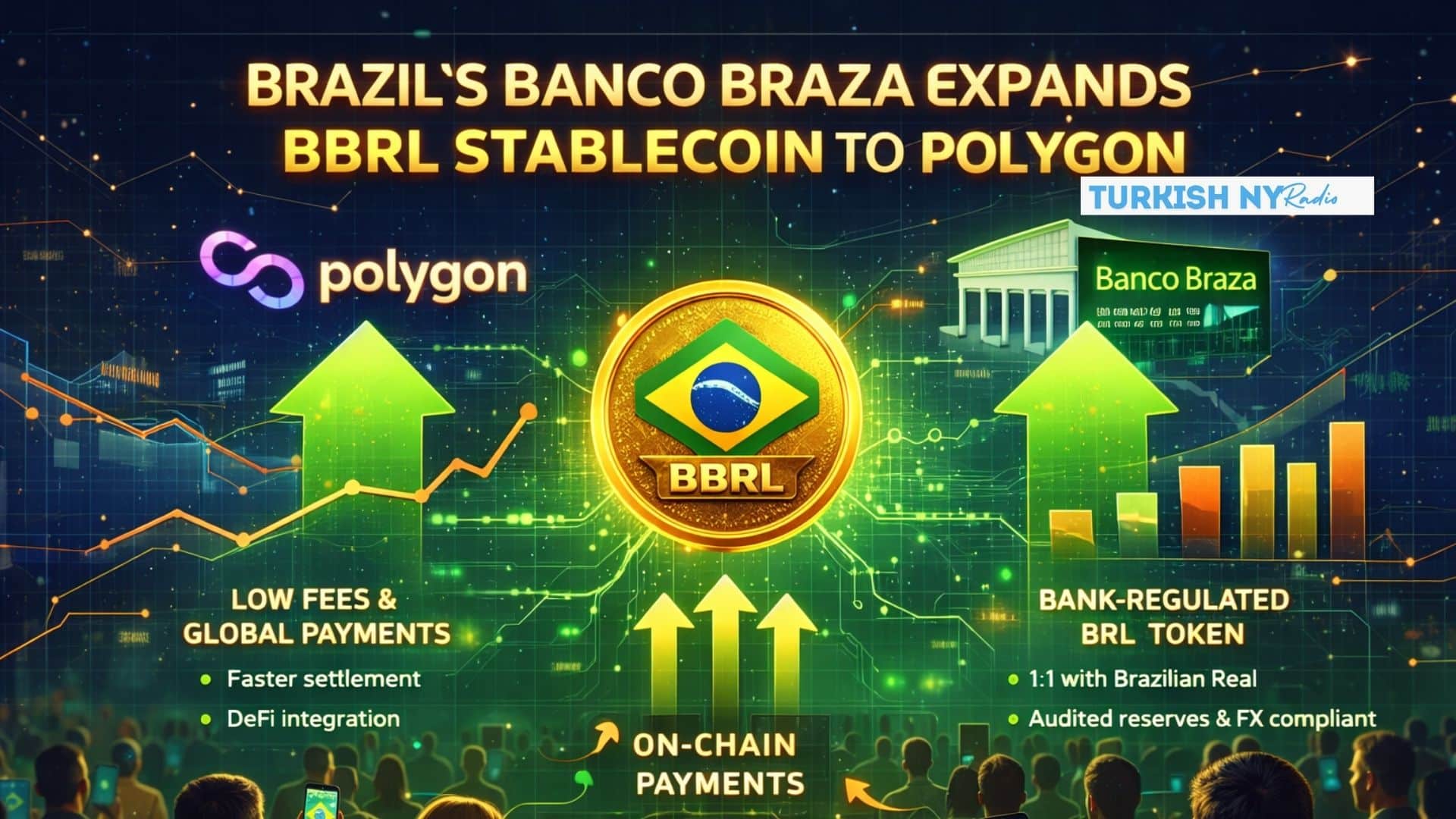
Banco Braza confirmed that BBRL is fully backed 1:1 by Brazilian real reserves and operates under Brazil’s regulatory framework. Unlike algorithmic tokens, the bank says its stablecoin is backed by audited reserves held within the traditional financial system.
A company spokesperson said the goal is to “combine the security of regulated banking with the efficiency of blockchain rails.”
By launching BBRL Stablecoin Polygon, the bank gains access to faster settlement times and significantly lower transaction fees compared to older blockchain networks.
The BBRL Stablecoin Polygon integration is designed to support businesses engaged in cross-border trade, remittances, and digital settlements. Brazil remains one of Latin America’s most active fintech markets, and demand for regulated digital payment tools continues to rise.
Why Polygon?
Polygon has emerged as a preferred Layer-2 scaling solution for institutions exploring tokenized assets and stablecoins. With high throughput and lower gas costs than Ethereum mainnet, Polygon offers infrastructure suited for financial-grade applications.
By choosing Polygon, Banco Braza places the BBRL Stablecoin Polygon rollout into an infrastructure that already hosts significant stablecoins and digitally traded assets from the real world.
According to industry observers, the move has the potential to strengthen financial passageways among Brazilian exchanges and global cryptocurrency infrastructure. The BBRL Stablecoin Polygon implementation might potentially lead to financial decentralized integrations, such as customizable payments and automatic settlement systems.
Brazil’s Developing Stablecoin Community
Brazil has significantly improved its clear regulation regarding digital currencies. The central bank has looked into monetary systems and digital payment modernisation through efforts such as Drex, the central bank’s national digital currency programme.
The introduction of BBRL Stablecoin Polygon symbolizes a larger organizational change: regulated financial institutions are no longer observing from the sidelines, but are actively constructing.
Market analysts point out that real-backed stablecoins play an important role in emerging nations where the volatility of currencies and international transactional friction remain issues. Businesses may utilize the BBRL Stablecoin Polygon to move BRL value abroad without depending solely on traditional correspondent financial techniques.
Some analysts think that the BBRL Stablecoin Polygon initiative may increase real-world volatility in cryptocurrency markets, growing recognition within Brazilian fintech businesses.
Institutional Implications
The introduction of BBRL Stablecoin Polygon highlights how banks are adapting to digital infrastructure rather than competing against it. By anchoring the token to regulated reserves, Banco Braza aims to differentiate itself from unregulated stablecoin issuers.
Experts suggest the BBRL Stablecoin Polygon model could serve as a blueprint for other Latin American financial institutions. As global stablecoin regulation tightens, fully backed and audited tokens may gain stronger institutional trust.
Conclusion
The launch of BBRL Stablecoin Polygon represents more than a technical deployment. It marks a convergence between Brazil’s traditional banking sector and scalable blockchain networks.
If adoption grows among enterprises and payment providers, the BBRL Stablecoin Polygon expansion could position Brazil as a leader in regulated stablecoin innovation across emerging markets.
Glossary of Key Terms
Stablecoin: A cryptocurrency with a fixed worth, generally attached to a monetary asset.
Brazilian real (BRL): Brazil’s national currency.
Layer-2 Network: A distributed ledger scalable solution that sits on top an additional network to increase speed and lower fees.
Polygon: A Layer 2 connection that improves Ethereum’s sustainability.
Fiat-Backed Token: Is a digital possession that is directly backed via conventional cash reserves.
FAQs for BBRL Stablecoin Polygon
1. What is the BBRL?
BBRL is a Brazilian real-backed stablecoin produced by Banco Braza that is backed 1:1 by reserve funds.


2. Why did are you launching on Polygon?
Polygon has cheaper transaction fees and faster settlement than many other networks.
3. Is BBRL subject to regulation?
Yes, Banco Braza follows Brazil’s monetary regulatory system.
4. How may BBRL be used?
It is capable of payments across borders, commercial transactions, and modern financial apps.
5. Why did is this important for Brazil?
It boosts Brazil’s position in controlled digital financial services while increasing real-denominated volatility in cryptocurrency marketplaces.