



This article was first published on TurkishNY Radio.
Tether’s USDT has cleared an important regulatory hurdle in Abu Dhabi, and that move says a lot about where stablecoins and the UAE are heading next.
The financial regulator of Abu Dhabi Global Market (ADGM), the Financial Services Regulatory Authority (FSRA), has formally recognized USDT as an “accepted fiat-referenced token” for use across several major blockchains inside the free zone.
Licensed firms in ADGM can now offer regulated services that involve USDT on networks such as Aptos, Celo, Cosmos, Kaia, Near, Polkadot, Tezos, TON and TRON, on top of earlier approvals on Ethereum, Solana and Avalanche..
ADGM Turns Stablecoins Into Regulated Market Infrastructure
By treating USDT as an accepted fiat-referenced token, ADGM is effectively placing this stablecoin inside a supervised framework similar to other financial instruments. Regulated institutions in the jurisdiction can integrate USDT into custody, trading, payment rails and treasury solutions, as long as they hold the right permissions from FSRA.
For market participants, that means clearer rules on who can use USDT, in what way, and under which risk controls. It also gives institutions a clearer comfort zone around topics such as client asset protection, segregation of funds and disclosure obligations, which are usually hard requirements for banks, fintech firms and professional asset managers.
The decision arrives as other major players are also securing approvals in the same financial center, including global exchanges that plan to run core trading, clearing and brokerage operations from ADGM with full regulatory oversight from early 2026.
Tether’s Reserves Picture In The Spotlight
Each new regulatory milestone brings fresh attention to the backing behind USDT. Recent attestation data shows total reserves of about $181.2 billion against roughly $174.4 billion in liabilities, which implies excess reserves of around $6.8 billion.
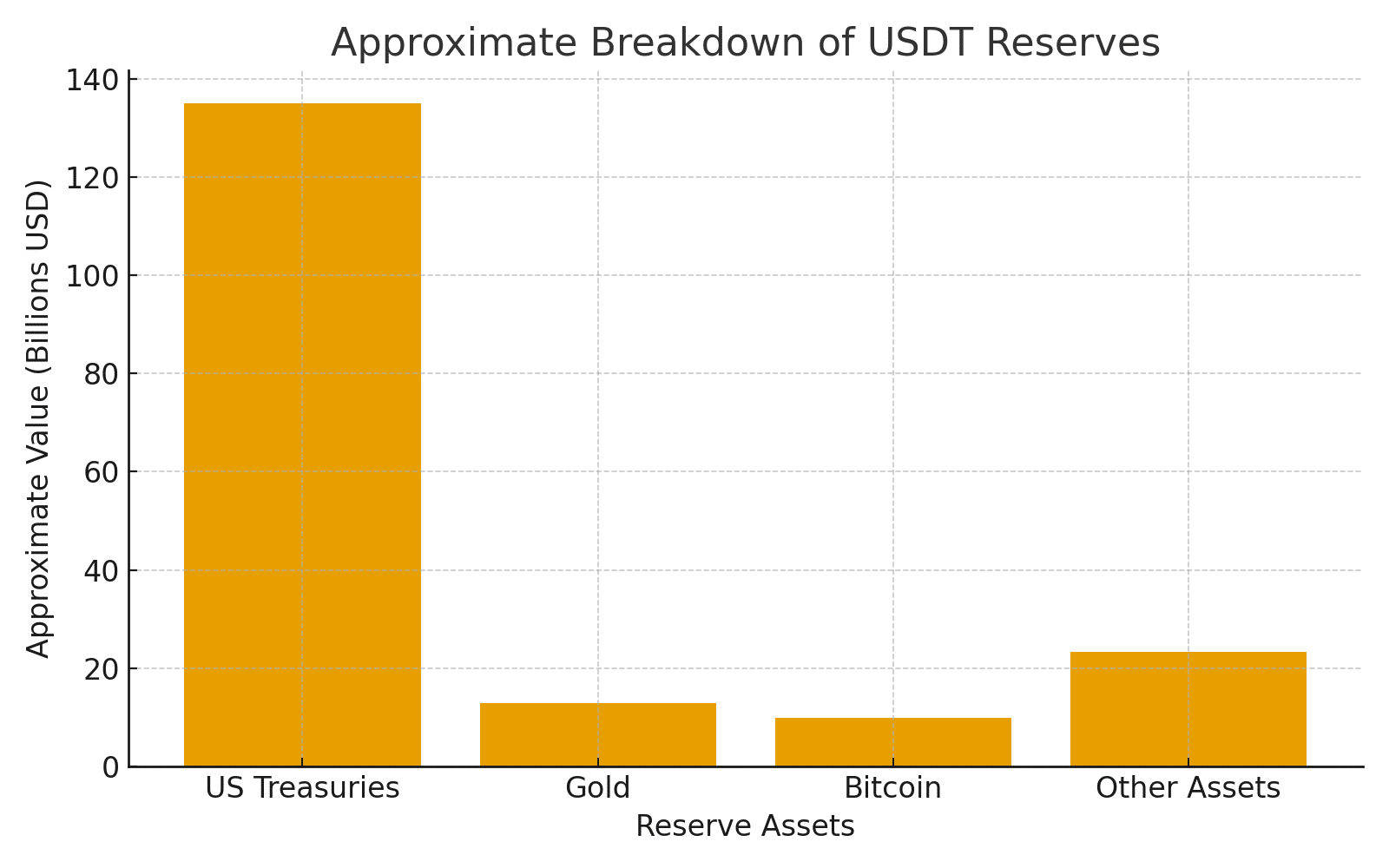
A large share of those reserves sits in short term United States Treasuries, while smaller portions are held in assets such as gold and Bitcoin. One recent breakdown reported about $135 billion in Treasuries, $12.9 billion in gold and $9.9 billion in Bitcoin, together representing close to 13 percent of total reserves.
On top of that, Tether has reported net profit above $10 billion for the first nine months of the year, helped by high interest income on its bond portfolio and growing USDT circulation.
For regulators, these numbers matter because they point to solvency, liquidity and the strength of the peg during market stress. For traders, they help explain why USDT often remains the deepest liquidity pool in crypto markets.
Key Crypto Indicators Behind This Story
This decision in Abu Dhabi sits at the intersection of a few core crypto indicators that professionals follow closely:
Market capitalization is the first signal. USDT remains the largest stablecoin by circulating supply, which means it often sets the tone for dollar liquidity across exchanges and DeFi markets. A regulated green light in a major financial center strengthens that leadership.
Liquidity and trading volumes come next. High spot and derivatives volume in USDT pairs make it easier for institutions to enter and exit positions without severe slippage. A regulated setting in ADGM can attract more high-volume participants that prefer clear rules around order handling and counterparty risk.
Reserve quality is another key indicator. The mix of Treasuries, cash-equivalents and risk assets such as Bitcoin and gold determines how resilient the peg may be in a sharp drawdown. Excess reserves above liabilities provide an additional buffer if markets move against the issuer.

Regulatory status is now just as important as any on-chain metric. Recognition as a fiat-referenced token in a respected jurisdiction signals that the issuer has at least met a baseline of disclosure and risk controls required by that regulator. That can influence how banks, fintech firms and funds decide which stablecoin to integrate.
Finally, geographic reach and multi-chain support matter for actual utility. By extending recognition to nine additional networks inside ADGM, regulators are acknowledging that stablecoins are no longer confined to one or two blockchains, but operate as cross-ecosystem settlement layers.
Conclusion: UAE Strengthens Its Stablecoin Playbook
The recognition of USDT as an accepted fiat-referenced token in Abu Dhabi Global Market is more than a technical regulatory tweak. It shows that stablecoins are steadily moving from a peripheral crypto tool to a piece of mainstream market infrastructure, especially in jurisdictions that want to compete as digital asset hubs.
For the UAE, it fits into a pattern of gradual but visible alignment between regulation and innovation. For Tether, it provides another signal that large parts of the market, and some regulators, are willing to treat USDT as a core settlement asset, as long as reserve transparency and risk controls keep pace with growth.
Investors will continue to watch the same familiar indicators: market cap, liquidity, reserve quality, profit strength and regulatory posture. In Abu Dhabi, at least, those signals have aligned strongly in favor of USDT.
Frequently Asked Questions
What did Abu Dhabi actually approve for USDT?
The financial regulator of Abu Dhabi Global Market recognized USDT as an accepted fiat-referenced token. Licensed firms in the free zone can now use USDT in regulated activities across several major blockchains.
Why does this matter for crypto markets?
The decision gives USDT a clearer legal status in a respected financial center. That makes it easier for institutions to integrate USDT into trading, payments and treasury, which can deepen liquidity and improve trust.
Is USDT fully backed by reserves?
Recent attestation reports show reserves of roughly $181 billion against about $174 billion in liabilities, leaving several billion dollars in excess reserves, mostly backed by short term government debt and other assets.+1
Glossary of Key Terms
Stablecoin
A type of cryptoasset designed to track the value of a reference asset, usually 1:1 with a fiat currency such as the United States dollar.
Fiat-referenced token
A regulated term for a digital token that references the value of a fiat currency and is backed by reserves, subject to specific rules in a given jurisdiction.
Abu Dhabi Global Market (ADGM)
An international financial center in Abu Dhabi with its own legal framework and independent financial regulator, the Financial Services Regulatory Authority.
Financial Services Regulatory Authority (FSRA)
The regulator that supervises financial services and virtual asset activities within ADGM, including licensing and oversight of firms that use stablecoins.
References